
Roll Up Kitchen Cabinet Doors: 5 Kits Compared

For most kitchens, Wood Grain ABS Tambour Door, 24 x 15 in is the clearest fit because it includes tracks and a handle and calls for at least 13 3/4 inches of cabinet depth. Choose another kit if your cabinet needs a different size, finish, or an aluminum construction.
Tambour doors use linked slats that travel along tracks and coil or roll into a storage area, avoiding the outward swing of a hinged door. Measure the cabinet opening and interior before choosing a kit.
We earn a commission if you buy through links on this page. As an Amazon Associate I earn from qualifying purchases. Products are compared on manufacturer specifications, not hands-on testing.
- Best overall: Wood Grain ABS Tambour Door, 24 x 15 in – The kit includes tracks and a handle, with a minimum cabinet depth of 13 3/4 inches.
- Best for tall openings: MLYAYE Aluminum Tambour Door, 24 x 60 in – This white aluminum kit is sized 24 by 60 inches and specifies cabinet layout requirements.
- Best for compact openings: Walnut ABS Tambour Door Kit, 14 x 26 in – The walnut ABS kit is sized 14 by 26 inches.
| Product | Best for | Material | Size | Minimum cabinet depth | Shop |
|---|---|---|---|---|---|
| Wood Grain ABS Tambour Door, 24 x 15 in | Standard depth cabinets | ABS | 24 x 15 in | 13 3/4 in | Check Price on Amazon |
| MLYAYE Aluminum Tambour Door, 24 x 60 in | Tall cabinet openings | Aluminum alloy | 24 x 60 in | 11 3/4 in | Check Price on Amazon |
| Walnut ABS Tambour Door Kit, 14 x 26 in | Small walnut openings | ABS | 14 x 26 in | — | Check Price on Amazon |
| JYHHCYS ABS Tambour Door Kit | No-groove installation | ABS | One size | — | Check Price on Amazon |
| MZZKFC Custom Tambour Door Kit | Custom-size openings | — | Custom size | 14 in | Check Price on Amazon |
Roll Up Kitchen Cabinet Doors
Compare each kit’s construction and sizing requirements against the cabinet opening and interior space.
Wood Grain ABS Tambour Door, 24 x 15 in

For a defined small opening, this wood grain ABS kit has a 24-by-15-inch size and calls for at least 13 3/4 inches of cabinet depth. Its package includes the panel, tracks, handle, and side covers, and its dual-track design is intended to guide the slats during opening and closing. The slat width is 3/4 inch and thickness is 1/2 inch. It suits buyers who want a complete kit for a kitchen or other cabinet. The depth requirement makes it a poor fit for shallower cabinets, so check both interior depth and opening dimensions first.
Bottom line: Choose this kit when the opening and cabinet depth meet its dimensions.
MLYAYE Aluminum Tambour Door, 24 x 60 in
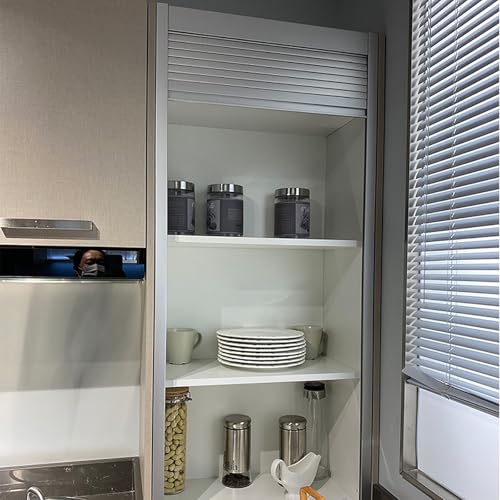
Unlike the ABS options, this white kit uses aluminum panels and tracks, with 1-inch-wide slats that are 3/10 inch thick. It is sized 24 by 60 inches and specifies a cabinet depth of at least 11 3/4 inches, plus a 7 1/10-inch top compartment for the roll. The maker also gives requirements for cabinet side-panel thickness and inward-shrinking bulkheads, which matter when planning the installation. It may suit a tall opening where those construction conditions can be met. Its particular top-space and bulkhead requirements make it less adaptable to cabinets with a different interior layout.
Bottom line: Choose this aluminum kit for a tall opening only when the cabinet layout meets its requirements.
Walnut ABS Tambour Door Kit, 14 x 26 in

This kit stands out for its compact 14-by-26-inch size and walnut finish, rather than a range of stated sizing requirements. The ABS door uses a dual-track design and an integrated handle, according to the maker, and the roll-up style avoids the clearance needed for a door swinging outward. It is aimed at appliance garages, sideboards, RVs, and similar storage. The fixed size makes it a better candidate for a small, measured opening than for a broad cabinet face; confirm the cabinet’s usable opening and depth before choosing it.
Bottom line: Choose it for a walnut-finish opening that matches the 14-by-26-inch size.
JYHHCYS ABS Tambour Door Kit
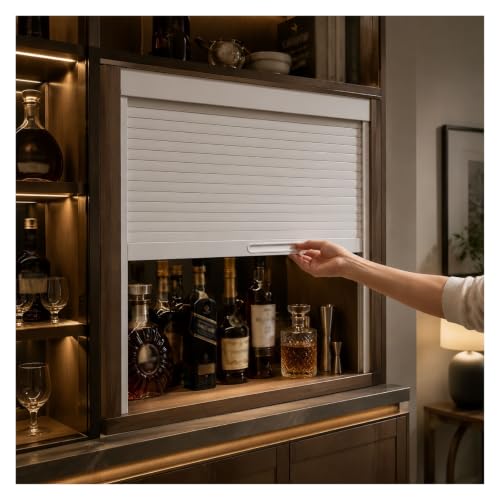
This kit emphasizes side-mounted guide rails rather than traditional grooving: the maker says the rails can be fixed to both cabinet sides with flathead screws. It uses ABS panels and frames, with 0.7-inch-wide slats that are 1/2 inch thick; the track is 0.7 inch wide and 0.4 inch thick. The maker also offers four color options and custom sizing. This may fit a project where cutting grooves is undesirable, but the size is described only as one size, so a buyer should confirm the dimensions and match them to the cabinet before proceeding.
Bottom line: Choose it when side-fixed rails suit the cabinet and a confirmed size matches the opening.
MZZKFC Custom Tambour Door Kit

For an opening that does not match a fixed kit size, this option is presented as customizable and specifies a minimum cabinet depth of 14 inches. It includes guide rails and a handle, and the maker says its tracks mount to the cabinet sides with included screws rather than requiring traditional slotting. The dual-track design is intended for smooth, one-hand operation. This makes it a candidate for an RV or small closet as well as kitchen storage. Its depth threshold is deeper than some other kits here, so it will not suit a shallow cabinet; confirm the custom dimensions before ordering.
Bottom line: Choose it for a custom opening when the cabinet has at least 14 inches of depth.
How to measure for roll up kitchen cabinet doors
Measure the clear opening width and height, then measure usable interior depth from the cabinet front to the back wall. Tambour kits need room for both side tracks and a roll storage area, so an opening measurement alone does not prove a fit. Keep the measurements in inches and compare them with the kit’s opening size; for kits with a minimum depth, use the actual interior depth rather than the cabinet’s outside dimension. For the aluminum kit here, the maker calls for at least 11 3/4 inches of depth and a 7 1/10-inch-high compartment above the opening. If your opening is 24 inches wide and 15 inches tall, the matching stated size is more relevant than a custom-size claim. Confirm fit requirements before ordering.
How tambour cabinet doors use space
A tambour door is made of connected slats that move through guide tracks and roll into a pocket or compartment, so the door does not need a hinged panel’s outward swing. The tradeoff is that the cabinet must reserve interior space for the slats and tracks. Track placement, roll-pocket height, and unobstructed movement determine whether the door can travel fully. A hinged door may use less interior depth but needs clear space in front of the cabinet; a roll-up door shifts that space requirement inside the cabinet. For a cabinet with less than 11 3/4 inches of depth, none of the kits with minimums here qualifies by those requirements, and the other kits require checking their fit before purchase.
ABS and aluminum tambour kits compared
ABS and aluminum are the two stated door materials in this group; material alone does not establish fit, so compare construction alongside size and cabinet layout. The aluminum kit specifies 1-inch-wide, 3/10-inch-thick slats and particular top-compartment and bulkhead conditions. The ABS kits include variants with a specified 1/2-inch-thick slat or 0.7-inch-wide slats, while some offer a fixed size and others describe custom sizing. A practical decision rule is to pick by measured cabinet compatibility first, then choose material and finish. A kit that cannot clear the cabinet’s interior path will not work just because its door face matches the opening.
| Need | What to prioritize | Example in this group |
|---|---|---|
| Stated aluminum construction | Depth and top roll compartment | 24 x 60 in aluminum kit |
| Fixed small opening | Exact door width and height | 14 x 26 in or 24 x 15 in ABS kit |
| Nonstandard opening | Confirmed custom dimensions | Custom-size kit |
Installation and safe operation
Side-mounted tracks avoid cutting grooves on some kits, but the cabinet sides still need to be suitable for secure fastening and parallel track alignment. Measure and mark both track positions from the same reference point; uneven tracks can make slats bind. Keep fingers clear of the moving slats and roll pocket while operating or adjusting a door, since moving parts can pinch. Do not force a door that catches: check for obstructions and alignment before continuing. The maker of one kit describes a ten-minute installation, but actual time depends on cabinet preparation, accurate measuring, and access to the sides. Plan for the full roll compartment and verify the intended travel path before attaching hardware.
Frequently Asked Questions
How much cabinet depth does a roll-up door need?
The minimums among these kits range from 11 3/4 to 14 inches. Measure the usable inside depth, and account for the roll pocket and tracks rather than relying on the cabinet’s exterior depth.
Can a tambour door fit a shallow cabinet?
Only if its tracks and roll pocket fit the available interior space. One kit here requires at least 11 3/4 inches of depth, while another requires 14 inches; check the requirements for the exact kit before choosing it.
What should I measure before ordering a tambour kit?
Measure the clear opening width and height, plus the usable interior depth. For kits that specify a top compartment or bulkhead layout, measure those areas too; the 24-by-60-inch aluminum kit calls for a 7 1/10-inch-high top compartment.
Are ABS and aluminum tambour doors interchangeable?
They are different constructions, and their dimensions and installation conditions can differ. The aluminum kit here has specific bulkhead and roll-compartment requirements, so compare those constraints with the cabinet before selecting by material.
Do roll-up cabinet doors need room inside the cabinet?
Yes, the slats need a path and storage space as they move into the roll area. Leave that space clear and keep fingers away from the moving slats to reduce pinch risk.