
Runstar Smart Body Fat Scale: 5 Models Compared

RunSTAR 11-Inch Platform Scale is the closest fit for a Runstar smart body fat scale if you want six readings on the platform display, including weight and body fat rate. Choose another model if you want heart rate on screen, an 8-electrode handle, or more extensive body-composition tracking.
Bioelectrical impedance analysis (BIA) scales estimate body composition by measuring how a small electrical current moves through the body, so readings work best as consistent trend data rather than a definitive body-fat measurement.
We earn a commission if you buy through links on this page. As an Amazon Associate I earn from qualifying purchases. Products are compared on manufacturer specifications, not hands-on testing.
- Best overall: RunSTAR 11-Inch Platform Scale – Its platform display shows six measurements, including weight and body fat rate.
- Best for heart rate: RunStar 22-Metric Scale – Its extra-large display includes heart rate among five readings.
- Best for offline use: RunStar Handle Scale, 50+ Metrics – Its handle supports setup, measurement review, and voice prompts without a phone.
- Best for color display: RunStar 28-Metric TFT Handle Scale – Its retractable handle has a full-color TFT LCD and shows seven readings.
| Product | Best for | Display readings | Electrodes | Body metrics | Shop |
|---|---|---|---|---|---|
| RunSTAR 11-Inch Platform Scale | Quick on-scale readings | 6 readings | 4 | 13 metrics | Check Price on Amazon |
| RunStar 22-Metric Scale | Heart-rate display | 5 readings | 4 | 22 metrics | Check Price on Amazon |
| RunStar Handle Scale, 50+ Metrics | Offline handle controls | 8 handle readings | 8 | 50+ metrics | Check Price on Amazon |
| RunStar 28-Metric TFT Handle Scale | Color handle screen | 7 handle readings | 8 | 28 metrics | Check Price on Amazon |
| RunStar 28-Metric Full-Body Scale | Compact 8-electrode scan | 3 display metrics | 8 | 28 metrics | Check Price on Amazon |
Runstar smart body fat scales
Compare the display and electrode setup first, then choose the model whose tracking features suit your routine.
RunSTAR 11-Inch Platform Scale

For direct readings without opening an app, this model puts six measurements on its large LCD: weight, body fat rate, BMI, muscle mass, body water rate, and bone mass. Its 11-inch platform uses four electrodes and four G-shaped sensors, and the scale syncs with an app. Runstar says measurement accuracy is within 0.2 lb.
Choose it if those core readings on the platform are more useful to you than a handle-based scan. The main tradeoff is the four-electrode setup, which does not offer the hand-and-foot measurement approach used by the 8-electrode models.
Bottom line: Pick this if a six-reading platform display matters more than a handle scan.
RunStar 22-Metric Scale
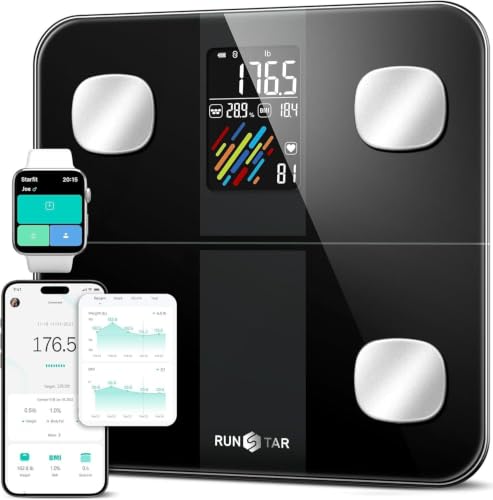
Heart rate is the distinguishing on-screen reading here: the extra-large VA display also shows weight, body fat, BMI, and body type. This 11.02-inch scale has four electrodes, supports up to 400 lb, and is described as measuring in 0.1 lb increments. Runstar says the screen presents the five readings within 15 seconds; app syncing is also included.
This is a good match for quick check-ins where heart rate on the scale itself is a priority. It uses four electrodes rather than the hand-and-foot arrangement on the 8-electrode options, so choose another model if that setup is important to you.
Bottom line: Choose this for a quick display that includes heart rate.
RunStar Handle Scale, 50+ Metrics

Offline controls set this model apart: its touch-control handle supports user setup, measurement review, deletion, unit switching, and volume adjustment without a phone. Runstar describes an 8-electrode, dual-frequency BIA system and a 50-plus-metric report; the handle displays eight metrics and provides voice prompts. The platform measures 12.2 by 12.2 inches, and the model supports up to 400 lb.
Choose it if you want handle controls and extensive reporting without relying on a phone during weigh-ins. Its larger feature set and 5.27-lb weight may be unnecessary if you only need basic readings directly on a platform.
Bottom line: Pick this for offline operation and a broad metric report.
RunStar 28-Metric TFT Handle Scale

A retractable handle with a full-color TFT LCD gives this model a different readout style from platform-only screens. The 8-electrode scale measures body composition through hand and foot contact, and its display shows seven key readings, including the change from the previous result. Runstar says Bluetooth pairing must be completed in the Starfit app before measurement; the app syncs with Apple Health, Fitbit, and Health Connect, and the scale is compatible with Fitdays.
It suits buyers who want a color handle display and connected tracking. Its 2.75-inch height and 16.96-inch width call for more storage room than a compact platform-only scale.
Bottom line: Choose this if a color handle display and app integrations are priorities.
RunStar 28-Metric Full-Body Scale

For a straightforward screen, this 8-electrode model cycles through three readings: weight, body fat, and BMI. Its dual-frequency BIA system tracks 28 body-composition metrics, while the scale measures in 0.1-lb increments and supports up to 400 lb. The 300-by-300-mm ABS platform has non-slip feet and a retractable cable.
Choose it if the 8-electrode design and broad app-based tracking matter more than seeing many readings on the scale itself. The display cycles through three metrics, so users wanting a fuller handle readout should consider one of the handle models.
Bottom line: Pick this for an 8-electrode scan with a simple three-metric display.
How to choose a smart body fat scale
Choose by the readings you will actually use and how they appear: a platform display is simple, while a handle display can surface more measurements without reaching for a phone. BIA scales estimate composition from electrical impedance; hydration and recent exercise can shift readings even when body tissue has not changed. Treat body-fat and muscle estimates as trend indicators, not clinical measurements. A useful rule is to prioritize a consistent weigh-in routine over extra metrics: if you only compare weight and a few readings, a six-reading screen may be enough; if you want hand-and-foot measurements, look for an 8-electrode design. Display count and total metrics are different things—a scale may track many measures in its app while showing only a few on its screen.
How to get more consistent BIA readings
For a repeatable comparison, weigh at the same time of day, ideally in the morning after using the bathroom and before eating or exercising. Keep the scale on a hard, level floor; carpet and uneven tile can affect load-cell measurements. Use bare, dry feet on the electrodes, since socks, wet skin, or misplaced contact can interfere with the impedance reading. A meal, a workout, alcohol, or a large change in fluid intake can alter the estimate, so avoid comparing a post-workout reading with a morning baseline. Day-to-day body-fat changes are often noise rather than meaningful tissue change; assess trends across several weeks under similar conditions rather than reacting to one reading.
Platform displays and handle scales compared
Platform-only scales suit users who want measurements visible underfoot, while handle models add hand electrodes for a different measurement path. Four electrodes contact the feet; 8-electrode systems typically add hand contacts and can estimate upper- and lower-body segments. A larger metric count does not guarantee greater accuracy, and decimal resolution such as 0.1 lb is not the same as accuracy. Use this comparison to match the interface to your routine, then check whether the app and display combination provides the readings you plan to follow.
| Need | Scale style to consider | Why it may fit |
|---|---|---|
| Core readings at a glance | Platform LCD | Measurements appear directly on the scale |
| Heart rate on-screen | Platform VA display | Heart rate is among the displayed readings |
| Hand-and-foot contact | 8-electrode handle scale | Electrodes measure through hands and feet |
| Phone-free scale controls | Handle with offline controls | Supports setup and reviewing readings on device |
Safe use and placement for body composition scales
Place a bathroom scale on a firm, dry, level surface and step on with dry feet; moisture around electrical appliances also creates a slip risk. BIA scales send a small current through the body, so people with pacemakers or other implanted electronic medical devices should check with their clinician and the device maker before using one. Keep the scale away from standing water and store handle cables without creating a trip hazard. Never use body-composition estimates to make medical decisions or replace a clinician’s assessment. The most useful measurement is a consistent personal trend, not a single reading or a comparison against a generic target.
Frequently Asked Questions
Are smart body fat scales accurate for body fat?
Consumer BIA scales estimate body fat from electrical impedance, and hydration can shift the result. Use readings to follow a trend collected under similar conditions, not as a clinical measurement.
When should I weigh myself for consistent readings?
Morning weigh-ins after using the bathroom and before eating or exercising help limit routine variation. Keep the timing and conditions consistent across measurements.
Do 8-electrode scales measure differently from 4-electrode scales?
An 8-electrode design adds hand contacts to the foot contacts, allowing measurements across more body segments. A larger electrode count does not by itself guarantee greater accuracy.
Does a 0.1-pound scale measure weight accurately to 0.1 pound?
A 0.1-lb increment describes display resolution, not guaranteed accuracy. Floor firmness, placement, and repeatability can affect a reading.
Can I use a BIA scale with a pacemaker?
People with pacemakers or other implanted electronic medical devices should consult their clinician and the device maker before using a BIA scale. These scales pass a small electrical current through the body.