
Ryobi 18V to 12V Adapter Options Compared

For most projects, 18V-to-12V 240W Converter is the straightforward Ryobi 18V-to-12V adapter choice because its 20A, 240W output matches the highest fixed-12V ratings here. Choose Adjustable 10A Converter instead if you need adjustable output or a built-in cigarette-lighter socket.
These adapters use a DC-DC buck converter to lower battery voltage for 12V equipment; match the converter’s output limit to the device, including startup demand.
We earn a commission if you buy through links on this page. As an Amazon Associate I earn from qualifying purchases. Products are compared on manufacturer specifications, not hands-on testing.
- Best overall: 18V-to-12V 240W Converter – Offers fixed 12V output rated up to 20A and 240W.
- Best for adjustable output: Adjustable 10A Converter – Provides a rotary voltage control, display, and cigarette-lighter socket.
- Best for a spare: Two-Pack 15A 180W Converters – Includes two converters, each rated for up to 15A and 180W.
| Product | Best for | Output | Max current | Notable feature | Shop |
|---|---|---|---|---|---|
| 18V-to-12V 240W Converter | Fixed 12V projects | 12V | 20A | Low-voltage shutoff | Check Price on Amazon |
| 20A 240W Converter with Fuse | Fused connections | 12V | 20A | 30A fuse | Check Price on Amazon |
| 15A 180W Converter | Lower-demand projects | 12V | 15A | Switch | Check Price on Amazon |
| Adjustable 10A Converter | Adjustable voltage | 5–13V | 10A | Display and socket | Check Price on Amazon |
| Two-Pack 15A 180W Converters | Two installations | 12V | 15A each | Two converters | Check Price on Amazon |
Ryobi 18V to 12V adapters
Compare fixed-output converters and an adjustable model by their output limits and connection features.
18V-to-12V 240W Converter
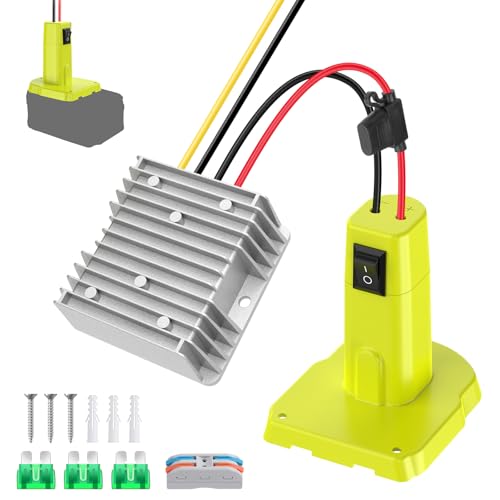
18V-to-12V 240W Converter pairs a 20A maximum with fixed 12V output, making it the highest-rated fixed-output option in this group. Its battery compatibility includes several Ryobi 18V battery models, and the converter has an on/off switch. The maker says it includes low-voltage, over-voltage, over-current, short-circuit, overload, and overheat protection. This suits a 12V project whose current demand stays within the converter’s limit. The fixed output is a limitation for devices that require a different voltage; choose an adjustable model for those setups.
Bottom line: Pick this for a fixed 12V setup needing up to 20A.
20A 240W Converter with Fuse

20A 240W Converter with Fuse combines a 20A maximum output with a 30A fuse and wire terminals, distinguishing it from the other fixed-output 240W option. It accepts 18V–20V input and provides 12V output, with compatibility listed for multiple Ryobi 18V battery models. The maker says its built-in protection covers multiple electrical fault conditions. This configuration may suit a wired project where a fuse and terminals fit the installation. Its output remains fixed at 12V, so it is not the choice for equipment that requires voltage adjustment.
Bottom line: Choose this when a fuse and wire-terminal connection suit your build.
15A 180W Converter

15A 180W Converter is rated for 15A and 180W, below the 20A fixed-output choices, and its battery adapter has an on/off switch. It accepts 18V–20V input and converts it to 12V; the compatibility spans several Ryobi 18V battery models. The maker says synchronous rectification supports conversion efficiency and stability. This option fits a project whose demand remains within its lower current ceiling. It is a poor match for a load that needs more than 15A, even if the battery itself can supply more.
Bottom line: Pick this for a 12V load that stays at or below 15A.
Adjustable 10A Converter

Adjustable 10A Converter stands apart with an output adjustment knob, a voltage display, and a built-in cigarette-lighter socket. The input range is 18V–20V. This suits setups that need voltage selection or a socket connection, but its 10A ceiling is lower than the other converters. Confirm that the device accepts the selected voltage and stays within the applicable power limit.
Bottom line: Choose this when adjustable voltage or a cigarette-lighter socket matters.
Two-Pack 15A 180W Converters

Two-Pack 15A 180W Converters provides two separate 12V converters, each rated up to 15A and 180W, making it the only two-unit option here. Each has a switch, wire terminals, and a 30A fuse; the product states compatibility with Ryobi 18V lithium batteries. The maker says the units include protection for several fault conditions. This arrangement suits two separate builds or a spare unit. The 15A limit applies to each converter, not to a combined output; neither unit is suitable for a single load above its individual rating.
Bottom line: Pick this for two separate projects that each stay within 15A.
How to choose a Ryobi 18V to 12V adapter
Start with the device’s voltage and maximum current, then match both to the converter. At 12V, 10A equals 120W, 15A equals 180W, and 20A equals 240W; use the lower limit if a product gives both a current and power maximum. A device can draw more current briefly at startup than during steady operation, so check its startup requirement rather than sizing only to its normal draw. For a variable-voltage device, select an adjustable converter and set its output to the device’s required voltage before connecting it. A fixed 12V converter is the simpler choice only when the equipment is designed for 12V.
Battery fit and electrical connections
Battery compatibility is model-specific: compare the adapter’s Ryobi battery models with the exact pack you plan to use instead of relying on the 18V label alone. A buck converter lowers DC voltage, but the battery pack’s actual voltage changes with charge and load, so use a converter designed for the pack’s input range. Observe polarity when wiring; reversing positive and negative can damage equipment. For wired setups, secure exposed connections against accidental contact and use an appropriately rated fuse close to the power source. A fuse protects wiring from excessive current; it does not raise the converter’s output rating or make an overloaded device safe.
Fixed and adjustable converters compared
Fixed 12V converters suit equipment designed for a constant 12V supply, while adjustable converters add flexibility at the cost of a lower stated current ceiling in this group. Choose by the actual connection and load, not by the highest wattage in isolation. The table gives a quick way to narrow the type; still confirm device voltage, startup demand, and connection requirements before wiring.
| Need | Converter type | Check before use |
|---|---|---|
| 12V-only equipment | Fixed 12V | Current and wattage ceiling |
| More than one target voltage | Adjustable output | Selected voltage and output ceiling |
| Device with cigarette-lighter plug | Converter with socket | Plug fit and device power demand |
Safe operating limits and common mistakes
Keep the total load within both the converter’s current and wattage ratings; exceeding either limit can cause shutdown, overheating, or damage. A converter’s protection features are safeguards, not permission to operate above its rating. Avoid assuming that a 12V device will work from every 12V converter: motors and other loads may have startup surges, and sensitive electronics may require tightly regulated voltage. Check the intended device’s input range and polarity, and disconnect the battery before changing wiring. If the load or connection type is unclear, confirm the voltage, maximum current, and polarity required by the device before connecting it.
Frequently Asked Questions
How many watts does a 12V 20A converter provide?
A 12V output at 20A is 240W, using volts multiplied by amps. Keep the device load at or below both the converter’s current and power ratings.
Can I run a 12V motor from this adapter?
A 12V motor can use a compatible converter if its running and startup current remain within the converter’s limits. Motors often draw a surge when starting, so check the motor’s current requirements before connecting it.
Does a Ryobi 18V battery stay at exactly 18 volts?
No; the pack’s voltage changes with its charge state and load. Use a converter whose input range is designed for the battery pack rather than assuming the nominal 18V label is its only operating voltage.
What does the fuse protect on a battery adapter?
A correctly rated fuse can interrupt excessive current through a wiring circuit, helping protect the wire from overheating. It does not increase the converter’s capacity, so keep the load within its specified limits.
Can I connect a 5V device to a 12V converter?
Only use a converter set to the voltage the device requires; applying 12V directly to a 5V-only device can damage it. For adjustable models, verify the selected output with the display or a meter before connecting the device.