
Ryobi Roofing Nail Gun: Pneumatic Alternatives Compared

No Ryobi roofing nail gun appears among these options, but AeroPro CN45N 15° Roofing Nailer suits most roofing work because it accepts 15-degree coil nails from 3/4 to 1-3/4 inches and holds 120 nails. These are pneumatic alternatives, so choose a different type if you need a cordless nailer or a Ryobi-branded tool.
We earn a commission if you buy through links on this page. As an Amazon Associate I earn from qualifying purchases. Products are compared on manufacturer specifications, not hands-on testing.
- Best overall: AeroPro CN45N 15° Roofing Nailer – Its 120-nail magazine and stated 70–120 PSI operating range pair with a 3/4- to 1-3/4-inch, 15-degree nail range.
- Best for shingle spacing: BOSTITCH RN46 Coil Roofing Nailer – An adjustable shingle guide helps set spacing, and its canister reloads with one side-loading action.
- Best for tool-free depth changes: AEROPRO 15° Coil Roofing Nailer – Its tool-free depth adjustment and 120-nail capacity suit frequent changes between shingle thicknesses.
- Best for siding projects: toolant Pneumatic Roofing Coil Nailer – It is also presented for fencing and wood siding, in addition to asphalt roofing shingles.
| Product | Best for | Magazine capacity | Working pressure | Shop |
|---|---|---|---|---|
| AeroPro CN45N 15° Roofing Nailer | General roofing | 120 nails | 70–120 PSI | Check Price on Amazon |
| BOSTITCH RN46 Coil Roofing Nailer | Shingle spacing | — | — | Check Price on Amazon |
| AEROPRO 15° Coil Roofing Nailer | Depth adjustment | 120 nails | 70–110 PSI | Check Price on Amazon |
| toolant Pneumatic Roofing Coil Nailer | Roofing and siding | 120 nails | 70–120 PSI | Check Price on Amazon |
Pneumatic roofing nail guns
These alternatives are coil nailers for roofing work; compare nail compatibility, magazine capacity and air supply before choosing.
AeroPro CN45N 15° Roofing Nailer

AeroPro CN45N 15° Roofing Nailer combines a firing rate of up to 3 nails per second with a 120-nail magazine and a 5.5-pound weight. The pneumatic nailer accepts 15-degree roofing coils from 3/4 to 1-3/4 inches and operates at 70–120 PSI, making it a straightforward fit for asphalt-shingle work when your compressor can supply that range. Included spares include feeder springs and a piston bumper, along with two pairs of safety glasses. The limitation is its air-hose requirement; choose another tool type if you need cordless operation.
Bottom line: Choose this if your compressor meets its pressure range and you want a 15-degree, 120-nail roofing coil nailer.
BOSTITCH RN46 Coil Roofing Nailer

BOSTITCH RN46 Coil Roofing Nailer stands apart with an adjustable shingle guide for setting spacing and a quick-set depth guide for nail placement. Its side-load canister uses a single action for reloading, while a zero-nail lockout helps avoid dry firing and signals when to reload. The nail length range is 3/4 to 1-3/4 inches, and the aluminum housing weighs 5.8 pounds. This is the option to consider when shingle alignment features matter most; confirm the nail coil angle and your compressor’s required pressure before choosing it.
Bottom line: Choose this if adjustable shingle spacing and fast side loading matter more than a published pressure range.
AEROPRO 15° Coil Roofing Nailer
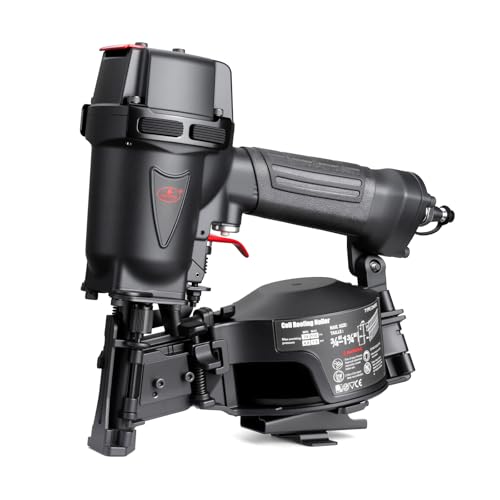
AEROPRO 15° Coil Roofing Nailer offers a tool-free depth adjustment, useful when moving among shingle thicknesses without stopping to find an adjustment tool. It holds 120 nails, accepts 15-degree coils from 3/4 to 1-3/4 inches, and has a working-pressure range of 70–110 PSI; its maximum pressure is 120 PSI. The tool weighs 5.52 pounds. Choose it for convenient depth changes within that operating range. Its pressure ceiling is not the same as its working range, so keep the compressor set within 70–110 PSI for operation.
Bottom line: Choose this if tool-free depth changes are a priority and your air setup supports 70–110 PSI.
toolant Pneumatic Roofing Coil Nailer

toolant Pneumatic Roofing Coil Nailer is presented for asphalt shingles as well as fencing and wood siding, giving it a broader stated job range than a shingle-only choice. It accepts 15-degree coil nails from 3/4 to 1-3/4 inches, holds 120 nails, weighs 5.7 pounds, and has a 70–120 PSI working range. The maker says it has a tested lifespan of over 500,000 shots; treat that as a maker claim rather than a service guarantee. Choose it for varied exterior fastening, but confirm the nail type matches each material and application.
Bottom line: Choose this if you want one pneumatic coil nailer for roofing plus the siding and fencing uses.
How to choose a roofing nail gun
Match nail angle, length and air supply before comparing extras. The roofing models that specify coil angle use 15-degree nails, while their compatible lengths run from 3/4 to 1-3/4 inches; a nailer and coil must match both angle and length. Most pneumatic roofing nailers need a compressor and hose, so compare the tool’s working-pressure range with the compressor’s regulated output rather than its maximum pressure alone. A useful rule: if your compressor cannot maintain at least the tool’s minimum PSI while firing, choose a different air setup or tool. Also weigh magazine capacity against roof size: a larger coil means fewer reloads, but does not replace checking that fasteners are seated correctly.
| Need | What to compare | Choice cue |
|---|---|---|
| Compatible fasteners | Angle and length | Match both nail specifications |
| Steady air supply | Working PSI | Compressor must sustain the range |
| Fewer reload stops | Magazine capacity | Compare coil capacity |
Roofing nail length and shingle fit
Choose nail length based on the roofing assembly, not just the shingle. A common asphalt-shingle installation uses 1-1/4-inch roofing nails, but thicker shingles, overlays or roof-deck conditions can call for a different length; the fastener needs to pass through the shingle and penetrate the deck as required by the roofing system. The range of 3/4 to 1-3/4 inches covers several lengths, but compatibility alone does not establish the right length for a roof. Confirm the required nail length and coil angle for the shingle and deck before ordering. Use the depth adjustment to seat the head flush without cutting through the shingle surface.
Pneumatic roofing nailer setup and safe use
Set regulator pressure within the tool’s working range, then test nail depth on scrap material before starting the roof. Excess pressure can drive nails too deep, while inadequate pressure can leave heads proud; both can compromise fastening. Wear eye protection, and use a stable ladder and fall-protection equipment on roof work. Roofing surfaces can be steep or slick, and a nailer is a loaded tool even when the trigger is released. Keep hands clear of the nosepiece and disconnect the air hose before clearing a jam or servicing the tool. Arrange the hose so it cannot snag underfoot or pull the nailer toward an edge.
Roofing nailer loading and maintenance mistakes
Use only coils with the correct angle and length, and avoid forcing a coil that does not seat smoothly in the magazine. A misaligned fastener coil can cause feed problems; disconnect the air supply before inspecting the magazine or clearing a jam. Clean debris from the nose and magazine after dusty roofing work, and check wear components such as feeder springs when feeding becomes inconsistent. Keep the tool dry and store it without pressure in the hose. Roofing nailers are exposed to grit, shingle granules and weather, so routine cleaning and inspection help identify wear before the next job; follow the tool’s maintenance schedule for lubrication and replacement parts.
Frequently Asked Questions
What nail length is common for asphalt shingles?
A 1-1/4-inch roofing nail is common for asphalt shingles, but the correct length depends on shingle thickness, roof layers and deck requirements. Choose a length that meets the roofing system’s required deck penetration.
Do roofing nail guns use a standard coil angle?
Many roofing coil nailers use 15-degree coils, but coil angle is not universal across every nailer. Match the angle printed for the tool to the fastener coil before loading.
What air pressure should I use for a roofing nailer?
Use the tool’s working-pressure range, not its maximum rating. For a tool with a 70 PSI minimum, the compressor must sustain at least 70 PSI during firing; test depth and adjust within the specified range.
How deep should a roofing nail sit?
A nail head should sit flush with the shingle surface without cutting through it. Test the depth setting on scrap or a sample shingle, then adjust if the head is proud or overdriven.
Can roofing nailers be used on siding?
Some coil nailers are presented for both roofing and siding, but siding fasteners and installation requirements can differ from roofing nails. Use them only when the tool and fasteners match the siding manufacturer’s requirements.