
SAE J1703 Brake Fluid: 5 Options Compared

For SAE J1703 brake fluid, STP Heavy Duty DOT 3 Brake Fluid is the direct match because its maker says it meets SAE J1703 and works in DOT 3 systems. Choose a different fluid only if your vehicle manual calls for another specification or DOT class; SAE J1703 alone does not establish compatibility with every brake system.
We earn a commission if you buy through links on this page. As an Amazon Associate I earn from qualifying purchases. Products are compared on manufacturer specifications, not hands-on testing.
- Best overall: STP Heavy Duty DOT 3 Brake Fluid – Its maker specifically says it meets SAE J1703 and DOT 3 requirements.
- Best for Toyota OE: Toyota Genuine Brake Fluid 00475-1BF03 – The maker identifies it as Toyota OEM fluid and says it meets or exceeds DOT 3 performance specifications.
- Best for low viscosity: Bosch ESI6 Low Viscosity Brake Fluid – It is a DOT 3/4/5.1 fluid intended as a replacement where those classes are specified.
| Product | Best for | Fluid class | SAE J1703 claim | Container size | Shop |
|---|---|---|---|---|---|
| STP Heavy Duty DOT 3 Brake Fluid | SAE J1703 match | DOT 3 | Meets SAE J1703 | 12 oz | Check Price on Amazon |
| Toyota Genuine Brake Fluid 00475-1BF03 | Toyota OEM option | DOT 3 | No claim supplied | 10 oz | Check Price on Amazon |
| Valvoline DOT 3 & 4 Synthetic Brake Fluid | DOT 3 or 4 | DOT 3 and DOT 4 | No claim supplied | 12 oz | Check Price on Amazon |
| Bosch ESI6 Low Viscosity Brake Fluid | Low viscosity systems | DOT 3, 4, and 5.1 | No claim supplied | 1 qt | Check Price on Amazon |
| TRIAX DOT 3 & 4 Brake Fluid | Heavy-duty use | DOT 3 and DOT 4 | No claim supplied | 6-quart pack | Check Price on Amazon |
SAE J1703 Brake Fluid Options
Compare the fluid classes and specification claims, then match them to the vehicle manual before choosing.
STP Heavy Duty DOT 3 Brake Fluid

Among these options, this STP fluid is the one whose maker explicitly says it meets SAE J1703. The 12-ounce container is intended for systems requiring DOT 3, and its maker also says it exceeds FMVSS No. 116 and helps protect against corrosion and vapor lock. That makes it the clearest match when SAE J1703 is the specific requirement. Its limitation is its DOT 3 scope: a vehicle requiring DOT 4 or another fluid class needs a product selected for that requirement instead.
Bottom line: Choose it when the manual calls for SAE J1703 or DOT 3.
Toyota Genuine Brake Fluid 00475-1BF03

Toyota’s genuine fluid stands apart as the OEM option here, and its maker says it meets or exceeds DOT 3 performance specifications. It is intended for the master brake cylinder and for brake and hydraulic clutch systems; the maker also describes corrosion and metal-component protection. This can suit an owner seeking Toyota-branded DOT 3 fluid rather than a product carrying an explicit SAE J1703 claim. Verify the manual’s exact specification before substituting it, since the maker does not make the J1703 claim.
Bottom line: Choose it when Toyota OEM fluid is your priority and the manual specifies DOT 3.
Valvoline DOT 3 & 4 Synthetic Brake Fluid

Valvoline’s option is distinguished by its DOT 3 and DOT 4 compatibility, rather than an explicit SAE J1703 claim. Its maker says it is suitable for hydraulic and disc brakes, mixes with conventional fluids, and uses a low-moisture formula for vapor-lock protection. The 12-ounce bottle may suit routine needs where the vehicle calls for DOT 3 or DOT 4. It is not the most direct choice when a buyer specifically needs documented SAE J1703 compliance, so match the DOT class and specification in the manual.
Bottom line: Choose it when the vehicle specifies DOT 3 or DOT 4, not J1703 documentation.
Bosch ESI6 Low Viscosity Brake Fluid
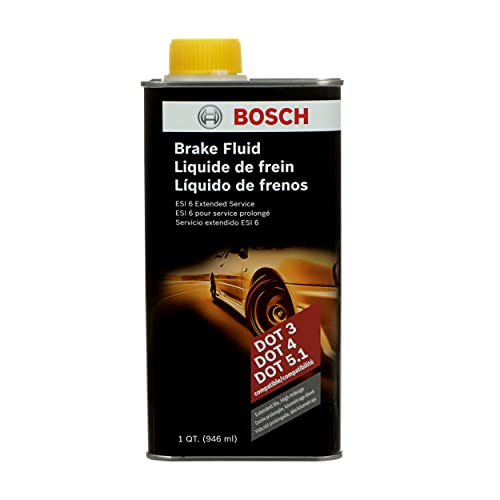
Bosch ESI6 differs from the other options by combining low viscosity with compatibility for DOT 3, DOT 4, and DOT 5.1 applications. Its maker gives a wet boiling point of 365°F and claims extended service intervals relative to those fluid classes. It is a quart-sized option for a vehicle designed for one of those DOT classes, but it does not carry an explicit SAE J1703 claim in the text. Do not confuse DOT 5.1 with DOT 5; the maker says ESI6 is not compatible with DOT 5.
Bottom line: Choose it when the manual calls for a compatible DOT 3, 4, or 5.1 fluid and low viscosity matters.
TRIAX DOT 3 & 4 Brake Fluid

TRIAX is the multi-quart option here, with the maker describing a full-synthetic DOT 3 and DOT 4 fluid for passenger vehicles and race use. Its maker claims resistance to brake fade and vapor lock, compatibility with electronic brake sensors, and corrosion protection. The size is a six-quart pack, so it differs from the smaller individual containers and may be more than a single service requires. Its maker does not explicitly claim SAE J1703 compliance, so it is not the direct match when that specification is mandatory.
Bottom line: Choose it when you need a larger DOT 3/4 supply and the vehicle permits those classes.
How to choose SAE J1703 brake fluid
Match the exact fluid specification and DOT class in the vehicle owner’s manual or reservoir cap; a shared DOT number does not prove that every other requirement is met. SAE J1703 is associated with glycol-based brake fluid requirements, while DOT 3, DOT 4, and DOT 5.1 are performance classes with minimum boiling-point requirements. DOT 3 minimums are 401°F dry and 284°F wet; DOT 4 minimums are 446°F dry and 311°F wet. Choose an explicitly J1703-marked product when the manual calls for J1703. If it names a different DOT class, follow that class rather than relying on a broad claim such as “all vehicles.”
| Manual requirement | Selection rule |
|---|---|
| SAE J1703 or DOT 3 | Prefer explicit J1703 and DOT 3 compatibility |
| DOT 4 | Use fluid marked DOT 4 |
| DOT 5 | Do not substitute glycol-based DOT 3, 4, or 5.1 |
DOT brake fluid types and mixing
DOT 3, DOT 4, and DOT 5.1 fluids are glycol-based and are generally chemically compatible, but topping off with a different class can reduce the system’s performance to the lower class and does not replace a required flush. DOT 5 is silicone-based and must not be mixed with those glycol fluids. A useful decision rule is to use the exact class in the manual unless the vehicle maker approves an upgrade; never infer approval from the phrase “backward compatible.” Keep brake fluid sealed, since glycol fluid absorbs moisture from air, which lowers its wet boiling point over time.
When brake fluid needs service
Many automakers call for brake fluid replacement about every 2 to 3 years, though the vehicle schedule takes precedence. Moisture lowers the boiling point, and repeated hard braking heats fluid; boiling can form compressible vapor and reduce braking response. A fluid test strip or electronic tester can estimate moisture content, but the result does not override a scheduled flush. If the brake pedal suddenly feels soft, braking changes, or a warning light appears, stop driving when safe and arrange inspection rather than treating a fluid top-off as a repair. Brake fluid can damage paint, so avoid spills and rinse accidental contact promptly with water.
Frequently Asked Questions
Can SAE J1703 brake fluid be used in a DOT 3 system?
Use it only when the fluid label and vehicle manual establish DOT 3 compatibility. DOT 3 has minimum boiling points of 401°F dry and 284°F wet, so the SAE label alone is not the complete selection check.
Can I mix DOT 3 and DOT 4 brake fluid?
DOT 3 and DOT 4 are glycol-based and can mix chemically, but the combined fluid may not retain DOT 4 performance. For a system requiring DOT 4, use DOT 4 for service and follow the vehicle’s flush schedule.
Is DOT 5.1 the same as DOT 5 brake fluid?
No. DOT 5.1 is glycol-based, while DOT 5 is silicone-based and incompatible with glycol fluid. Check the reservoir cap and manual before adding either type.
How often should brake fluid be replaced?
A common interval is every 2 to 3 years, but the vehicle maker’s schedule controls. Moisture absorption lowers wet boiling point, and severe use can make condition checks especially important.
Can brake fluid damage a car’s paint?
Yes, brake fluid can damage automotive paint. Keep the container away from painted panels and rinse any spill with water promptly.