
Safest Step Ladder for Seniors: 3 Models Compared

For most seniors, HBTower 4-Step Ladder with Handrails is the strongest fit because its four steps and handrails provide support while climbing. Choose HBTower 3-Step Steel Ladder for a lighter three-step ladder, or consider DIAMONDFORGE 3-Step Steel Ladder if its high maker-claimed capacity matters more than having a full handrail.
A step ladder is a self-supporting folding ladder; use one only when fully open and locked on a firm, level surface.
We earn a commission if you buy through links on this page. As an Amazon Associate I earn from qualifying purchases. Products are compared on manufacturer specifications, not hands-on testing.
- Best overall: HBTower 4-Step Ladder with Handrails – Four steps, handrails, rubberized feet and a 330-pound maximum load.
- Best for lighter carry: HBTower 3-Step Steel Ladder – Three steps and an 11.5-pound net weight make it the lightest option with a handrail.
- Best for high capacity: DIAMONDFORGE 3-Step Steel Ladder – The maker claims a 900-pound maximum load and cites ANSI/ASC A14.11 testing.
| Product | Best for | Steps | Maximum load | Net weight | Shop |
|---|---|---|---|---|---|
| HBTower 4-Step Ladder with Handrails | Supported climbing | 4 | 330 lb | 16 lb | Check Price on Amazon |
| HBTower 3-Step Steel Ladder | Lightweight handling | 3 | — | 11.5 lb | Check Price on Amazon |
| DIAMONDFORGE 3-Step Steel Ladder | High load rating | 3 | 900 lb* | 13.6 lb | Check Price on Amazon |
Step Ladders for Seniors
Compare support, step count and load before choosing a ladder for indoor or outdoor tasks.
HBTower 4-Step Ladder with Handrails
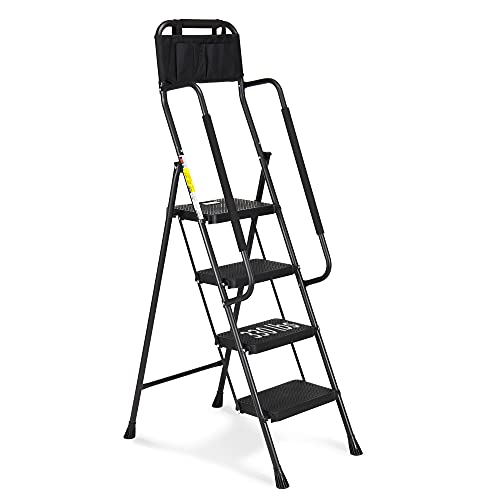
Four steps and handrails set this ladder apart for tasks that need more reach with support while ascending or descending. Its steel frame, automatic metal safety latch, rubberized feet and soft sponge-wrapped rails are designed for a stable grip and floor contact. The maker gives a 330-pound maximum load and a 16-pound net weight. It suits users who value handrails and need a taller step ladder, but it weighs more than the three-step options. Confirm the ladder’s open dimensions fit your workspace before use.
Bottom line: Choose this for the combination of four steps and handrails.
HBTower 3-Step Steel Ladder

At 11.5 pounds, this is the lightest option, with three steps, a steel frame and a handgrip for users who need a ladder that is easier to carry. Its safety buckle locks automatically when the ladder is in use, and the back cross brace reinforces the support structure. The folded depth is 2.56 inches, which can help when storage space is tight. The maker’s provided features do not give a maximum load rating, so buyers who need a specific rated capacity should verify it before choosing this model.
Bottom line: Choose this when lower carry weight and compact storage matter most.
DIAMONDFORGE 3-Step Steel Ladder

A maker-claimed 900-pound maximum load distinguishes this three-step steel ladder from the other options. Wide non-slip pedals, soft handgrips, reinforced bottom bars and three safety latches are among its described construction features; the maker also says it passed 17 reliability tests under ANSI/ASC A14.11 standards. Its 13.6-pound weight is between the lighter three-step ladder and the four-step model. The handle is not described as a full-length handrail, so seniors seeking support along the climb should favor a ladder with explicit handrails instead.
Bottom line: Choose this if the maker-claimed high load rating is your priority and the handle suits your needs.
How to Choose a Step Ladder for Seniors
For users who want support while climbing, prioritize full handrails, a stable base and steps wide enough for secure foot placement. A three-step ladder can be easier to carry, while a four-step model may provide more reach but weighs more in these choices. Ladder capacity includes the user’s weight plus clothing, tools and anything carried; choose a rating that covers the total load with room to spare. A decision rule: if a handrail is essential for balance, choose a model explicitly described with handrails rather than assuming a soft handle provides the same support. Never climb while carrying bulky items that interfere with a secure grip.
Safe Step Ladder Setup and Climbing
Open a folding step ladder completely and confirm its locking brace or latch is engaged before climbing. Place it on a firm, dry, level surface; uneven ground, rugs that shift, and wet floors can undermine stability. Face the ladder while climbing, keep your body centered between the rails, and maintain three points of contact—two hands and one foot, or two feet and one hand—when moving. Do not stand on the top cap or the step immediately below it unless the ladder identifies that surface as a step. Move the ladder rather than leaning sideways, and keep other people clear of the work area.
Step Count, Reach and Load Ratings
Step count alone does not tell you how high you can safely work: the top cap is commonly not a standing step, and the person’s reach and task position affect usable height. The three choices here include two three-step ladders and one four-step ladder, so select based on the actual task rather than stretching from the highest step. Ladder duty ratings commonly range from 200 to 375 pounds across household and professional classes; capacity means the combined user and carried load. A higher number does not make a ladder appropriate for every user or setup. Check the ladder’s safety labels and keep the total load within its limit.
When a Step Ladder Is the Wrong Choice
A step ladder is self-supporting and should be fully opened for use; it is not an extension ladder and should not be leaned against a wall. Use a different access method for tasks that require reaching far beyond the side rails, working on stairs, or placing the ladder on sloped or unstable ground. Keep ladders away from energized electrical lines, since metal frames conduct electricity; fiberglass is the usual choice for work near electrical hazards, with distance still essential. For senior users, ask someone to stabilize the surrounding work area and hand over tools rather than climbing with them. Do not use a ladder with bent rails, damaged feet or a latch that fails to lock.
Frequently Asked Questions
How many points of contact should I keep on a ladder?
Keep three points of contact while climbing: two hands and one foot, or two feet and one hand. Move only one limb at a time and face the ladder.
Can I stand on the top step of a step ladder?
The top cap is commonly not designed as a standing step, so choose a taller ladder if the work is out of reach.
What does a ladder’s maximum load include?
Maximum load includes the user’s body weight plus clothing, tools and materials carried on the ladder. Add those weights together and stay within the ladder’s rating.
Can I use a steel step ladder near power lines?
No; steel conducts electricity, so keep metal ladders away from energized lines. Fiberglass is generally preferred for electrical work, but it does not remove the need to maintain safe clearance.
How should I place a step ladder on a floor?
Set the ladder fully open on a firm, dry, level surface and engage its locking brace or latch before climbing. Do not put it on a shifting rug, uneven ground or a wet floor.