
Saker Portable Welder: Four 110V Options Compared

For most buyers, Saker 110V Welder, 20 Rods is the clearest Saker portable welder choice because it combines 110V operation, five current settings and a 20-rod bundle. These are compact stick welders that use 3/32-inch rods; choose a different package if you need a larger included rod supply, and confirm the machine’s duty cycle before buying.
These options share the same 20–120A output range and IGBT inverter design, so the practical distinction is primarily whether rods are included and how many.
We earn a commission if you buy through links on this page. As an Amazon Associate I earn from qualifying purchases. Products are compared on manufacturer specifications, not hands-on testing.
- Best overall: Saker 110V Welder, 20 Rods – Its 20–120A range and 20 included rods make it a straightforward starter package.
- Best for larger rod supply: Saker 110V ARC Welder, 80 Rods – The package includes 80 welding rods.
- Best for a smaller bundle: Saker 110V ARC Welder, 40 Rods – It includes 40 welding rods with the same current range.
| Product | Best for | Included rods | Shop |
|---|---|---|---|
| Saker 110V Welder, 20 Rods | Starter rod bundle | 20 | Check Price on Amazon |
| Saker 110V ARC Welder, 80 Rods | Larger rod supply | 80 | Check Price on Amazon |
| Saker 110V ARC Welder, 40 Rods | Mid-size rod bundle | 40 | Check Price on Amazon |
| Saker 110V Portable Welder | Welder-only package | — | Check Price on Amazon |
Saker portable welder options
These four 110V stick-welder packages share core output specifications but differ in their included rod bundles.
Saker 110V Welder, 20 Rods
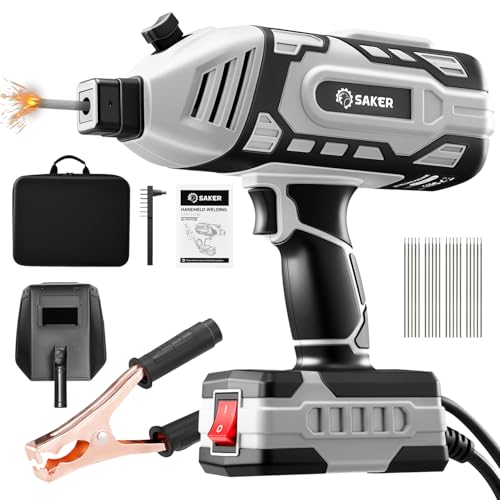
Saker 110V Welder, 20 Rods is the only package here whose included quantity is specified as 20 rods, making it a modest bundle for someone who wants some consumables with the machine. Its five-setting current adjustment spans 20–120A, and the unit is designed for 3/32-inch rods. Saker says its IGBT inverter supports arc stability and easier starting; the machine is described for carbon steel and iron work. A 3/32-inch rod is a common size for light repair, but this package may not suit a buyer who wants a larger supply ready for practice or multiple jobs.
Bottom line: Choose this package if 20 included rods are enough for your first repairs.
Saker 110V ARC Welder, 80 Rods
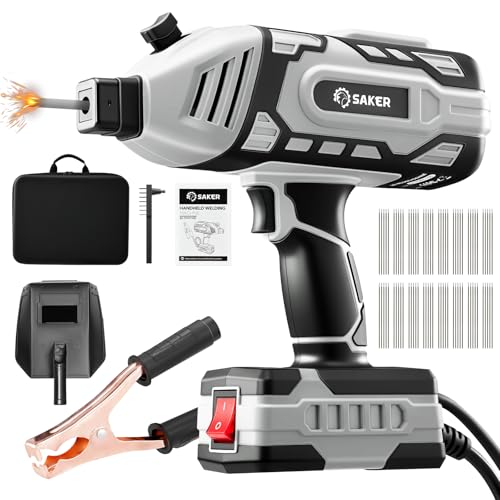
Saker 110V ARC Welder, 80 Rods has the largest included rod bundle among these options, with 80 rods alongside the 110V welder. The machine weighs 1.7 kg and provides five current levels across a 20–120A range, with 3/32-inch electrodes as the fit. Saker says its IGBT design supports a stable arc, and the package is framed for garage, outdoor and DIY use. The larger consumable supply may help a learner who expects repeated practice; it does not change the machine’s output range, so buyers choosing by welding capacity should compare amperage and confirm their electrode’s requirements.
Bottom line: Pick this one if you expect to use a larger number of rods.
Saker 110V ARC Welder, 40 Rods

Saker 110V ARC Welder, 40 Rods sits between the other rod bundles, including 40 rods with a 110V portable ARC welder. Its 20–120A output is adjusted through five levels, and the machine weighs 1.7 kg. Saker says the IGBT inverter design helps maintain arc stability; the product is intended for 3/32-inch rods. This package may suit a buyer who wants more consumables than the 20-rod option but does not need 80. The rod count is the meaningful difference from the other packages, not a broader stated current range or a different electrode size.
Bottom line: Choose this bundle if 40 rods better match your planned amount of practice.
Saker 110V Portable Welder

Saker 110V Portable Welder is the machine-only option in this group: its package is identified as the welding machine rather than a rod-count bundle. It shares the 110V input, five-level adjustment and 20–120A range found on the other units, and it is designed for 3/32-inch welding rods. Saker says the IGBT inverter supports stable current and arc starting for repair and DIY use. This is the sensible package for a buyer who already has compatible rods; someone starting without consumables should compare it with a bundle that explicitly includes rods.
Bottom line: Pick this option if you already have compatible 3/32-inch rods.
How to choose a Saker portable welder
Choose among these Saker packages by rod supply first, since all four share the 110V input and 20–120A range. Stick welding, also called shielded metal arc welding, uses a flux-coated consumable electrode; the electrode type and workpiece thickness influence the useful amperage, not simply the machine’s maximum setting. For many 3/32-inch electrodes, a typical working range is roughly 40–90A, though the electrode maker’s range and welding position matter. Use the lowest suitable setting that maintains a steady arc, then adjust in small steps. If you need to weld heavier material or use another electrode diameter, check the electrode’s amperage guidance and machine compatibility rather than assuming the 120A maximum guarantees suitability.
What 3/32-inch welding rods fit
The Saker units are designed for 3/32-inch rods, a diameter commonly used for light repair and thinner sections. Electrode diameter alone does not identify its coating or intended application: E6013 and E7018, for example, have different handling and storage considerations. Match the electrode classification to the base metal, joint and welding position; clean rust, paint and oil from the joint before welding. A useful decision rule is to select a rod whose recommended amperage overlaps the machine’s available settings and the thickness of the work. Do not treat included rods as universal consumables; confirm their classification and suitability for the job before striking an arc.
Portable stick welder safety and setup
Stick welding creates intense ultraviolet light, hot spatter and fumes, so use a welding helmet with a correctly rated filter, flame-resistant clothing, welding gloves and adequate ventilation. Keep a clear zone around the work and remove combustible material; sparks can travel well beyond the immediate joint. Clamp the work lead to clean metal close to the weld, and keep the electrode holder and cables dry and undamaged. The units are 110V, but input voltage alone does not establish the circuit capacity or a safe duty cycle for a particular job. Check the duty cycle and required electrical supply before buying, and never weld on a container that held flammable material.
Common mistakes with compact welders
A common mistake is setting amperage by habit rather than matching the electrode recommendation: excessive current can cause burn-through, while too little can make the rod stick and produce an inconsistent bead. Another is welding over coatings or contamination; remove paint, rust and oil first, and avoid breathing the resulting fumes. Short practice beads on clean scrap help establish a workable setting before a repair. Let hot metal cool in a controlled area, and do not touch the electrode or workpiece with bare skin. These compact units’ listed 20–120A range and 3/32-inch rod fit are useful boundaries, but they do not replace matching the electrode and job requirements.
Frequently Asked Questions
What size rods fit these Saker welders?
The Saker machines are designed for 3/32-inch welding rods. Confirm the electrode type and its recommended amperage as well as its diameter, since rods of the same size can be intended for different work.
How many amps do 3/32-inch rods need?
Many common 3/32-inch stick electrodes run roughly 40–90A, but the electrode classification and welding position change the appropriate setting. Use the electrode maker’s range and adjust until the arc remains steady without excessive spatter or burn-through.
Can a 110V welder run from a household outlet?
A 110V input matches the nominal voltage of many US household circuits, but that alone does not establish whether a particular circuit can safely supply the machine. Check the machine’s electrical requirements and the circuit rating before connecting it.
What does a welder duty cycle mean?
Duty cycle is the portion of a 10-minute period a welder can operate at a specified output before needing to cool. Compare the cycle at the amperage you plan to use, because a rating at lower current does not describe continuous operation at the maximum setting.
What protective gear is needed for stick welding?
Use a welding helmet with an appropriate filter shade, welding gloves and flame-resistant clothing to protect against arc radiation and hot spatter. Work with ventilation, since fumes can be hazardous, and keep sparks away from combustible materials.