
Sanding Attachment for Drill: 5 Kits Compared by Fit

For a sanding attachment for a drill, 3-Inch Wet-and-Dry Sanding Kit is the most versatile match here because its 3-inch kit spans 60 to 10,000 grit and includes sanding and buffing pads. Choose a smaller disc for tight areas or 5-inch discs for broader surfaces; the flap-wheel set is a different format for edges and rust removal.
We earn a commission if you buy through links on this page. As an Amazon Associate I earn from qualifying purchases. Products are compared on manufacturer specifications, not hands-on testing.
- Best overall: 3-Inch Wet-and-Dry Sanding Kit – Its 3-inch discs cover 60–10,000 grit, with wet-and-dry sanding and polishing accessories.
- Best for tight areas: 2-Inch Aluminum-Oxide Disc Set – The 2-inch hook-and-loop discs suit smaller work zones and include 10 grit options.
- Best for broad surfaces: AUTOTOOLHOME 5-Inch 8-Hole Disc Set – The 5-inch, 8-hole discs cover 60–800 grit and include a backing pad.
| Product | Best for | Disc or wheel size | Grit range | Abrasive | Shop |
|---|---|---|---|---|---|
| 3-Inch Wet-and-Dry Sanding Kit | Sanding and polishing | 3 inches | 60–10,000 | Silicon carbide | Check Price on Amazon |
| 2-Inch Aluminum-Oxide Disc Set | Small work areas | 2 inches | 80–3,000 | Aluminum oxide | Check Price on Amazon |
| AUTOTOOLHOME 5-Inch 8-Hole Disc Set | Broad surfaces | 5 inches | 60–800 | Aluminum oxide | Check Price on Amazon |
| Pukamam 80-Grit Flap Wheel Set | Edges and rust | Multiple wheel sizes | 80 | Aluminum oxide | Check Price on Amazon |
| Zoatcba 3-Inch Wet-and-Dry Kit | Fine polishing range | 3 inches | 60–10,000 | Silicon carbide | Check Price on Amazon |
Sanding Attachments for a Drill
Match the backing format and diameter to the work area, then choose the grit range for the finish you need.
3-Inch Wet-and-Dry Sanding Kit

The 3-inch format and wide grit spread make this kit a versatile choice for moving from material removal toward polishing. The set includes hook-and-loop discs, foam and wool-style buffing pads, and backing pads with 1/4- and 1/8-inch shanks. Silicon carbide abrasives are suited to both wet and-dry sanding, and the maker says the grit markings are printed for easy identification. The small diameter is useful around compact areas, but it covers less surface per pass than a 5-inch disc. Choose another format if you need flap wheels for edges or rust removal.
Bottom line: Choose this kit for mixed sanding and polishing tasks where a 3-inch pad fits.
2-Inch Aluminum-Oxide Disc Set
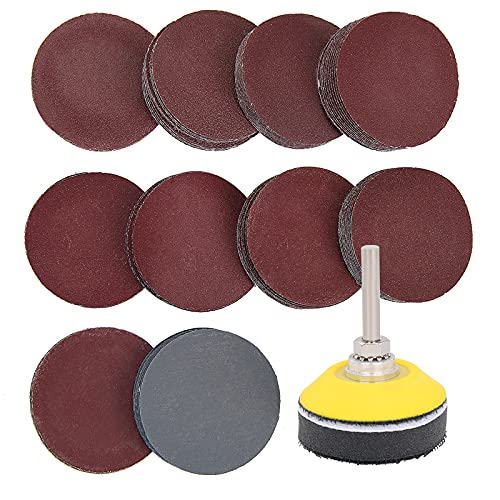
The 2-inch discs are the smallest flat-disc option here, making this set a practical fit for confined areas where a larger pad could be awkward. It comes with 100 hook-and-loop discs across 10 grit choices, from 80 to 3,000, plus a 1/4-inch-shank backing plate and foam buffer pad. Aluminum oxide is the abrasive, and the maker describes the set for sanding and finishing metal and nonmetal materials. Its smaller diameter means slower coverage on wide panels, and the range does not extend to the 10,000-grit polishing stage available in the 3-inch kits.
Bottom line: Pick this set for compact surfaces and a 2-inch backing plate.
AUTOTOOLHOME 5-Inch 8-Hole Disc Set

The 5-inch discs provide the broadest flat sanding area among these kits, and the 8-hole pattern identifies this as a format intended for compatible dust-extracting sanders. The assortment has 80 hook-and-loop discs in eight grit choices from 60 to 800, with 10 discs per grit. Aluminum oxide is used for wood, metal, and other materials; the maker also describes an anti-clogging coating. A backing pad and M10 adapter are included. Before choosing it for a drill, confirm that the pad and adapter match the drill setup you intend to use; the wide disc is less suited to small contours.
Bottom line: Choose this set when larger surfaces call for a 5-inch sanding area.
Pukamam 80-Grit Flap Wheel Set

Unlike the flat hook-and-loop discs, this set uses flap wheels on 1/4-inch shanks, so it suits localized work such as deburring, cleaning, and rust removal. The 20-piece set contains 80-grit aluminum-oxide wheels in 10 different sizes, giving the user several wheel dimensions for varied sanding scenarios. That format can reach edges and smaller contours more readily than a broad disc. The tradeoff is a single abrasive grade: 80 grit is a coarse-to-medium sanding choice, not a progression for fine finishing or polishing. It is best for surface preparation rather than achieving a smooth final sheen.
Bottom line: Pick the flap wheels for edge work, deburring, and rust cleanup.
Zoatcba 3-Inch Wet-and-Dry Kit

The 3-inch discs and 60-to-10,000 grit spread make this kit a close alternative to 3-Inch Wet-and-Dry Sanding Kit, with a larger 174-piece assortment. It includes foam sponge and wool buffing pads, backing pads, and 1/4- and 1/8-inch adapter shanks. Silicon carbide discs support wet or dry sanding, according to the maker, while hook-and-loop backing allows quick disc changes. Check the included mix if a specific pad or disc count is essential to your work.
Bottom line: Choose this larger assortment for 3-inch wet-and-dry sanding and polishing.
How to Choose a Drill Sanding Attachment
Start with the work area: a 2-inch disc reaches small surfaces, while 5-inch discs cover broader areas in fewer passes. Match the shank or adapter to the drill chuck, and do not assume a disc diameter alone guarantees compatibility. Abrasive material also matters: aluminum oxide is common for general sanding on wood and metal, while silicon carbide is often selected for fine finishing and wet sanding. Grit determines the cut: lower numbers remove material faster, and higher numbers refine scratches. For a progression, move through adjacent grits rather than jumping directly from coarse to very fine, which can leave visible scratches beneath a polished finish.
Disc Size, Backing, and Hole Pattern
Flat sanding discs attach to a backing pad, commonly with hook-and-loop fastening, while flap wheels mount directly on a shank. A 5-inch 8-hole disc pattern is designed around dust-extraction openings; align the holes with a compatible pad to preserve airflow. Drill-mounted pads can be flexible, but the drill is not a random-orbit sander, so it can leave circular marks if held at an angle or spun in place. Use a light touch and keep the pad moving. As a rule, choose a disc no larger than the backing pad and avoid forcing an adapter into a chuck that cannot grip it securely.
| Work need | Useful format | Key check |
|---|---|---|
| Small or contoured area | 2- or 3-inch disc | Pad and shank fit |
| Wide flat surface | 5-inch disc | 8-hole alignment |
| Edges and localized cleanup | Shank-mounted flap wheel | Wheel clearance |
Grit Progression for Sanding and Polishing
Grit numbers describe abrasive particle size: a lower grit cuts more aggressively, and a higher grit leaves finer scratches. Common woodworking progressions often use 80, 120, 180, and 220 grit, while automotive polishing kits may extend to several thousand grit for surface refinement. Follow the material and finish requirements because paint, bare wood, metal, and plastic need different starting points. Keep each step until the previous scratches are gone before moving finer; skipping several grades can make defects persist through polishing. Wet sanding can reduce airborne dust, but use only abrasives and workpieces suitable for water, and keep moisture away from the drill and electrical connections.
Safe Use with a Power Drill
Secure the workpiece, wear eye protection, and use a dust mask appropriate to the material, since sanding can produce airborne particles. Keep loose clothing and hair away from the rotating pad, and unplug or remove the battery before changing discs or adapters. A drill’s side handle and variable speed control can improve control, but use the lowest effective speed and avoid pressing hard; excessive force can stall the tool, overheat the abrasive, or damage the surface. Metal dust and sparks require extra distance from flammable materials. For wet sanding, do not let water reach the drill motor, chuck, or battery contacts.
Frequently Asked Questions
Can I use regular sandpaper on a drill?
A drill needs a backing pad or shank-mounted abrasive attachment to hold sandpaper securely. Hook-and-loop discs require a matching hook-and-loop pad, and adhesive-backed discs need a compatible adhesive surface.
What grit should I start with for wood?
For typical bare-wood sanding, 80 or 100 grit can remove roughness, followed by 120 and 180 or 220 for a smoother finish. Start finer on already-smooth wood to avoid unnecessary scratches.
Can drill sanding discs be used wet?
Only use discs identified for wet sanding, and keep water away from the drill, battery, and electrical connections. Wet sanding can control dust, but it is unsuitable for materials that swell or corrode when wet.
Why does a drill sanding pad leave swirl marks?
A drill spins the pad in one direction rather than orbiting it randomly, so the abrasive can leave circular marks if pressure or angle varies. Keep the pad flat, use light pressure, and progress through finer grits.
How do I match a sanding disc to my drill?
Match the backing pad’s shank to the drill chuck and the disc diameter to the pad diameter. A 1/4-inch shank fits only if the chuck can securely clamp it, and adapters should not wobble during rotation.