
Sentry True Wireless Earbuds: Models Compared by Fit

Sentry BT980W True Wireless Earbuds is the closest match for Sentry true wireless earbuds because it is explicitly cord-free and includes a charging case. Choose Sentry OSE Dot Earbuds instead if active noise cancellation matters more; consider TAGRY True Wireless Earbuds or Tribit FlyBuds 3 if you want a non-Sentry alternative with longer claimed playback.
True wireless earbuds connect without a cord between the two earpieces, while the case stores and recharges them between listening sessions.
We earn a commission if you buy through links on this page. As an Amazon Associate I earn from qualifying purchases. Products are compared on manufacturer specifications, not hands-on testing.
- Best overall: Sentry BT980W True Wireless Earbuds – The Sentry model is explicitly true wireless and includes a portable charging case.
- Best for noise control: Sentry OSE Dot Earbuds – Sentry claims active noise cancellation with up to 20 dB of sound reduction.
- Best for long playback: Tribit FlyBuds 3 – Tribit claims up to 110 hours of total playback with its charging case.
| Product | Best for | Design or feature | Claimed playback | Color | Shop |
|---|---|---|---|---|---|
| Sentry BT980W True Wireless Earbuds | Sentry true wireless | True wireless | — | White | Check Price on Amazon |
| Sentry OSE Dot Earbuds | Active noise control | Wireless; active noise cancellation | Up to 18 hours | Black | Check Price on Amazon |
| SENTRY HPXBT999 Pro Series | Simple wireless use | Bluetooth wireless; noise isolation | — | Black | Check Price on Amazon |
| TAGRY True Wireless Earbuds | Case battery display | True wireless; IPX5 | Up to 60 hours | White | Check Price on Amazon |
| Tribit FlyBuds 3 | Extended case playback | True wireless; IPX8 | Up to 110 hours | Black | Check Price on Amazon |
Sentry True Wireless Earbuds and Alternatives
Compare the Sentry options with related wireless earbuds by design, claimed features and playback.
Sentry BT980W True Wireless Earbuds

Sentry BT980W True Wireless Earbuds is the clearest match for Sentry true wireless earbuds: the cord-free pair comes with a portable charging case and Bluetooth connectivity. Its ergonomic in-ear design is intended to stay secure during workouts, commutes and daily activities, so it suits listeners who want an everyday pair without a cable connecting the buds.
The maker gives a weight of 0.25 pounds for the product and package dimensions of 7 × 4.8 × 1.7 inches; those figures may not describe the earbuds alone.
Bottom line: Choose this if you want Sentry-branded, cord-free earbuds with a charging case.
Sentry OSE Dot Earbuds

Sentry OSE Dot Earbuds stands apart from the basic Sentry option by adding active noise cancellation and button audio controls. Choose this model if noise control is a priority alongside a charging case and built-in microphone.
Noise cancellation is not the same as a secure physical seal: fit and ear-tip coverage affect how much outside sound reaches the ear.
Bottom line: Pick this if active noise cancellation matters more than a clearly specified cord-free design.
SENTRY HPXBT999 Pro Series

SENTRY HPXBT999 Pro Series focuses on core wireless functions: Bluetooth audio, a hands-free microphone, easy synchronization and a charging carry case. Its noise isolation is a different approach from active noise cancellation, relying on the earbud fit rather than an electronic cancellation feature. This makes it a related Sentry option for listeners who want basic cordless listening and call support.
The product name does not establish a true wireless design, so this is a less direct match than Sentry BT980W True Wireless Earbuds for buyers specifically seeking two cord-free earbuds. Playback time and the type of noise isolation are not available in the specifications; confirm a cord-free configuration if that is essential.
Bottom line: Choose this for basic Sentry Bluetooth audio and hands-free calling.
TAGRY True Wireless Earbuds

TAGRY True Wireless Earbuds is a non-Sentry alternative with a dual LED power display on the case and support for both wireless and USB-C charging. TAGRY claims up to 60 hours of total playback, with up to 6 hours per earbud charge and about four additional full charges from the case. It also carries an IPX5 rating, which is a useful distinction for exercise or wet-weather exposure.
IPX5 indicates protection against water jets, not a guarantee that earbuds can be submerged. Choose this model if you value the case display and charging options, but do not treat the water rating as permission to swim with it.
Bottom line: Pick this if you want a case power display and IPX5-rated earbuds.
Tribit FlyBuds 3
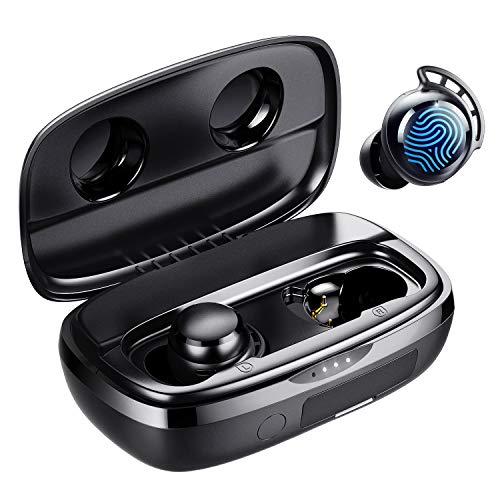
Tribit FlyBuds 3 offers the longest total playback among these options: Tribit claims up to 110 hours with the case and up to 7 hours per charge. The feature set also names custom EQ, Bluetooth 5.3, a built-in microphone and one-step pairing when the case opens. It suits listeners who prioritize infrequent case charging over staying with the Sentry brand.
Tribit gives an IPX8 water-resistance rating, but the maker does not establish a specific immersion depth or duration. Water-resistance ratings do not make earbuds suitable for every swimming condition, so check the manufacturer’s limits before exposing them to water.
Bottom line: Choose this if claimed total playback and a higher water-resistance rating are priorities.
How to choose Sentry true wireless earbuds
Start with the design, then choose between basic isolation and active noise cancellation. True wireless models have no cable between earpieces; each bud connects wirelessly to the source device, and the case stores and recharges them. Passive isolation comes from the fit around the ear canal, while active noise cancellation uses microphones and electronics to reduce some ambient sound. These approaches are not interchangeable: a claimed decibel reduction does not describe how well the ear tips seal.
For movement, prioritize a secure fit and an appropriate water rating rather than assuming every in-ear shape stays put. For calls, look for a built-in microphone or hands-free mic. If runtime matters, distinguish playback per charge from total playback with the case; those figures measure different things.
What playback and charging figures mean
Earbud-only playback and case-assisted playback should be compared separately. A total-playback claim counts listening across multiple charges from the case, while a per-charge figure describes one session before the buds need recharging. Battery life can also change with volume, active noise cancellation and call use, so treat a maker’s maximum as a best-case claim rather than guaranteed daily runtime.
Charging cases may use wired charging, wireless charging or both; check which method fits your routine. A case power display can help track remaining charge, but it does not extend runtime by itself. If you need a minimum session length, choose a model whose per-charge claim meets that target, rather than relying only on its larger case-total figure.
Water ratings and safe earbud use
IPX5 and IPX8 represent different water-exposure categories, not a simple promise that a product is waterproof in every situation. IPX5 is protection against water jets; IPX8 covers immersion under conditions defined for the product. The exact depth and duration matter, so do not infer a swimming limit from the rating alone.
Sweat, rain and swimming are different use cases, and water resistance can diminish with wear or damage. Keep charging cases dry unless they have their own stated water rating, and never charge wet earbuds. For the safest fit, insert earbuds gently and stop using them if discomfort or irritation occurs.
Choosing fit, controls and noise reduction
A secure in-ear fit depends on the shape of the ear tip and ear canal, not simply whether a product is described as ergonomic. If earbuds shift during a short walk or head movement, adjust the position before using them for workouts. A charging case helps protect and recharge the buds when they are not being worn, but compact-looking dimensions do not establish how the earbuds themselves fit.
Button controls provide physical input, while touch controls—when included—respond to taps; neither control type guarantees a particular layout. Noise isolation is produced by fit, whereas active noise cancellation is an electronic feature. Choose ANC when reducing steady background sound is important, but retain awareness of traffic and other hazards when listening outdoors.
Frequently Asked Questions
What does true wireless mean for earbuds?
True wireless earbuds have no cable connecting the left and right earpieces. Each bud communicates wirelessly with the audio source, and a case commonly stores and recharges them.
Is noise isolation the same as active noise cancellation?
No. Noise isolation comes from a physical seal around the ear, while active noise cancellation uses electronics to reduce some ambient sound. A snug fit still matters for both comfort and passive isolation.
Does a 60-hour playback claim mean one charge?
Usually, a total figure that includes a charging case spans multiple listening sessions. Compare the per-charge runtime separately; TAGRY’s claim here distinguishes up to 6 hours per earbud charge from up to 60 hours total.
Can IPX5 earbuds be used while swimming?
IPX5 is a water-jet protection rating, not a swimming rating. Do not submerge IPX5 earbuds; even an IPX8 product needs a depth and duration limit before use in water.
How can I get a secure in-ear fit?
A secure fit depends on the ear tip sealing comfortably without pressure or slipping. Test the fit with gentle movement before exercising, and do not force an earbud that causes pain.