
Skandia 10-Piece Knife Set: Fit and Features

The Skandia 10-piece set is the Hampton Forge Aero block set, with an 8-inch chef knife, four steak knives and a wood block; choose it if you want that specific configuration. If you need a larger assortment, a sharpener, or storage without a block, compare the alternatives by included knife types and storage style.
We earn a commission if you buy through links on this page. As an Amazon Associate I earn from qualifying purchases. Products are compared on manufacturer specifications, not hands-on testing.
- Best overall: Skandia Aero 10-Piece Block Set – It is the Skandia by Hampton Forge set, with a wood block and four 4.5-inch steak knives.
- Best for forged knives: Cangshan HELENA 10-Piece Set – It includes forged German-steel knives, an acacia block and an adjustable sharpener.
- Best for compact storage: ODDIER 10-Piece Knife Set – Its universal block holds the included knives and accessories in one set.
| Product | Best for | Storage | Largest knife | Steak knives | Shop |
|---|---|---|---|---|---|
| Skandia Aero 10-Piece Block Set | Skandia set match | Wood block | 8 in. chef knife | Four, 4.5 in. | Check Price on Amazon |
| Cangshan HELENA 10-Piece Set | Forged knife set | Acacia wood block | 9 in. carving knife | — | Check Price on Amazon |
| ODDIER 10-Piece Knife Set | All-in-one storage | Universal block | 8 in. chef knife | — | Check Price on Amazon |
| Cuisinart ColorCore 10-Piece Set | Covered storage | Individual blade guards | — | — | Check Price on Amazon |
| Astercook 21-Piece Knife Set | Broad knife assortment | Hardwood block with sharpener | 8 in. chef knife | Eight, 4.5 in. | Check Price on Amazon |
Skandia 10-Piece Knife Sets and Alternatives
Compare the Skandia set with related kitchen knife sets by their included blades and storage.
Skandia Aero 10-Piece Block Set

The Skandia by Hampton Forge Aero set is the direct match for this search, and its mix includes an 8-inch chef knife, 8-inch bread knife, 7-inch santoku, 5-inch utility knife, 3.5-inch paring knife and four 4.5-inch steak knives. A wood cutlery block stores the knives, while full-tang handles and a stainless bolster distinguish this set from the alternatives. The maker says the knives are dishwasher safe on the top rack. Choose it for a matching block set with steak knives; buyers wanting a sharpener or a larger specialty assortment should consider a different configuration.
Bottom line: Choose this set if you want the Skandia Aero configuration with four steak knives and a wood block.
Cangshan HELENA 10-Piece Set
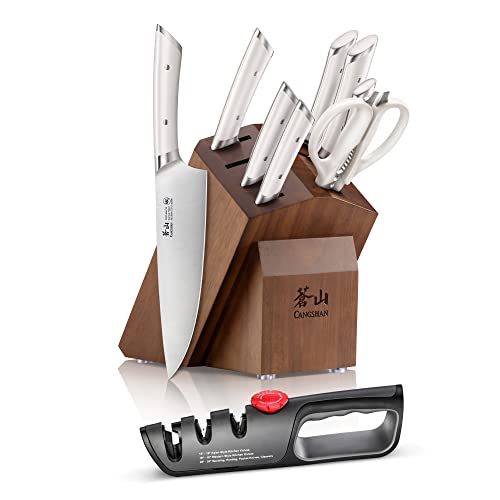
The Cangshan HELENA is the alternative here with forged German-steel knives and an acacia wood block. Its assortment includes an 8-inch chef knife, 7-inch santoku, 8-inch bread knife, 9-inch carving knife, shears, two smaller prep knives and an adjustable sharpener. The maker says the steel is German X50CrMoV15, the blades are sharpened to 16 degrees, and its ULTRA6 heat treatment scores 58 ±2 on the Rockwell scale. This set suits cooks who want carving and peeling tools alongside core knives. It is not the Skandia model, and its handle style and steel specification may matter to buyers comparing feel and maintenance.
Bottom line: Pick this set if the 9-inch carving knife and adjustable sharpener suit your prep needs.
ODDIER 10-Piece Knife Set

The ODDIER set adds a peeler, sharpener and kitchen shears to its six knives, so it covers more small prep tasks than the Skandia configuration. The six knives include an 8-inch chef knife, 8-inch slicing knife, 8-inch bread knife, 7-inch santoku, 5-inch utility knife and 3-inch paring knife; a universal block provides shared storage. The maker says its high-carbon Cr3 German stainless steel is hand-polished and ground at a 15-degree angle, and cautions that the sharp knives should be kept away from children. It suits buyers wanting these extras together, but it is not the Skandia set.
Bottom line: Choose it if a peeler, sharpener and shears in the set are priorities.
Cuisinart ColorCore 10-Piece Set
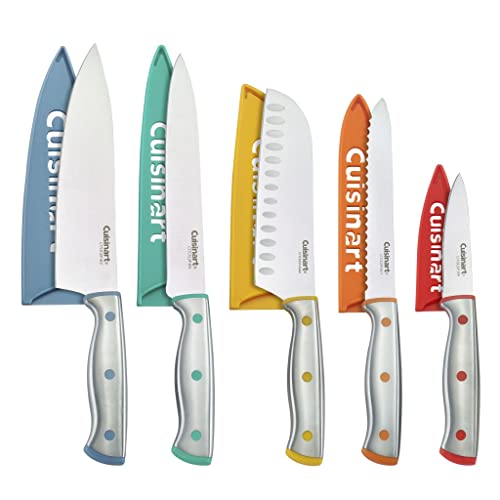
The Cuisinart ColorCore set differs from the block sets by using a cover for each knife rather than a shared knife block. Its product name identifies a 10-piece set, while the maker identifies five stainless-steel kitchen knives for common slicing, dicing, chopping and mincing tasks. The maker says the blades are precision-ground and the color-coded, riveted handles are designed for a secure grip; it also mentions lifetime coverage. This is a fit for drawers or kitchens where individual blade guards are preferable. Buyers who want a complete block-based assortment should compare the Skandia set or another block option instead.
Bottom line: Pick this set if individual blade covers fit your storage setup better than a block.
Astercook 21-Piece Knife Set
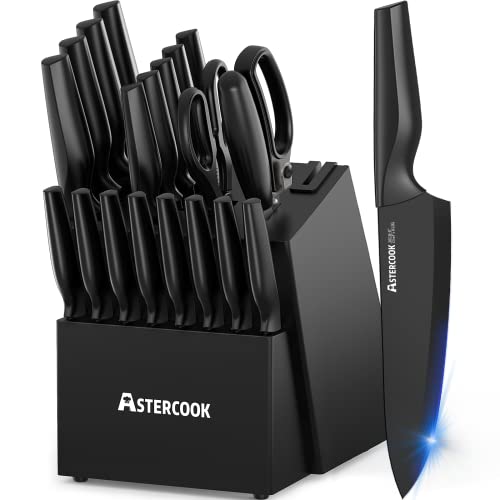
The Astercook set is the largest assortment here, with 21 pieces including an 8-inch chef knife, slicing and bread knives, boning and cheese knives, peeling and paring knives, eight steak knives, poultry shears and kitchen shears. Its hardwood block has a built-in sharpener, unlike the Skandia set’s wood block without a sharpener in the assortment. The maker says the stainless-steel blades have a black coating intended to resist oxidation and rust. Consider it when you want specialty knives and a large steak-knife group; its broad assortment takes more counter or drawer planning than a smaller set.
Bottom line: Choose it if the specialty blades, eight steak knives and built-in sharpener match your kitchen.
How to choose a 10-piece knife set
Choose by the knives you will use and how you will store them, not by the piece count alone. Sets may count steak knives, shears, sharpeners, peelers or a block among their pieces, so compare the actual knife list. A useful everyday core is an 8-inch chef knife, a paring knife around 3 to 4 inches, and a serrated bread knife; a utility or santoku knife adds a different cutting shape. A block is convenient when counter space is available, while individual blade guards let knives fit in a drawer. Match the set to meals: frequent roasts favor a carving knife, while individual place settings benefit from steak knives. Keep sharp knives out of children’s reach and store blades covered or in a stable block.
For a set centered on a named model, verify the exact line and included assortment: a similar piece count does not make another brand or model the same set.
Knife sizes and common kitchen tasks
An 8-inch chef knife is a versatile size for chopping vegetables and slicing boneless foods; a 6-inch chef knife can feel easier to control for smaller hands or tight boards. Paring knives typically have 3- to 4-inch blades for peeling and detailed trimming, while bread knives commonly use 8- to 10-inch serrated blades to cross crusts without crushing soft interiors. A santoku often has a shorter, flatter edge than a chef knife, which suits straight chopping strokes. These are typical category ranges, not a guarantee about every set. Measure counter and drawer space before choosing a block, and allow room to remove knives safely without striking a wall or another blade.
For a quick task-to-knife reference, use the usual role of each blade shape rather than assuming every set includes every type.
| Knife type | Typical blade length | Common task |
|---|---|---|
| Chef | 6–8 in. | Chopping and slicing |
| Paring | 3–4 in. | Peeling and trimming |
| Bread | 8–10 in. | Slicing crusty loaves |
| Utility | 4–6 in. | Small general cuts |
Knife block and blade-guard storage
A knife block keeps multiple blades upright and accessible, but it needs a stable, dry spot with enough clearance to lift knives out vertically. Individual guards make drawer storage possible, but blades should lie flat and not slide against loose utensils. Never leave an exposed knife in a crowded sink or beneath dishwater: a submerged edge is difficult to see and can cause a serious cut. Wash knives separately, dry them before storage and keep handles clear of the cutting area. For households with children, use a secure location or a child-resistant barrier rather than relying on a high counter alone. Choose guards or a block that fit the actual blade lengths in the set.
Knife care and sharpening basics
Hand-washing and immediate drying help protect knife edges and handles, even when a maker permits dishwasher cleaning. Dishwasher cycles can let blades strike other utensils, while prolonged moisture can affect handles and block materials. Use a wood, plastic or other knife-friendly cutting board; glass and stone are hard surfaces that quickly dull edges. A honing rod realigns a slightly rolled edge, while sharpening removes material to form a new edge, so they are not interchangeable. For home sharpening, keep a consistent angle: many Western-style kitchen knives use roughly 15 to 20 degrees per side, while the correct angle depends on the blade. Store sharp knives where children cannot access them.
Frequently Asked Questions
How often should kitchen knives be sharpened?
Sharpening frequency depends on use and the cutting surface; a home cook may need a full sharpening every 6 to 12 months. Hone a frequently used knife more often to realign its edge, and use a board made of wood or plastic rather than glass or stone.
Can kitchen knives go in the dishwasher?
Hand-washing is the safer routine for preserving edges and handles, even if a set’s maker says top-rack dishwasher cleaning is allowed. Keep knives separate from other utensils, wash carefully, and dry them immediately before storage.
What size chef knife is best for home cooking?
An 8-inch chef knife is a common all-purpose choice for chopping and slicing, while a 6-inch blade can be easier to control on a small board. Leave enough counter clearance to guide the full blade without hitting nearby objects.
Is a santoku knife different from a chef knife?
A santoku typically has a shorter blade and flatter edge profile than a Western chef knife, favoring straight chopping motions. A chef knife’s more curved edge makes rocking cuts easier; choose based on your preferred cutting motion and board space.
How should kitchen knives be stored safely?
Store knives in a stable block or with individual blade guards, and keep them inaccessible to children. Avoid loose, uncovered blades in drawers or sinks, where an edge can catch a hand unexpectedly.