
Small Ball Ice Cube Trays: 4 Sizes Compared

For small ball ice cube trays, choose the ball diameter that fits your bottle opening; the 0.56-inch set targets narrow-mouth bottles, while larger balls suit cups and mixed drinks. Pick a different set if you need conventional cubes or larger cocktail ice, since these molds make miniature round ice.
Nunibum 0.56-Inch Mini Ice Ball Set is the best match for narrow-mouth bottles because its 0.56-inch balls are designed for that use and its four trays produce 264 pieces.
We earn a commission if you buy through links on this page. As an Amazon Associate I earn from qualifying purchases. Products are compared on manufacturer specifications, not hands-on testing.
- Best overall: Nunibum 0.56-Inch Mini Ice Ball Set – Its 0.56-inch balls are designed for narrow-mouth bottles, and four trays produce 264 pieces.
- Best for 0.95-inch balls: 3-Pack 0.95-Inch Mini Ice Ball Trays – Three trays make 84 small balls, with a storage bin included.
- Best for 0.8-inch balls: Optish 0.8-Inch Ice Ball Set – The set includes three trays, a sealed bin and a scoop for 99 balls.
- Best for pebble ice: WIBIMEN 0.55-Inch Pebble Ice Trays – Its 0.55-inch pebble-style ice is intended for bottles and drinks.
| Product | Best for | Ball diameter | Tray count | Included accessories | Shop |
|---|---|---|---|---|---|
| Nunibum 0.56-Inch Mini Ice Ball Set | Narrow-mouth bottles | 0.56 in | 4 | Bin, scoop | Check Price on Amazon |
| 3-Pack 0.95-Inch Mini Ice Ball Trays | Larger mini balls | 0.95 in | 3 | Lid, bin | Check Price on Amazon |
| Optish 0.8-Inch Ice Ball Set | Parties and travel | 0.8 in | 3 | Sealed bin, scoop | Check Price on Amazon |
| WIBIMEN 0.55-Inch Pebble Ice Trays | Pebble-style ice | 0.55 in | 4 | Ice box, scoop | Check Price on Amazon |
Small Ball Ice Cube Trays Compared
Compare ball size, batch output and kit components to find a tray set that suits your drinkware.
Nunibum 0.56-Inch Mini Ice Ball Set

The smallest diameter in this group, 0.56 inch, makes this set the bottle-focused choice. Four trays produce 66 balls apiece, or 264 total, and the kit includes a storage bin and scoop. The manufacturer says the BPA-free, food-grade trays are safe for direct contact with food and drinks. The balls are also suited to iced coffee and cocktails. Choose another set if you want larger ice for slower-melting drinks; miniature pieces have more exposed surface area for their volume and can melt more quickly than larger ice.
Bottom line: Choose this set when fitting ice through narrow bottle openings is the priority.
3-Pack 0.95-Inch Mini Ice Ball Trays

The 0.95-inch balls are larger than the other sizes here, making this three-tray set a fit for people who prefer more substantial mini ice. Its name specifies 84 balls, and the included bin provides a place to keep them after release. The maker describes a fill-guide design and a lid that lets excess water drain through holes; it also says the BPA-free plastic lid helps block freezer odors. The tradeoff is size: measure a narrow bottle opening before choosing this set, because its balls are larger than the 0.55- and 0.56-inch options.
Bottom line: Pick this set for larger mini balls and a lidded storage bin.
Optish 0.8-Inch Ice Ball Set
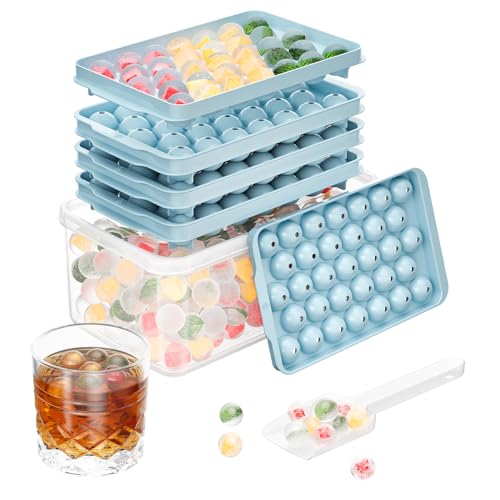
The Optish set pairs a middle-size 0.8-inch ball with a sealed storage bin and scoop, a useful combination for serving drinks or carrying the kit for RV travel and camping. Three trays make 99 balls, according to the manufacturer, and the flexible twist-release design is intended to help free them without forceful squeezing. The manufacturer also says the balls chill drinks with low liquid dilution. The included accessories distinguish it from sets with a bin alone, but buyers focused on fitting narrow bottle necks may prefer the smaller 0.55- or 0.56-inch sizes.
Bottom line: Choose this kit for a mid-size ball with a bin and scoop.
WIBIMEN 0.55-Inch Pebble Ice Trays

The 0.55-inch pieces are explicitly pebble-style ice, making this four-tray kit a close match for shoppers seeking tiny round ice rather than conventional cubes. The set includes an ice box and scoop, and the manufacturer recommends letting the tray sit at room temperature for 30 to 60 seconds before gently twisting it to release the ice. It also advises keeping the tray flat and not filling above the water line. The product does not give a total ball count in the specifications, so buyers prioritizing a known batch total may prefer a set with an output.
Bottom line: Pick this set for 0.55-inch pebble-style ice and its release guidance.
How to choose small ball ice cube trays
Start with the diameter that will pass through your narrowest cup or bottle opening. A practical rule is to leave at least 1/8 inch of clearance around the ice; if an opening measures 3/4 inch across, select balls no larger than 1/2 inch, or choose an even smaller size for easier pouring. Small ice exposes more surface area relative to its volume than large ice, so it can chill a drink quickly but also melt faster. Choose larger pieces when a slower melt matters more than fitting through a narrow neck. Tray count and total output are separate: a set with more trays does not necessarily make more ice than another set.
The size labels here can guide a first pass, but bottle openings and ice shape both affect fit.
| Need | Starting choice |
|---|---|
| Narrow bottle opening | 0.55–0.56-inch balls |
| Mid-size round ice | 0.8-inch balls |
| Larger mini ice | 0.95-inch balls |
Ball diameter and drinkware fit
Ball diameter is the key fit measurement; check the narrowest part of a bottle mouth, not the wider cap or shoulder. For a reliable pass-through, aim for an opening at least 1/8 inch wider than the ice diameter, and allow more clearance if the opening is irregular or the ice may be slightly misshapen. A 0.55-inch ball therefore needs about 0.68 inch of opening under this rule. Round ice may roll differently from cubes, so test one frozen piece before filling a bottle with a batch. For cups and cocktail glasses, access is less restrictive, and the deciding factor is often how quickly the drink should cool versus how long the ice should last.
Do not treat “mini” and “pebble” as interchangeable size standards: compare the actual diameter whenever a container fit matters. If precise pass-through is essential, confirm the opening measurement and the ice diameter before choosing.
Filling, freezing and releasing mini ice
Freeze water with trays set flat to limit spills and uneven filling; a typical home freezer should be kept at 0°F for food storage. Leave headroom because water expands as it freezes, and avoid filling beyond a mold’s marked water line. Thin, small pieces generally freeze sooner than large blocks, but freezing time changes with freezer temperature, tray material and how full the freezer is; use fully solid ice rather than relying on a fixed time. To release pieces, let a tray warm briefly at room temperature and twist gently if its design allows. Avoid striking a frozen plastic tray against a hard counter, which can crack or deform it.
Store released ice covered in a clean freezer-safe bin. Ice can pick up odors from uncovered foods, so a fitted lid or sealed container helps preserve a neutral taste.
Frequently Asked Questions
Will small ice balls fit through a water bottle opening?
Measure the narrowest opening and leave about 1/8 inch more width than the ball diameter for easier passage. A 0.56-inch ball therefore calls for an opening of roughly 0.68 inch or wider.
Do smaller ice balls melt faster in drinks?
Generally, yes: small pieces expose more surface area relative to their volume than large pieces, so they can chill quickly and melt sooner. Use larger ice when a slower melt is more important than fitting through a narrow opening.
How full should an ice ball tray be?
Fill only to the mold’s water line or below it, since water expands as it freezes. Set the tray flat in the freezer to reduce spill risk while it freezes.
What freezer temperature should I use for ice trays?
A typical home freezer target is 0°F. Freezing time is not fixed; freezer temperature, tray design and load all affect when small pieces become solid.
How can I release ice balls without cracking a tray?
Let a tray sit at room temperature briefly, then use a gentle twist if the tray is designed for twisting. Avoid banging plastic against hard surfaces, which can damage it.