
Small Engine Fuel Lines: 5 Kits Compared by Fit

For most small-engine repairs, the four-size 4-Size Yellow Fuel Line Kit kit is a practical starting point because it includes four common inside-and-outside diameter combinations and four feet of hose. Choose a different kit if you need clamps, filters, primer bulbs or five hose sizes; exact fit still depends on matching the original line.
We earn a commission if you buy through links on this page. As an Amazon Associate I earn from qualifying purchases. Products are compared on manufacturer specifications, not hands-on testing.
- Best overall: 4-Size Yellow Fuel Line Kit – Four common ID/OD sizes and four feet of hose cover a range of small-engine replacements.
- Best for clamps: Tanbupu 5-Size Line and Clamp Kit – Includes five hose sizes and 50 clamps in matching inner diameters.
- Best for repair parts: partszen 4-Size Repair Kit – Combines four hose sizes with fuel filters and primer bulbs.
| Product | Best for | Hose sizes | Length | Included extras | Shop |
|---|---|---|---|---|---|
| 4-Size Yellow Fuel Line Kit | Common sizes | 4 sizes; 0.08–0.125 in ID | 4 ft | None specified | Check Price on Amazon |
| Tanbupu 5-Size Line and Clamp Kit | Clamps included | 5 sizes; 1/8–5/16 in ID | 3.3 ft | 50 clamps | Check Price on Amazon |
| Hipa 4-Size Fuel Line, 4 ft Each | Longer stock | 4 sizes; 0.08–1/8 in ID | 4 ft each | None specified | Check Price on Amazon |
| partszen 4-Size Repair Kit | Repair components | 4 sizes; 0.08–1/8 in ID | 4 ft each | Filters and primer bulbs | Check Price on Amazon |
| ZHRANXZ 4-Size Line Repair Kit | Bulbs and filters | 4 sizes; ID not given | 2 ft per size | Filters and primer bulbs | Check Price on Amazon |
Small Engine Fuel Lines Compared
Compare each kit’s hose dimensions and included repair parts before choosing a replacement.
4-Size Yellow Fuel Line Kit

Four common ID/OD combinations make this kit a useful choice when the original hose size is uncertain but can be measured. The sizes are 0.08 × 0.14, 1/8 × 1/4, 1/8 × 3/16 and 3/32 × 3/16 inches, with four feet of line to cut for a repair. It is intended for 2-cycle small engines such as trimmers, chainsaws and blowers. The kit contains hose only, so choose another option if the job also calls for clamps, filters or primer bulbs.
Bottom line: Choose this kit for common small-engine hose sizes when you only need replacement line.
Tanbupu 5-Size Line and Clamp Kit

Unlike the four-size hose-only kits, this set pairs five hose diameters with 50 clamps. The hose IDs are 1/8, 3/16, 0.22, 1/4 and 5/16 inch; the line is made from NBR, a material described as oil- and heat-resistant. It suits repairs where a clamp is needed to secure the hose, and its range extends to a 5/16-inch inner diameter. The total hose length is 3.3 feet, so it may be limiting if a repair needs more line than that.
Bottom line: Choose this set when you need multiple hose sizes and clamps together.
Hipa 4-Size Fuel Line, 4 ft Each

Each of the four hose sizes comes in a four-foot length, giving this kit more total line than options that specify a single combined length. The IDs are 0.08, 3/32 and 1/8 inch, paired with the outside diameters of 0.14, 3/16, 3/16 and 1/4 inch. The maker says the tubing resists oil, gas and corrosion and is suitable for small-engine equipment including lawn mowers, chainsaws and trimmers. This is a hose-only kit, so it does not bundle clamps or other repair components.
Bottom line: Choose it when you want four feet of each of four hose sizes.
partszen 4-Size Repair Kit
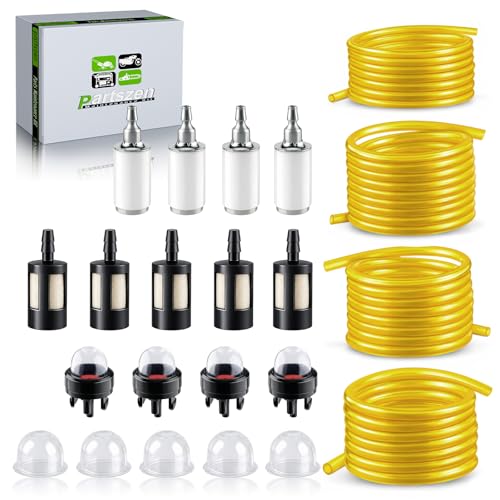
Fuel filters and primer bulbs distinguish this kit from the line-only alternatives. It includes four hose dimensions—2 × 3.5, 3 × 6, 3 × 5 and 2.5 × 5 mm—and the maker gives a total hose length of 6.1 meters, with each size four feet long. The package also includes white and black filters and two types of primer bulbs for specified applications. A key limitation is the maker’s warning that the hose is not compatible with fuel containing more than 10% ethanol, so check the fuel blend before choosing it.
Bottom line: Choose this kit when your repair also needs filters or primer bulbs and your fuel blend is compatible.
ZHRANXZ 4-Size Line Repair Kit

Replacement filters and primer bulbs are included alongside four sizes of fuel tubing, making this option a parts bundle rather than just a hose assortment. The maker identifies the tubing as Tygon material and says it resists oil, gasoline and corrosion. The length is two feet per size, useful for short replacement sections or compact repairs. The specific hose diameters are not provided in the specifications, so this kit is less straightforward to match by measurement than the alternatives with explicit ID/OD dimensions.
Bottom line: Choose it if the included repair components matter and you can verify hose fit before ordering.
How to choose small engine fuel lines
Match the hose’s inside diameter to the engine’s fuel line barb, and check outside diameter when the line passes through a tight grommet or housing. A hose that is too loose on a barb can leak or slip off; one that is too tight may be difficult to install or can be damaged during fitting. Measure the old line at an undamaged end, since a cracked or swollen section can distort the size. Compare both dimensions, not just the nominal size, when the kit provides them. If you cannot identify the original size, an assortment offers options, but confirm the chosen line seats securely on the fittings before running the engine.
Fuel hose material and fuel compatibility
Use hose intended for gasoline fuel systems, not ordinary clear vinyl tubing, which may soften or degrade with fuel exposure. Small-engine fuel hoses are commonly made from fuel-resistant elastomers; material names alone do not guarantee compatibility with every fuel blend. Ethanol content matters because some hose formulations have limits, and partszen 4-Size Repair Kit specifically carries a warning against fuel above 10% ethanol. Check your equipment’s fuel requirements and the hose maker’s compatibility guidance before installing a line. Fuel leaks create a fire hazard: work with the engine cool, away from sparks or flames, and clean up spilled fuel before starting the equipment.
When to replace a small engine fuel line
Replace fuel line that is cracked, hardened, swollen, kinked or loose at a connection rather than waiting for a leak. Flexible lines carry fuel between the tank, filter and carburetor, so a restriction or air leak can interfere with engine operation. Route replacement hose along the original path and keep it clear of hot engine parts, sharp edges and moving components. Cut the tubing squarely with a sharp blade so the end seats evenly over the barb. Do not stretch the line to reach a fitting; tension can pull it loose. After installation, inspect connections for seepage before using the equipment.
Fuel line kit differences at a glance
Choose a kit by the measured hose size and the repair parts you need, not by the number of pieces alone. The table highlights the practical distinction between hose assortments and bundles that add clamps, filters or primer bulbs.
| Repair need | Kit type | What to check |
|---|---|---|
| Replace hose only | Four-size line assortment | Match ID and OD to the original line |
| Secure replacement hose | Line with clamps | Clamp diameter fits the hose and barb |
| Replace several components | Line with filters or primer bulbs | Filter and bulb fit the equipment |
Clamps should secure the hose without cutting into it, and a replacement filter must match the fuel system’s connection style. Primer bulbs are also model-dependent, so compare the bulb and carburetor connection before relying on a bundle to cover the whole repair.
Frequently Asked Questions
How do I measure a small engine fuel line?
Measure the inside diameter and outside diameter at a clean, undamaged end of the original hose. Match both measurements to the replacement where possible, especially if the line passes through a grommet or close-fitting opening.
Can I use clear vinyl tubing for gasoline?
Use tubing rated for gasoline rather than ordinary clear vinyl, which may soften or degrade in fuel. Confirm compatibility with the fuel blend, including ethanol content, before installing the line.
How should a replacement fuel line be routed?
Follow the original route and keep the hose clear of hot surfaces, sharp edges and moving parts. Leave enough slack to avoid tension at the fittings, but avoid kinks that could restrict fuel flow.
When should a small engine fuel line be replaced?
Replace a line when it becomes cracked, hard, swollen, kinked or loose at a fitting. Inspect connections for seepage after installation, with the engine cool and away from ignition sources.
Do small engine fuel lines need clamps?
A clamp can help secure a hose where the original setup uses one or the fit is not sufficiently snug. Select a clamp sized to the hose and barb, and tighten it enough to hold without cutting into the tubing.