
Smith & Wesson J-Frame Holsters Compared by Fit

For a Smith & Wesson J-Frame with a barrel up to 2.25 inches, Sticky Holsters MD-5 Medium stands out for its ambidextrous design and non-slip construction. Choose a different option if you need a right-hand leather holster or your revolver has a barrel longer than 2.25 inches.
J-Frame holsters are shaped for compact revolvers, but model, barrel length and draw hand still determine fit.
We earn a commission if you buy through links on this page. As an Amazon Associate I earn from qualifying purchases. Products are compared on manufacturer specifications, not hands-on testing.
- Best overall: Sticky Holsters MD-5 Medium – Ambidextrous design accommodates either draw hand and the fit covers J-Frames with barrels up to 2.25 inches.
- Best for leather: Cardini Leather IWB Holster – Colombian leather construction and right-hand draw suit buyers seeking a traditional IWB holster.
- Best for longer barrels: 1791 Gunleather J-Frame IWB Holster – The fit includes similar revolvers with barrels up to 2.5 inches.
| Product | Best for | Barrel fit | Carry style | Material | Shop |
|---|---|---|---|---|---|
| Sticky Holsters MD-5 Medium | Ambidextrous carry | Up to 2.25 in. | IWB or pocket | Non-slip material, foam | Check Price on Amazon |
| Cardini Leather IWB Holster | Right-hand leather | 2.5 in. size | IWB | Colombian leather | Check Price on Amazon |
| 1791 Gunleather J-Frame IWB Holster | Extended barrel fit | Up to 2.5 in. | IWB | Steerhide leather | Check Price on Amazon |
| Kosibate Suede IWB Holster | Suede concealment | Most J-Frames | IWB | Suede leather | Check Price on Amazon |
Smith & Wesson J-Frame Holsters
Match the holster to your revolver’s barrel length, preferred carry position and draw hand.
Sticky Holsters MD-5 Medium

Unlike the leather designs here, the MD-5 is an ambidextrous pouch that can be used for inside-the-waistband or pocket carry. It fits J-Frames and compatible revolvers with barrels up to 2.25 inches, including the S&W 12, 36, 37 and 60. The non-slip outer material is designed to hold against clothing or skin, while closed-cell foam forms the inner layer. Its two-sided draw suits left- or right-handed users. The main limitation is the 2.25-inch barrel ceiling, which rules it out for longer-barrel revolvers.
Bottom line: Choose this if you want a pouch-style holster that works for either draw hand.
Cardini Leather IWB Holster

Cardini pairs a right-hand IWB design with Colombian leather, unlike the ambidextrous pouch option. The holster is made for five-shot revolvers including S&W J-Frames and Taurus 605 models; the selected size is 2.5 inches. Its features include a soft interior, a sweat shield and a metal clip for waistband or belt attachment. Cardini says the leather forms to the revolver after moderate use, so it may suit buyers who prefer a molded leather fit over a flexible pouch. The right-hand draw is the key constraint for left-handed carriers.
Bottom line: Pick this for a right-hand, leather IWB setup for a five-shot J-Frame.
1791 Gunleather J-Frame IWB Holster
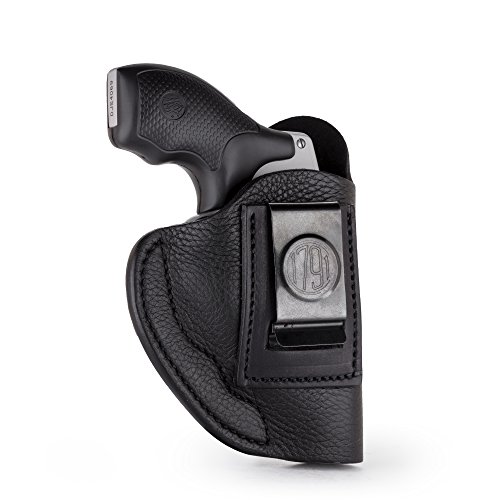
Among these holsters, this 1791 design gives the widest barrel allowance: up to 2.5 inches for J-Frame and similar .38 Special revolvers. It is a right-hand IWB holster made from American steerhide, with reinforced, double-stitched construction. The named compatible revolvers include S&W 637, 638 and 642 models. The maker says the leather needs no break-in period. Its fit range makes it a useful candidate when a 2.25-inch limit is too short, but left-handed users need a different draw orientation.
Bottom line: Choose this if your compatible revolver has a barrel up to 2.5 inches and you draw right-handed.
Kosibate Suede IWB Holster

Kosibate uses suede rather than the Colombian or steerhide leather of the other leather options. Its small IWB holster fits many J-Frame-style revolvers, including S&W 442, 642, M&P 340 and Bodyguard models, and has a clip for belt attachment. The feature set also says it fully conceals the trigger. This makes it a candidate for buyers prioritizing a slim suede design and broad model compatibility. The fit is for most J-Frame styles rather than a barrel-length limit, so confirm the exact revolver fit before ordering.
Bottom line: Pick this if you want a suede IWB holster and your exact revolver is compatible.
How to choose a Smith & Wesson J-Frame holster
Start with the revolver’s exact model, barrel length and draw hand; a J-Frame label alone does not guarantee the same fit. Measure barrel length from the cylinder face to the muzzle, and compare it with the holster’s limit. For these options, the explicit maximums are 2.25 and 2.5 inches. Then decide between IWB carry and pocket carry: a pocket holster should stay in the pocket during the draw and cover the trigger guard. A right-hand holster is not interchangeable with a left-hand one. If the model or barrel length is unclear, verify that fit before ordering rather than relying on a generic .38 Special label.
J-Frame barrel length and model fit
Confirm both the revolver model and barrel length because small revolvers can differ in cylinder, sight and grip dimensions. A holster molded or sized for one version may bind or leave excess space on another. When the maker gives a maximum barrel length, treat it as a fit boundary, not a guarantee that every model under that length fits. Use this guide to narrow the options, then confirm the exact model designation against the holster fit statement.
| Fit need | Option to consider |
|---|---|
| Barrel up to 2.25 inches; either draw hand | Sticky Holsters MD-5 Medium |
| Right-hand leather IWB; selected 2.5-inch size | Cardini Leather IWB Holster |
| Right-hand IWB; stated maximum 2.5 inches | 1791 Gunleather J-Frame IWB Holster |
| Suede IWB; model-based fit | Kosibate Suede IWB Holster |
IWB and pocket carry differences
IWB holsters sit inside the waistband and attach to a belt or waistband; pocket holsters are intended to remain in a pocket during the draw. Pocket carry needs a pocket large enough to keep the holster upright and prevent other items from entering the trigger area. IWB position also affects comfort: appendix, hip and behind-the-hip positions change how the grip and cylinder press against the body. Try the unloaded revolver in the holster before carrying, and confirm the holster stays in place when drawing. These listed choices are primarily IWB designs, while Sticky Holsters MD-5 Medium also permits pocket carry.
Trigger coverage and safe holster use
A carry holster should fully cover the trigger guard and retain the revolver securely during normal movement. Before holstering, keep the firearm unloaded while checking fit, and look for interference from the trigger, cylinder, sights or grip. Never force a revolver into a tight holster or reholster while clothing or fingers can enter the trigger area. For leather, moisture and heat can change shape, so let a wet holster air-dry away from direct heat and recheck fit before carrying. Inspect clips, seams and retention regularly; replace a damaged or loose holster rather than relying on it to secure a loaded firearm.
Frequently Asked Questions
How do I measure a J-Frame barrel for a holster?
Measure from the front face of the cylinder to the muzzle, then compare that length with the holster’s fit. These options give explicit limits of 2.25 or 2.5 inches, so a longer barrel can exceed the intended fit.
Will a J-Frame holster fit every .38 Special revolver?
No; .38 Special is a cartridge designation, not a guarantee of matching frame, cylinder or barrel dimensions. Confirm the exact revolver model, then check its fit against the holster’s named models or barrel limit.
Can I use a right-hand holster for left-hand draw?
A right-hand holster is made for a right-hand draw and may not position the grip correctly for a left-hand draw. Choose an ambidextrous design or a holster built for the left-hand draw.
Should a pocket holster stay in place during a draw?
Yes; a pocket holster should remain in the pocket as the revolver is drawn. Test that behavior with an unloaded firearm, and keep keys or other objects out of the pocket.
How often should I inspect a carry holster?
Inspect it before carrying and periodically thereafter, focusing on trigger coverage, seams, clips and retention. Stop using it if damage or a loose fit prevents secure retention.