
Sonix Pro Cellular Trail Camera: 5 Models Compared

Stealth Cam Sonix Pro Max 2.0 2-Pack suits property owners who want two camera positions monitored at once, because the Sonix Pro Max 2.0 combo includes two cameras. Choose another option if resolution, 360-degree coverage or a solar-panel bundle is the deciding requirement.
Cellular trail cameras send captures over a mobile network, so placement and signal access matter as much as image specifications.
We earn a commission if you buy through links on this page. As an Amazon Associate I earn from qualifying purchases. Products are compared on manufacturer specifications, not hands-on testing.
- Best overall: Stealth Cam Sonix Pro Max 2.0 2-Pack – The Sonix Pro Max 2.0 combo includes two cellular cameras for monitoring separate locations.
- Best for 1080p video: Stealth Cam Fusion Max 2-Pack – The Fusion Max 2-Pack offers 1080p video and 36MP photo resolution.
- Best for panoramic coverage: Stealth Cam Revolver PRO – The Revolver PRO rotates for 360-degree coverage and captures 1440p video.
- Best for solar power: Stealth Cam Fusion MAX 2-Pack Solar Bundle – The Fusion MAX bundle pairs two cameras with two solar panels.
| Product | Best for | Camera count | Photo resolution | Video resolution | Shop |
|---|---|---|---|---|---|
| Stealth Cam Sonix Pro Max 2.0 2-Pack | Two-location coverage | 2 cameras | — | — | Check Price on Amazon |
| Stealth Cam Fusion X-Pro Dual SIM 2-Pack | Fast trigger capture | 2 cameras | 36 MP | 720p | Check Price on Amazon |
| Stealth Cam Fusion Max 2-Pack | 1080p video | 2 cameras | 36 MP | 1080p | Check Price on Amazon |
| Stealth Cam Revolver PRO | Panoramic coverage | 1 camera | 40 MP | 1440p | Check Price on Amazon |
| Stealth Cam Fusion MAX 2-Pack Solar Bundle | Solar-assisted setup | 2 cameras | 36 MP | 720p | Check Price on Amazon |
Sonix Pro Cellular Trail Camera Alternatives
Compare the Sonix Pro combo with other Stealth Cam cellular setups by coverage, image resolution and included power accessories.
Stealth Cam Sonix Pro Max 2.0 2-Pack

The Sonix Pro Max 2.0 combo stands apart by supplying two cameras for monitoring separate stands, travel corridors or food plots. The maker says its Command Pro app can trigger photos or HD video on demand, giving users a way to request a capture remotely. This setup suits buyers whose priority is covering multiple locations with the named Sonix Pro line. Its practical tradeoff is managing two camera placements and their power needs rather than one; pick a single-camera model if you want to mount only one unit.
Bottom line: Pick this combo when you want two Sonix Pro camera positions monitored.
Stealth Cam Fusion X-Pro Dual SIM 2-Pack
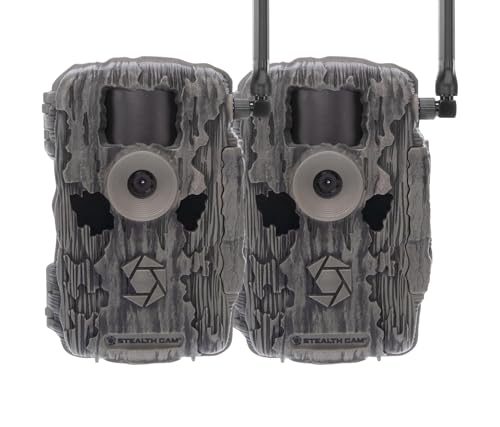
The Fusion X-Pro differs from the Sonix Pro by specifying 36MP photos, 720p video and a 0.4-second trigger speed. The maker says it has an 80-foot detection range, an adjustable PIR sensor and on-demand photo transmission. Its two-camera package is suited to monitoring separate sites, while dual SIM support is intended for AT&T or Verizon connectivity. Buyers who prioritize video detail should compare its 720p capture with the higher video resolution of other choices here; trigger speed and detection range are separate measures.
Bottom line: Choose it for a two-camera setup with specified trigger and detection figures.
Stealth Cam Fusion Max 2-Pack

The Fusion Max 2-Pack raises video resolution to 1080p compared with the Fusion X-Pro’s 720p, while retaining 36MP photo capture. The maker says its trigger speed is 0.35 seconds, with detection and infrared flash ranges of 80 feet; it also includes two pre-installed SIM cards for AT&T or Verizon. Quick Scan QR setup is another distinguishing feature. This package suits buyers who want higher stated video resolution in a two-camera cellular system. Its differentiator is not solar power, so consider the solar bundle if reducing battery-change trips is a priority.
Bottom line: Choose it when 1080p video and two-camera coverage matter most.
Stealth Cam Revolver PRO

The Revolver PRO is the only single-camera panoramic option here: its rotating system is designed to cover a full 360 degrees. The maker says it captures 40MP photos and 1440p QHD video with audio, with a 100-foot detection range and a 0.4-second trigger speed. It suits a location where broad surrounding coverage matters more than placing cameras at multiple separated sites. The limitation is physical: one rotating camera cannot cover two distant locations simultaneously, unlike the two-camera packages.
Bottom line: Pick it for one location where panoramic coverage is the priority.
Stealth Cam Fusion MAX 2-Pack Solar Bundle

The Fusion MAX bundle stands apart by including two solar panels and two tree mounts alongside its two 36MP, 720p cellular cameras. The maker says the panels are intended to keep the cameras powered without routine AA swaps; each camera has dual SIMs for AT&T or Verizon. This package suits buyers who can position the panels for sunlight and want to reduce battery-maintenance trips. Solar output depends on exposure and conditions, so buyers should not assume a shaded mounting spot will provide the same power as a sunny one.
Bottom line: Choose this bundle when solar panels and mounts are useful for both camera positions.
How to choose a cellular trail camera
Start with the number and spacing of locations, then compare image resolution and power approach. Two cameras cover two separated sites; a rotating panoramic unit covers a broad view from one mounting point, not two distant places. Photo megapixels and video resolution describe different outputs, so compare them only within their own category. Trigger speed measures the delay before capture, while detection range describes how far movement may be sensed; neither guarantees a usable image at that distance. For cellular models, confirm the carrier signal at the exact mounting spot before relying on remote delivery. Trees, terrain and building materials can affect reception, and moving a camera a short distance may change connectivity.
A practical rule: choose a multi-camera pack when your monitored sites are farther apart than one camera’s useful field of view.
Mounting and cellular signal
Mount trail cameras about 3 to 4 feet above ground for many wildlife-trail setups, then adjust for the target animal and terrain. Aim north when practical to reduce direct sunlight entering the lens; an east- or west-facing view can produce glare during sunrise or sunset. Clear moving branches from the detection zone, since heat or motion can trigger false captures. Cellular coverage must be checked where the camera will sit, not just at the nearest road or house. Keep cameras on property you are allowed to monitor, and avoid pointing them into neighboring private spaces. Check local rules before placing cameras on public land, since access and camera regulations can vary by jurisdiction.
Trail camera specifications that matter
Detection range, flash range and cellular transmission are three different limits. A camera may detect motion farther away than its infrared illumination can produce a clear night image, while network signal controls whether a capture can be sent remotely. Compare trigger speed when monitoring fast-moving animals, but remember that camera angle and placement also affect whether an animal crosses the sensor zone. For video, resolution is only one factor; frame rate and audio capability matter when supplied. The table below separates the principal coverage approaches represented by these options.
| Need | Camera approach | Decision point |
|---|---|---|
| Monitor separate locations | Two-camera pack | Choose when mounting sites are distinct |
| Cover around one point | Rotating panoramic camera | Choose when a single site needs broad direction coverage |
| Reduce battery visits | Solar bundle | Choose when panels can receive suitable sunlight |
Power and seasonal care
Cold weather reduces the usable capacity of many batteries, so check power more often during freezing conditions and after heavy capture periods. Solar panels need an unobstructed view of the sky; branches, deep shade and snow cover can reduce charging. Before mounting, test the camera at the intended height and angle, confirm the network connection, and review a sample day and night capture. Clean the lens and sensor window with a soft cloth, and secure the mount so wind does not shift the framing. Keep battery compartments sealed and inspect them for moisture or corrosion during routine visits. A cellular camera can still record locally when configured with a supported memory card, but remote access depends on network availability.
Frequently Asked Questions
How far above the ground should a trail camera be mounted?
A height of about 3 to 4 feet works for many wildlife-trail placements. Adjust higher or lower for the target animal, slope and expected direction of travel.
Does detection range equal infrared flash range?
No, detection range is the distance at which the sensor may notice movement, while flash range describes how far night illumination reaches. A detection claim of 80 feet does not by itself mean a clear night image at 80 feet.
Where should I point a trail camera to reduce glare?
A north-facing view is a useful default because it avoids most direct sunrise and sunset light entering the lens. If that direction is impractical, avoid aiming east or west when possible and clear branches that could move across the sensor.
How can I check cellular reception at a camera site?
Check reception at the precise mounting location before depending on remote delivery, because terrain and vegetation can make signal differ across a property. If the camera cannot connect there, try a nearby position with a clearer path to the network.
Do solar trail camera panels work in shaded locations?
Solar charging depends on exposure, so a panel in deep shade should not be expected to perform like one with direct sunlight. Keep the panel’s view of the sky clear and inspect it after snow or branch cover.