
Sonix Pro Stealth Cam: Models Compared by Fit

Stealth Cam Sonix Pro Max 2.0 2-Pack is the closest match for someone searching for a Sonix Pro Stealth Cam because it is the Sonix Pro Max 2.0 cellular trail camera combo with two cameras and app-triggered capture on demand. Choose Stealth Cam Fusion X-Pro 2-Pack or Stealth Cam Fusion Max 2-Pack instead if trigger speed, detection range, or video resolution matters more than the Sonix Pro name; Stealth Cam Spectre 4K Pro is a different Stealth Cam line with 4K video.
We earn a commission if you buy through links on this page. As an Amazon Associate I earn from qualifying purchases. Products are compared on manufacturer specifications, not hands-on testing.
- Best overall: Stealth Cam Sonix Pro Max 2.0 2-Pack – The Sonix Pro Max 2.0 is a cellular two-camera combo with on-demand photo and video capture through Command Pro.
- Best for video detail: Stealth Cam Fusion Max 2-Pack – It supports 1080p video and a 0.35-second trigger speed.
- Best for adjustable detection: Stealth Cam Fusion X-Pro 2-Pack – It pairs an 80-foot detection range with an adjustable PIR sensor.
| Product | Best for | Camera count | Trigger speed | Video resolution | Shop |
|---|---|---|---|---|---|
| Stealth Cam Sonix Pro Max 2.0 2-Pack | Two-site coverage | 2 cameras | — | — | Check Price on Amazon |
| Stealth Cam Fusion Max 2-Pack | Fast captures | 2 cameras | 0.35 sec | 1080p | Check Price on Amazon |
| Stealth Cam Fusion X-Pro 2-Pack | PIR adjustment | 2 cameras | 0.4 sec | 720p | Check Price on Amazon |
| Stealth Cam Spectre 4K Pro | 4K video | 1 camera | 0.3 sec | 4K at 30 fps | Check Price on Amazon |
Sonix Pro Stealth Cam Options
Compare the Sonix Pro bundle with nearby Stealth Cam cellular models by coverage and capture specifications.
Stealth Cam Sonix Pro Max 2.0 2-Pack

The Sonix Pro Max 2.0 is the direct fit for this search, and its defining difference is a two-camera cellular bundle. The maker says Command Pro can trigger real-time photos or HD video on demand, which suits scouting multiple stand locations, travel corridors, or food plots without entering the area. The two units let a buyer cover separate locations, but the camera information gives no trigger-speed or detection-range figure for comparing capture performance with the other models. Choose this bundle when Sonix Pro identity and multi-location coverage matter more than a specific speed or range target.
Bottom line: Pick this when the Sonix Pro name and two-camera coverage are the priorities.
Stealth Cam Fusion Max 2-Pack

The Fusion Max stands out from the Sonix Pro bundle with a 0.35-second trigger and 1080p video. The maker also gives it an 80-foot detection and infrared flash range, plus a burst mode of one to six images per trigger. Two pre-installed SIM cards connect to AT&T or Verizon, and QR-code setup is intended to simplify setup. It is a useful alternative for buyers prioritizing capture speed and video detail, but it is a Fusion Max rather than a Sonix Pro model. Its SIM/network fit matters where cellular coverage is weak.
Bottom line: Choose this if a 0.35-second trigger and 1080p video matter most.
Stealth Cam Fusion X-Pro 2-Pack
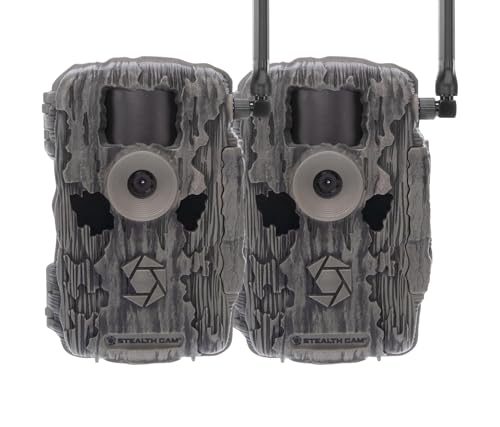
The Fusion X-Pro distinguishes itself with an adjustable PIR sensor and an 80-foot detection range, unlike the Sonix Pro bundle’s emphasis on on-demand Command Pro capture. It records 36MP photos and 720p HD video, with a 0.4-second trigger and one to two images per burst. Dual SIM support is described for AT&T and Verizon, and the camera accepts SD cards up to 32 GB; the card is sold separately. This two-camera cellular pack fits buyers who want to tune detection behavior, though its 720p video is lower resolution than the Fusion Max’s 1080p.
Bottom line: Pick this for adjustable PIR detection and a two-camera cellular setup.
Stealth Cam Spectre 4K Pro

The Spectre 4K Pro is the most distinct alternative: it is a single cellular camera with dual-core processing and dual camera sensors, rather than a two-camera Sonix Pro bundle. Its 0.3-second trigger and 100-foot wildlife detection range suit buyers seeking a fast single-camera unit with on-demand monitoring.
Bottom line: Choose this for a single camera with 4K video and live monitoring.
Choosing a cellular trail camera by coverage
Start with the number of locations you need to watch: a two-camera pack can cover two separate sites, while a single unit is enough for one focal point. Trigger speed, detection range, and burst count describe different things: speed is the delay before capture, range is the detection distance, and burst count is the number of frames per trigger. Among these options, stated trigger speeds span 0.3 to 0.4 seconds and detection ranges span 80 to 100 feet, where provided. For a tight travel corridor where a fast-moving animal may cross the sensor quickly, favor a model with a trigger at or below 0.4 seconds. For broader placements, prioritize the detection range and confirm cellular signal at each location.
Image resolution and video format
Photo megapixels and video resolution are separate specifications, so a higher photo number does not automatically mean sharper video. Higher-resolution video creates larger files and can use more storage or data, making clip length and upload settings relevant as well as resolution. Choose 720p when basic motion clips are sufficient; consider 1080p or 4K when finer detail is the priority. Compare the sensor and resolution claim carefully: the Spectre’s model name says 56MP while its maker says 40MP.
Cellular setup and storage basics
Cellular cameras send captures over a carrier connection, so carrier support alone does not guarantee signal at a wooded camera site. The Fusion models specify AT&T and Verizon SIM support; check coverage at the exact mounting location before relying on remote capture. A practical setup is to test the camera near the intended site, then mount it only after confirming signal and capture behavior. Keep the lens and sensor window clear, and use the camera’s PIR-zone controls where available to reduce triggers from vegetation.
Mounting and detection placement
Placement determines what the sensor can see: mount the camera aimed across a trail rather than directly down it when animals are likely to approach along the path. Aiming across the path gives movement through the detection area rather than a direct approach, helping the camera register a crossing. Avoid pointing at moving branches, tall grass, or sunlit backgrounds that can trigger a passive infrared sensor as temperatures change. The Spectre lists adjustable PIR zones, and the Fusion X-Pro has an adjustable PIR sensor; use those controls to narrow the monitored area when the field of view includes brush. Leave adequate clearance for the flash and lens, and secure the camera to a stable tree or post to keep framing consistent.
Frequently Asked Questions
How far can a cellular trail camera detect movement?
The Fusion X-Pro and Fusion Max specify 80 feet, while the Spectre 4K Pro gives a 100-foot wildlife detection range. Actual detection depends on sensor angle, target movement, temperature contrast, and vegetation between the camera and trail.
What does a 0.4-second trigger speed mean?
A 0.4-second trigger is the delay between the camera detecting movement and taking a picture. For animals crossing quickly, a trigger at or below 0.4 seconds can reduce the chance that the subject leaves the frame before capture.
Can a trail camera work without cellular service?
Cellular transmission requires a supported carrier signal where the camera is mounted. The Fusion X-Pro also supports an SD card up to 32 GB, so local storage can retain captures even when transmission is not the main workflow.
Is 4K video better than 1080p for trail footage?
4K records more image detail than 1080p when the subject and camera are properly framed, but it also creates larger files. Choose 4K when detail is the priority; 1080p is a more moderate resolution for routine clips.
How should I aim a trail camera at a path?
Aim across the path so passing movement crosses the sensor field, rather than pointing straight down the trail. Keep moving branches and tall grass out of the detection zone to limit unwanted triggers.