
Stage 2 Cam for 5.3 Vortec: 5 Kits Compared

BTR Stage 2 Truck Cam Install Kit suits most 5.3 Vortec owners who want a stage 2 truck cam and stock-converter compatibility, with lifters, trays and gaskets included. Choose Sloppy Mechanics Stage 2 Cam Kit instead if a choppy idle matters more and you can accommodate its suggested higher-stall converter for an automatic.
A stage 2 cam changes valve timing and lift; the label is not a standardized performance grade, so compare the actual cam specifications and included parts.
We earn a commission if you buy through links on this page. As an Amazon Associate I earn from qualifying purchases. Products are compared on manufacturer specifications, not hands-on testing.
- Best overall: BTR Stage 2 Truck Cam Install Kit – The maker describes it as working well with stock converters, and the kit includes lifters, trays and gaskets.
- Best for a lopey idle: Sloppy Mechanics Stage 2 Cam Kit – Its 228/230-degree duration and .585-inch lift are paired with an explicitly lopey idle character.
- Best for a complete parts package: E1840P Sloppy Mechanics Stage 2 Kit – The kit includes cam, lifters and trays, springs, pushrods, gaskets, seals and a crank bolt.
| Product | Best for | Duration at .050 in. | Valve lift | Included parts | Shop |
|---|---|---|---|---|---|
| BTR Stage 2 Truck Cam Install Kit | Stock converters | 208/21X degrees | .549 in. | Cam, gaskets, lifters, trays | Check Price on Amazon |
| E1840P Sloppy Mechanics Stage 2 Kit | Full component kit | 228/230 degrees | .585 in. | Cam, lifters, trays, springs, pushrods | Check Price on Amazon |
| Sloppy Mechanics Stage 2 Cam Kit | Choppy idle | 228/230 degrees | .585 in. | Cam, springs, seals, pushrods | Check Price on Amazon |
| E1840P Stage 2 Cam Kit | Stock-converter drivability | 212/22X degrees | .552 in. | Cam, pushrods, springs, seals, gaskets | Check Price on Amazon |
| Stage 2 Cam Kit with .560-Lift Beehive Springs | Street and towing | 214/222 degrees | .550 in. | Cam, .560-lift springs, seals, pushrods | Check Price on Amazon |
Stage 2 Cam Kits for 5.3 Vortec
Compare the cam profiles and included components before choosing a kit for your engine and converter.
BTR Stage 2 Truck Cam Install Kit

BTR Stage 2 Truck Cam Install Kit is the stock-converter-oriented option among these kits: Brian Tooley Racing says the cam works well with stock converters. Its profile is 208/21X degrees, .549-inch lift and 108.5-degree lobe separation, with a three-bolt pattern. The package combines the cam with LS1 head gaskets, Delphi LS7 lifters and guide trays, making it a fit for a buyer replacing several valvetrain components at once. The limitation is that the exhaust duration is given only as “21X,” so compare the exact cam card before selecting it for a tightly planned build.
Bottom line: Pick this if stock-converter use and included lifters, trays and gaskets are priorities.
E1840P Sloppy Mechanics Stage 2 Kit
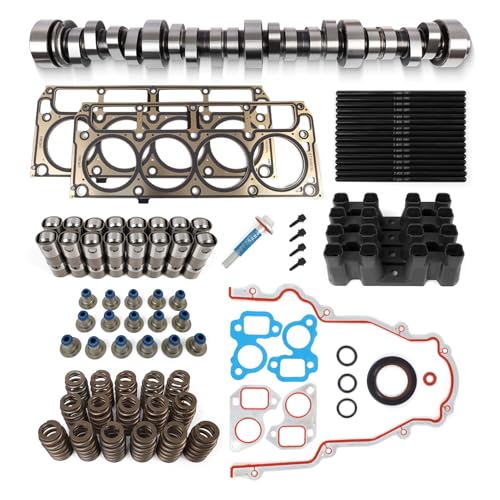
E1840P Sloppy Mechanics Stage 2 Kit stands out for the breadth of the package: it includes LS7 lifters with trays and bolts, beehive springs, 7.400-inch chromoly pushrods, LS1 head gaskets, valve seals, a timing cover gasket set and a crank bolt. The cam is a hydraulic roller with 228/230 degrees duration at .050 inch, .585-inch lift, 112-degree lobe separation and a 2,200–5,400-rpm range. That combination is aimed at a buyer seeking a coordinated parts bundle rather than a mild stock-converter-oriented profile. Confirm that the included pushrod length and three-bolt cam arrangement match the build before assembly.
Bottom line: Choose this when you want the broadest set of installation components in one kit.
Sloppy Mechanics Stage 2 Cam Kit

Sloppy Mechanics Stage 2 Cam Kit is the most clearly identified choice for a deliberately lopey idle: the maker describes its profile that way and calls it fairly aggressive. It has 228/230 degrees duration at .050 inch, .585-inch lift and a 112-degree lobe separation. The kit combines the cam with PAC Racing 1218 springs, chromoly pushrods and hat-style seals, and the fit range includes 4.8L through 6.2L Gen 3/4 LS engines. The tradeoff for an automatic is important: the maker says best performance comes with a 2,600–2,800-rpm stall converter, so it is not the natural pick for someone keeping a stock converter.
Bottom line: Pick this for the specified aggressive idle if your automatic can use the recommended converter.
E1840P Stage 2 Cam Kit
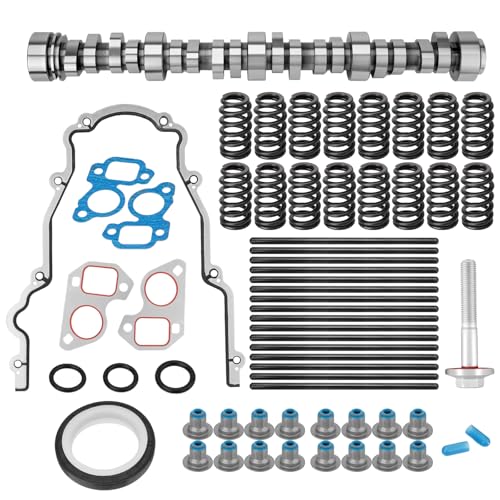
E1840P Stage 2 Cam Kit pairs .552-inch lift with a 107-degree lobe separation and a three-bolt pattern; its intake duration is 212 degrees, while exhaust duration is given as “22X.” The package includes 16 pushrods, 16 springs, 16 seals and a gasket kit, but does not list lifters among its included components. The maker says it is intended to improve responsiveness and torque while retaining smooth drivability with stock converters. That makes it a reasonable comparison point for a street-oriented build, but buyers assembling a full valvetrain should account for lifters separately and verify the precise exhaust-duration figure before comparing it to other cam cards.
Bottom line: Choose this if stock-converter drivability is a priority and you have lifters covered.
Stage 2 Cam Kit with .560-Lift Beehive Springs
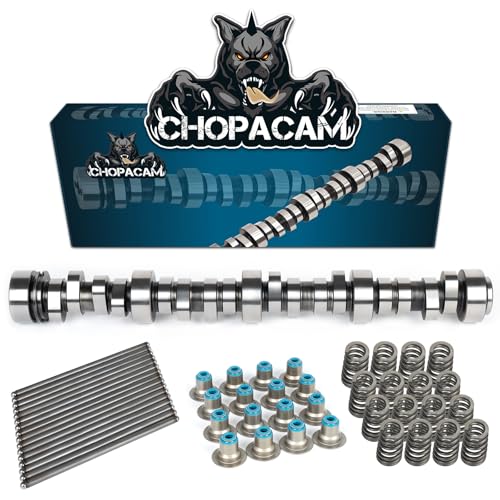
Stage 2 Cam Kit with .560-Lift Beehive Springs is the kit here that explicitly names towing, street performance and off-road use among its intended applications. It lists 214/222 degrees duration, .550-inch cam lift, a 108-degree lobe separation and a 106-degree intake centerline; the package includes .560-lift beehive springs, valve seals and 7.400-inch replacement pushrods. The maker claims an output increase, but that claim should not be treated as a guaranteed result for every engine combination. This package may suit a buyer who needs springs and pushrods alongside the cam. Its fit spans multiple LS sizes, so confirm the engine generation and any vehicle-specific fit requirements.
Bottom line: Pick this for a street or towing build when the included springs and pushrods suit your setup.
How to compare stage 2 cam specifications
Compare duration at .050 inch, valve lift and lobe separation angle rather than relying on the “stage 2” label, which has no universal definition. Duration describes how long a valve is open at the checking height; more duration generally shifts the useful power band upward and can make idle quality less smooth. Lift is the valve’s maximum opening distance, but higher lift also makes spring clearance and valvetrain geometry more important. Lobe separation changes overlap and idle behavior alongside duration and installation centerline. A RPM range is a maker’s intended range, not a promise that every 5.3 will make power across it.
Match the cam to the converter and driving use
Match the cam profile to the torque converter, gearing and driving pattern; the most aggressive idle is not automatically the best street choice. A tighter, longer-duration profile can reduce low-speed manners, while a higher-stall converter can help an automatic leave from a stop in a useful part of its power band. In these choices, one kit explicitly calls out stock converters and another specifies 2,600–2,800 rpm stall for best automatic performance. Those are maker recommendations for those particular profiles, not universal converter rules. If the truck regularly tows at low speed, prioritize the maker’s street or towing intent and check how the cam’s RPM range relates to the engine’s working range. Manual-transmission builds do not use a torque converter.
Check 5.3 Vortec fit before ordering
Confirm the engine generation, cam gear attachment and variable valve timing arrangement before choosing a cam kit. “5.3 Vortec” covers engines across different model years and configurations, while the kits generally identify Gen 3/4 or 1999–2013 fit; shared displacement alone does not prove every part is interchangeable. Cam gear attachment matters because these kits call out a three-bolt pattern. Variable valve timing also changes the cam and front-cover requirements: one kit warns that VVT-equipped engines need additional components. For a build with under 4 inches of clearance at the retainer or other tight valvetrain packaging, do not assume a spring kit is compatible from its advertised lift rating alone; verify assembled spring height and coil-bind clearance with the cam and retainers being used.
Plan the cam swap and valvetrain checks
A cam swap is a valvetrain job, not just a camshaft replacement: lifters, trays, springs, seals, pushrods, gaskets and timing components may all affect the parts plan. Compare each package against the parts your engine actually needs, since kits here vary from cam-and-lifter bundles to spring-and-pushrod sets. Before startup, verify valve-spring coil-bind and retainer-to-seal clearance, pushrod length, lifter preload and piston-to-valve clearance for the assembled combination; cam lift by itself cannot confirm safe clearance. Use the cam manufacturer’s installation centerline and degree the cam rather than relying only on timing-mark alignment. A performance cam also generally requires engine calibration changes, so plan for tuning rather than expecting stock engine management to account for different airflow and valve timing.
Frequently Asked Questions
Does a stage 2 cam fit every 5.3 Vortec engine?
No; a 5.3L displacement match alone does not establish fit across engine generations and equipment. Verify the engine generation, cam gear pattern and whether the engine has VVT before choosing a kit.
Will a stage 2 cam work with a stock converter?
Some profiles are described for stock-converter use, while more aggressive profiles can call for a higher-stall converter. One cam in these choices recommends 2,600–2,800 rpm stall for best automatic performance.
What does 108-degree lobe separation mean for idle?
Lobe separation is the angle between the intake and exhaust lobe centerlines, and it affects valve overlap when considered with duration and installed centerline. A 108-degree figure alone cannot predict idle quality without the rest of the cam profile and engine combination.
Does a cam swap need an engine tune?
Plan on calibration changes after a cam swap because altered valve timing changes airflow and engine behavior. The needed calibration depends on the cam, engine hardware and vehicle controls.
How do I know the springs clear the cam lift?
The spring’s lift rating is only one check; assembled spring height, coil-bind clearance and retainer-to-seal clearance also matter. Verify those clearances with the actual cam, springs, retainers and seals before running the engine.