
Stair Helper for Seniors: Cane and Walker Options

For stair use, the NORTTA stair climbing walker is the most clearly specified option here for users who need adjustable legs and up to 300 pounds of support. Choose a stair assist cane instead if a cane-style aid suits your mobility and you can follow its specific use requirements.
These products are different types of mobility aids, so match the device to your stair technique and ability rather than choosing by adjustability alone.
We earn a commission if you buy through links on this page. As an Amazon Associate I earn from qualifying purchases. Products are compared on manufacturer specifications, not hands-on testing.
- Best overall: NORTTA Foldable Stair Climbing Walker – The wheel-free walker has height-adjustable legs and a 300-pound capacity.
- Best for handrail users: 20-Level Assist Cane with Stabilizing Feet – Its safety instructions require use with a fixed household handrail and warn against putting full body weight on the cane.
| Product | Best for | Type | Height adjustment | Weight capacity | Shop |
|---|---|---|---|---|---|
| NORTTA Foldable Stair Climbing Walker | Adjustable leg support | Wheel-free walker | Height adjusts | 300 lb | Check Price on Amazon |
| 20-Level Assist Cane with Stabilizing Feet | Fixed-handrail users | Assist cane | 20 levels | — | Check Price on Amazon |
| 20-Level Stair Climbing Assist Cane | Portable cane support | Assist cane | 20 levels | — | Check Price on Amazon |
| ZczCjWq 13-Level Stair Assist Cane | Higher stated capacity | Assist cane | 13 levels | 300 lb | Check Price on Amazon |
Stair Helpers for Seniors Compared
Compare the support style and stated limits before choosing a stair aid for your home.
NORTTA Foldable Stair Climbing Walker

The NORTTA is the only walker in this group, with four height-adjustable legs and no wheels. Its aluminum-alloy frame weighs 6.2 pounds, supports up to 300 pounds and arrives ready to use without assembly. The maker says the legs adjust to different heights for stairs and that the walker can be used on carpet, tile, hardwood and uneven ground. It may suit someone who needs a walker-style frame rather than a single cane, but its 22.8-inch length and 17.7-inch width mean the user must have room to position it on each step.
Bottom line: Choose this if you need a wheel-free walker frame with height-adjustable legs and fit the weight limit.
20-Level Assist Cane with Stabilizing Feet

The first 20-level cane stands out for its explicit requirement to pair the aid with a fixed household stair handrail. The maker says its carbon-steel frame has an anti-rust coating, an anti-slip foam handle and four rubber feet; the cane weighs 4.5 pounds and measures 45 inches high, 13 inches long and 13 inches wide. The safety limit matters: users must not lean their full body weight entirely on this cane. It is suitable only for someone able to use the handrail and follow that restriction, not as a substitute for a handrail.
Bottom line: Choose this only if you can use a fixed stair handrail and will not place your full body weight on the cane.
20-Level Stair Climbing Assist Cane
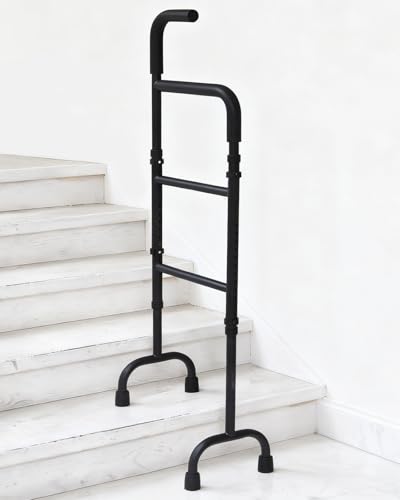
The second 20-level assist cane is presented as portable and freestanding, unlike the first cane’s requirement to use a fixed handrail. It weighs 4.5 pounds and measures 35 inches high, 13 inches long and 13 inches wide. The maker says it requires assembly and includes instructions and hardware; for severe mobility impairments, a caregiver or health professional should be present for initial use until the user is accustomed to it.
Bottom line: Choose this if you want a portable cane-style aid and can arrange the recommended assisted initial use.
ZczCjWq 13-Level Stair Assist Cane
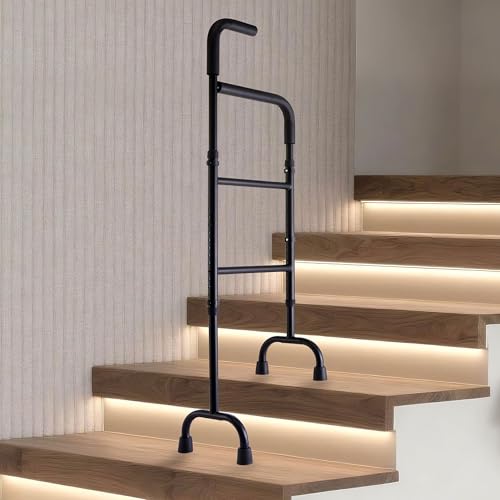
The ZczCjWq cane is the only cane here with a 300-pound capacity. Its carbon-steel frame has an anti-rust coating, and the maker says rubber tips grip wood, tile and carpet; the product also has a reinforced plastic sleeve that should not be removed. The maker gives a 45-inch length and 4.5-pound weight. It suits buyers who prioritize a capacity and 13 adjustment settings, but the other dimensions appear to contain inconsistent units, so verify the intended size before choosing it for a particular stair setup.
Bottom line: Choose this if its 300-pound stated capacity fits your needs and you confirm the size works for your stairs.
How to choose a stair helper for seniors
Choose by the way the aid supports you: a cane gives a single support point, a walker uses a frame, and a half-step aid changes the rise you negotiate. A standard stair riser is commonly about 7 to 7.75 inches high, so a device must be positioned and used for each step rather than treated as a continuous ramp. A cane that requires a fixed handrail cannot replace that rail or safely take full body weight if its instructions prohibit it. If you cannot keep one hand on the rail while managing the device, ask a physical therapist or occupational therapist to assess the stair routine before using a cane-style aid.
Check stair fit and adjustment
Measure the clear tread depth and the height of several consecutive risers; older homes can have uneven steps, and a device that works on one step may not sit correctly on the next. Place mobility aids fully on a tread, not partly over the edge, and keep rubber feet clean and intact because dust, water and worn tips can reduce grip. A useful rule is to avoid any cane or platform whose base cannot sit flat within the stair tread; do not compensate by leaning harder. For a walker, also check that its frame can be turned and set down without striking the wall or handrail.
The following distinctions help narrow the style before measuring a specific staircase.
| Need | Device style | Key check |
|---|---|---|
| Frame support | Wheel-free stair walker | Foot placement and frame clearance |
| Handrail plus extra support | Assist cane | Handrail access and safe cane placement |
| Lower effective step rise | Half-step platform aid | Platform sits securely on each tread |
Use stair aids with fall safety in mind
Stairs are a high-consequence place to lose balance, so use the handrail whenever one is available and avoid carrying objects that occupy the hand needed for support. A cane-style stair aid is not automatically a stair lift, and a device’s multiple feet do not make it appropriate to bear unlimited body weight. The first cane specifically warns against full-weight loading and requires a fixed handrail; treat that instruction as a firm use limit. Do not use a stair aid on wet or loose surfaces, and stop if the frame rocks, a pin is not locked, or a rubber foot is damaged.
Set up and maintain a stair helper
Before each stair use, inspect the frame, adjustment pins, fasteners and rubber contact points; a pin that is only partly engaged can let a leg shift under load. Assemble a kit fully before use and test the aid on level ground first, then have a caregiver present for initial stair practice if balance or mobility is significantly limited. Replace worn or cracked rubber feet rather than trying to restore grip with tape. For a device with adjustable legs, make height changes only when it is unloaded and recheck each lock before moving to the next step.
Frequently Asked Questions
Can a stair assist cane replace a handrail?
No, a cane should not be treated as a replacement for a fixed stair handrail. One model here explicitly requires handrail use and warns users not to put full body weight on the cane.
How high is a typical stair step?
A typical residential stair riser is roughly 7 to 7.75 inches high. Measure several steps, since uneven risers can affect where a device sits.
How often should stair cane rubber feet be checked?
Check the rubber feet before each stair session for cracks, looseness or a smooth worn surface. Replace a damaged tip before use because compromised tread can slip on a stair.