
StaySafe Fire Extinguisher: 5 Options Compared

For most buyers seeking a StaySafe fire extinguisher, LifeSafe StaySafe All-in-1, 3-Pack is the clearest choice because it is the All-in-1 spray offered as a 3-pack and is made for 10 fire types. Choose a different option if you want a lithium-battery-specific spray, a different brand, or a conventional dry-chemical extinguisher.
Fire sprays and rated extinguishers are not interchangeable by default: confirm that the product’s fire rating and approval suit the hazards and location you need to cover.
We earn a commission if you buy through links on this page. As an Amazon Associate I earn from qualifying purchases. Products are compared on manufacturer specifications, not hands-on testing.
- Best overall: LifeSafe StaySafe All-in-1, 3-Pack – The StaySafe All-in-1 is offered as a 3-pack and is made for 10 fire types.
- Best for lithium batteries: StaySafe Lithium Fire Spray – This StaySafe spray focuses on lithium-ion battery fires and specifies use from at least 1 meter away.
- Best for rated household coverage: Kidde Basic 110, 2.5 lb – The Kidde is a dry-chemical extinguisher with a 1-A:10-B:C rating and 2.5 pounds of agent.
| Product | Best for | Fire coverage | Format | Pack or size | Shop |
|---|---|---|---|---|---|
| LifeSafe StaySafe All-in-1, 3-Pack | Multi-area coverage | 10 fire types | Liquid spray | 3-pack | Check Price on Amazon |
| StaySafe All-in-1 Spray, Red | Single spray option | 10 fire types | Liquid spray | Single unit | Check Price on Amazon |
| StaySafe Lithium Fire Spray | Lithium battery focus | Lithium-ion battery fires | Liquid spray | — | Check Price on Amazon |
| AmzBoom Fire Extinguisher Spray, 2-Pack | Bracket-mounted placement | 8 fire types | Water-based spray | 2-pack | Check Price on Amazon |
| Kidde Basic 110, 2.5 lb | Rated household fires | 1-A:10-B:C | Dry chemical | 2.5 lb agent | Check Price on Amazon |
StaySafe Fire Extinguishers and Alternatives
Compare each option’s intended fire coverage and format before deciding what belongs in your home, vehicle, or other space.
LifeSafe StaySafe All-in-1, 3-Pack

The 3-pack is the main distinction: it gives buyers three StaySafe All-in-1 units rather than a single spray. LifeSafe says the formula is intended for electrical fires up to 1,000 volts, including lithium-ion battery fires, as well as cooking oil, textiles, petrol/diesel, paper/card, motor oil and bio-ethanol fires. The maker also describes it as non-toxic and eco-friendly with no toxic residue. It suits buyers who want the same broad-coverage spray in several locations.
Bottom line: Choose this if you want three all-in-one sprays for separate locations.
StaySafe All-in-1 Spray, Red
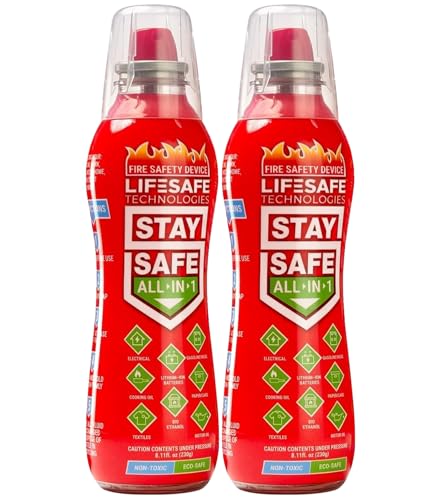
This StaySafe All-in-1 option is a single spray rather than the 3-pack in LifeSafe StaySafe All-in-1, 3-Pack. LifeSafe says it covers electrical fires up to 1,000 volts, including lithium-ion battery fires, along with cooking oil, textiles, petrol/diesel, paper/card, motor oil and bio-ethanol. Its described operating steps are to remove the cap, point at the fire and spray until discharged. That simple format may suit someone who needs one unit for a chosen spot.
Bottom line: Choose this if one StaySafe All-in-1 spray fits your intended location.
StaySafe Lithium Fire Spray

The StaySafe Lithium spray narrows its focus to flames from lithium-ion batteries in devices such as phones, laptops and power banks, unlike the broader All-in-1 sprays. LifeSafe says it is formulated for electrical fires up to 1,000 volts and specifies a minimum distance of 1 meter. The use is to remove the cap, point at the fire and spray until the unit is discharged. This option suits buyers looking specifically for a battery-fire spray. Its fields do not establish broad coverage for cooking oil, paper or other household fire types, so it should not be treated as a substitute for an extinguisher matched to those hazards.
Bottom line: Choose this for a specifically lithium-battery-focused spray, not broad household coverage.
AmzBoom Fire Extinguisher Spray, 2-Pack

The AmzBoom option comes as a 2-pack with two mounting brackets, a practical difference from the StaySafe sprays. Its maker describes an 8-in-1 water-based formula for fires including wood, cooking oils, gasoline and lithium-ion batteries, with a protective barrier intended to help prevent reignition. The maker also describes it as non-toxic and residue-free. This may suit buyers who want bracket-mounted sprays for multiple spots.
Bottom line: Choose this if two bracket-mounted sprays suit your placement plan.
Kidde Basic 110, 2.5 lb

The Kidde differs from the sprays by using dry chemical and giving a specific 1-A:10-B:C rating. It contains 2.5 pounds of extinguishing agent, has an all-metal construction and a pressure indicator; the maker describes it as residential, single-use and designed for 12 years without service. The rating identifies coverage for ordinary combustibles, flammable liquids and energized electrical equipment, making it a defined option for common household fire risks. It is not presented as lithium-ion-specific, and the single-use design means it is replaced after discharge. Buyers seeking a light, multi-fire-type spray should compare formats and intended hazards rather than equating this rating with spray claims.
Bottom line: Choose this if you want a conventional dry-chemical unit with a household rating.
How to choose a fire extinguisher by fire class
Match the extinguisher’s class rating to the material that could burn, not just to the room where it sits. Class A covers ordinary combustibles such as wood and paper; Class B covers flammable liquids; and Class C applies while electrical equipment is energized. Class K addresses cooking oils and fats in commercial kitchens. A multipurpose ABC extinguisher covers A, B and C hazards, but that label does not automatically mean it is appropriate for every battery fire or commercial cooking setup.
For a home, a unit marked 1-A:10-B:C provides a more interpretable rating than a general count of fire types. A spray that names several fuels may still have different capacity, discharge time and approval status. Compare the actual rating and the hazard list, and confirm any voltage limit or minimum operating distance that matters to the intended use.
Where to place a home fire extinguisher
Place an extinguisher where it is accessible on the way out, not where a fire could trap you between the unit and an exit. NFPA guidance commonly recommends at least one extinguisher on each level of a home and one near (but not directly beside) cooking areas; keep it away from the stove so a flare-up does not block access. A garage may need its own unit if it contains fuel, paints or powered equipment.
Mounting height depends on unit weight and local rules; many household units are wall-mounted with the carrying handle no higher than about 5 feet for lighter extinguishers, while heavier units use a lower limit. Keep the pressure gauge visible where present, and make sure the mounting spot is reachable without moving stored items. An extinguisher is a backup, not a reason to stay in a room with a growing fire.
How to use an extinguisher without delaying escape
Use an extinguisher only on a small, contained fire with a clear exit behind you. The familiar PASS sequence is pull the pin, aim at the fire’s base, squeeze the lever and sweep side to side; follow the device’s actual activation design if it is a spray without that lever. Keep a safe distance and retreat if the fire grows, smoke thickens or the first attempt does not work quickly.
Call 911 when a fire is beyond an early, contained stage, and evacuate people and pets rather than trying to fight it. Never use water on energized electrical equipment or burning cooking oil. Lithium-ion battery fires can reignite after visible flames diminish, so move away and get emergency help if a battery is smoking, heating or burning.
Fire extinguisher types and tradeoffs
Conventional dry-chemical extinguishers often have a clear A:B:C rating, while compact sprays may emphasize a broader list of targeted fire types and easier point-and-spray operation. Neither format alone proves suitability: compare rating, fire hazard, placement and the maker’s operating limits. For electrical equipment, confirm whether the manufacturer specifies an energized-voltage limit; for battery fires, look for a clear lithium-ion indication rather than assuming all electrical-fire coverage is equivalent.
The table distinguishes the types represented here. “—” means the specifications do not provide the attribute; it is not a claim that the product lacks that feature.
| Type | Typical point of comparison | Good fit when |
|---|---|---|
| Dry-chemical ABC extinguisher | Class rating such as 1-A:10-B:C | You want a conventional rated unit for common household hazards |
| Multi-fire-type spray | Named fire types and any voltage limit | You want compact spray operation and confirmed coverage for your hazards |
| Lithium-focused spray | Battery-specific claims and minimum distance | Lithium-ion devices are the particular concern |
Frequently Asked Questions
What does a 1-A:10-B:C rating mean?
A 1-A:10-B:C rating identifies an extinguisher’s performance for ordinary combustibles, flammable liquids and energized electrical equipment. The numbers express relative extinguishing capacity within the A and B classes; Class C is a suitability designation for energized electrical fires, not a numeric capacity.
Can a fire extinguisher spray be used on lithium batteries?
Only use a product whose maker specifically identifies lithium-ion battery fires in its intended coverage. A lithium-focused spray here specifies a minimum distance of 1 meter, but a battery that is heating, smoking or burning can reignite, so evacuate and call emergency services rather than approaching an uncontrolled fire.
How many extinguishers should a home have?
A common NFPA recommendation is at least one extinguisher on each level of a home, with one near the kitchen and additional coverage where garage hazards warrant it. Placement matters as much as count: keep each unit reachable along an exit route and away from the fire hazard itself.
How often should a home fire extinguisher be checked?
Check a home extinguisher monthly for a readable label, accessible location, damage and a charged pressure gauge when it has one. Follow the manufacturer’s inspection schedule, and replace or service a unit that is discharged, damaged or outside its service life.
When should you avoid using an extinguisher?
Do not try to extinguish a fire that is spreading, producing heavy smoke or blocking your exit. Leave immediately and call 911; for burning cooking oil or energized equipment, never use water.