
Super Lubricants for Car Max Power: 3 Options Compared

For automotive maintenance, Super Lube 92003 Silicone Grease is the best fit for a small amount of multipurpose grease, while Super Lube Silicone Grease 92016 provides the same grease in a larger canister. These are specialty lubricants, not substitutes for engine oil; choose by the component and lubricant form it requires.
We earn a commission if you buy through links on this page. As an Amazon Associate I earn from qualifying purchases. Products are compared on manufacturer specifications, not hands-on testing.
- Best overall: Super Lube 92003 Silicone Grease – The 3 oz tube packages silicone grease for automotive maintenance and sealing jobs.
- Best for larger jobs: Super Lube Silicone Grease 92016 – It has the same silicone grease in a 14.1 oz canister.
- Best for small oiling jobs: Super Lube 51010 Synthetic Oil – The synthetic oil is rated for temperatures from -40°F to 450°F.
| Product | Best for | Form | Package size | Shop |
|---|---|---|---|---|
| Super Lube 92003 Silicone Grease | Small grease jobs | Silicone grease | 3 oz tube | Check Price on Amazon |
| Super Lube Silicone Grease 92016 | Larger grease jobs | Silicone grease | 14.1 oz canister | Check Price on Amazon |
| Super Lube 51010 Synthetic Oil | Small oiling jobs | Synthetic oil | 0.25 fl oz | Check Price on Amazon |
Super Lube Automotive Lubricants
Match grease or oil to the component’s lubrication requirement rather than choosing by the word “automotive” alone.
Super Lube 92003 Silicone Grease

For a compact grease package, Super Lube 92003 Silicone Grease comes in a 3 oz tube; Super Lube Silicone Grease 92016 offers the same silicone grease in a larger canister. The synthetic formula contains Syncolon and is intended for automotive and industrial lubrication, including O-rings, bearings, control cables, and locks. The maker says it resists water washout and meets NSF H1 food-grade registration. This is grease, not a pourable oil or engine lubricant, so it suits parts whose maintenance requirements call for grease. Its small tube may be limiting when servicing several components or doing repeated maintenance.
Bottom line: Choose this for occasional or small-volume grease applications.
Super Lube Silicone Grease 92016
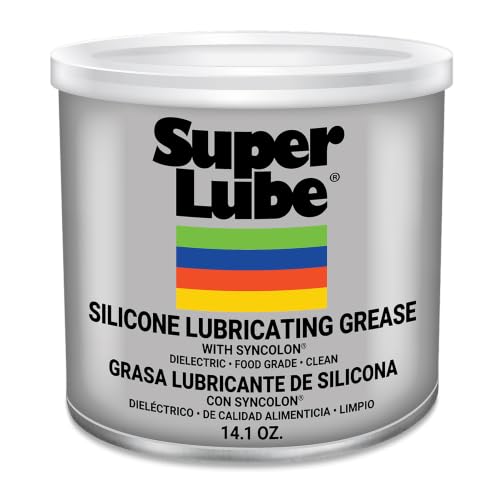
The 14.1 oz canister makes Super Lube Silicone Grease 92016 the larger-package choice compared with the 3 oz tube of Super Lube 92003 Silicone Grease. It contains silicone lubricating grease with Syncolon for automotive and industrial applications, including bearings, O-rings, control cables, and locks. The maker says the formula resists water washout and meets NSF H1 food-grade registration. Grease is appropriate only where the component calls for that form; it is not a replacement for engine oil or other specified fluids. The canister is less suited to a buyer who needs only a small amount or a narrow-tip application.
Bottom line: Choose this when the job calls for more of the same silicone grease.
Super Lube 51010 Synthetic Oil

Unlike the grease in Super Lube 92003 Silicone Grease and Super Lube Silicone Grease 92016, Super Lube 51010 Synthetic Oil is a high-viscosity synthetic oil in a 0.25 fl oz package, aimed at machine maintenance and applications such as 3D printers. The maker says it is NSF-rated and food grade, resists water washout, and operates from -40°F to 450°F. Those claims do not establish suitability for a car’s engine, transmission, or any particular component; use it only where the vehicle or equipment specification calls for this oil. The very small package is a limitation for jobs requiring more than spot lubrication.
Bottom line: Choose this for a small oiling task that calls for this type of synthetic oil.
How to choose a car lubricant
Start with the component’s required lubricant form: engine oil, gear oil, grease, and general-purpose spray are not interchangeable. Grease stays in place and is used where a fitting or part is designed for grease; oil flows and is used where a component calls for oil. Check the vehicle manual or component label for the required fluid type and specification before applying anything. A lubricant’s automotive-use claim alone does not establish compatibility with every car system. If the job is routine engine service, select the specified engine oil rather than a specialty grease or machine oil.
Grease versus oil for automotive maintenance
Grease combines a base oil with a thickener so it can remain on a surface; oil is thinner and circulates or flows through passages. A grease’s thickener type matters: silicone grease and conventional chassis grease are different formulations, so do not assume they can be substituted. The products here include silicone grease and a small-format synthetic oil, not a motor-oil grade. Match the lubricant to the part’s service requirement, and do not use these products as engine oil without explicit vehicle approval. A practical rule: if the manual specifies an oil viscosity grade or fluid standard, use a product meeting that exact specification instead of a general-purpose lubricant.
Application and compatibility checks
Before applying a lubricant, identify the surface materials and the part’s service instructions; seals, plastics, and bearings can have different compatibility needs. Apply only enough lubricant to cover the intended contact area, since excess grease can collect dirt or interfere with movement. Keep lubricants away from brake friction surfaces, tires, and hot exhaust components, where contamination or heat can create a safety problem. Clean the part before application so grit is not trapped against moving surfaces. For vehicle systems with a specified fluid or grease requirement, confirm that the exact formulation meets it; “automotive” use by itself is not a compatibility standard.
Frequently Asked Questions
Can Super Lube silicone grease replace engine oil?
No; silicone grease is a different form of lubricant from engine oil and is not a substitute. Use the viscosity grade and specification required by the vehicle manual for engine service.
What is the difference between silicone grease and synthetic oil?
Grease is thickened to stay in place, while oil flows more readily for applications designed to receive oil. Choose by the component’s specified lubricant form, not simply by whether both products are synthetic.
How much lubricant should I apply to a car part?
Use only enough to lubricate the intended contact area; excess grease can attract grit or obstruct movement. The appropriate amount depends on the part’s design and its maintenance instructions.
Can automotive grease be used on rubber seals?
Only if the seal material and equipment instructions are compatible with that particular grease. Seal materials differ, so confirm compatibility before applying lubricant to rubber.
Should lubricant be applied near car brakes?
Keep lubricant off brake pads, rotors, and other friction surfaces because contamination can reduce braking performance. Apply only to specified non-friction points and keep the product away from the rotor and pad faces.