
Swimming Pool Flow Meter: 5 Models Compared by Fit

H2 Flow Controls FV-C FlowVis is the closest match for most pool owners who want a flow meter with a built-in check valve and flexible installation. Choose a different model when your pipe size or expected flow falls outside its fit or 20–110 GPM accuracy range.
A swimming pool flow meter measures water movement through the circulation system, usually in gallons per minute (GPM). Match its pipe connection and operating range to your plumbing and pump setup.
We earn a commission if you buy through links on this page. As an Amazon Associate I earn from qualifying purchases. Products are compared on manufacturer specifications, not hands-on testing.
- Best overall: H2 Flow Controls FV-C FlowVis – Combines a check valve with a 20–110 GPM range and flexible installation options.
- Best for higher flow: Rola-Chem 570351T 2-inch Top Mount – Its 2-inch PVC model is rated for 40–140 GPM.
- Best for no-cut installation: Blue-White FLOWREAD R-315 – It installs on 1.50-inch ID PVC pipe without cutting tools, primer, or cement.
| Product | Best for | Flow range | Pipe size | Installation | Shop |
|---|---|---|---|---|---|
| H2 Flow Controls FV-C FlowVis | Meter and check valve | 20–110 GPM | 2 x 2.5 in. | Flexible, in-line | Check Price on Amazon |
| FlowVis FV-2 for 2-inch Schedule 40 | Flexible 2-inch fit | — | 2 in. Schedule 40 | Flexible, in-line | Check Price on Amazon |
| Rola-Chem 570351T 2-inch Top Mount | Higher-flow 2-inch | 40–140 GPM | 2 in. PVC | Top mount | Check Price on Amazon |
| Rola-Chem 570341-T 1.5-inch | Lower-flow 1.5-inch | 25–60 GPM | 1.5 in. PVC | Horizontal, top mount | Check Price on Amazon |
| Blue-White FLOWREAD R-315 | No-cut 1.5-inch fit | 10–70 GPM | 1.50 in. ID PVC | No-cut installation | Check Price on Amazon |
Swimming Pool Flow Meters
Compare these meters by their flow ranges, pipe sizes, and installation requirements.
H2 Flow Controls FV-C FlowVis

H2 Flow Controls FV-C FlowVis combines flow measurement with a check valve, unlike the top-mount and pipe-mounted meters in this group. Its scale reads GPM, with an optional LPM scale, and the maker reports an average accuracy of 2.01% between 20 and 110 GPM. The in-line design can be installed horizontally, vertically, upside down, or next to an elbow. The maker says no calibration is required and the meter is NSF certified to 50 PSI. This model suits owners who want both functions in one fitting; its range may not suit systems that normally run below 20 or above 110 GPM.
Bottom line: Choose this when you want an in-line meter that also serves as a check valve.
FlowVis FV-2 for 2-inch Schedule 40

FlowVis FV-2 for 2-inch Schedule 40 is the 2-inch Schedule 40 option with a GPM scale and a check-valve function. The maker says it can be installed horizontally, vertically, or upside down, with little-to-zero straight-pipe requirements and no effect on accuracy. The maker also reports at least 98.1% accuracy, a 15-year design life, and a 3-year warranty; it is NSF 50 certified and certified for outdoor use. This model is a fit for a 2-inch Schedule 40 system where installation flexibility matters.
Bottom line: Pick this for a 2-inch Schedule 40 line when you need flexible placement.
Rola-Chem 570351T 2-inch Top Mount

Rola-Chem 570351T 2-inch Top Mount covers a higher flow range than the 1.5-inch Rola-Chem meter here, spanning 40–140 GPM (151–530 LPM) on 2-inch PVC pipe. Its top-mount format makes it a different installation style from the in-line meters in this group. The range suits pool circulation systems whose normal readings fall within that band; compare the meter’s range with the pump’s actual operating flow rather than relying on a pump’s maximum rating. This model does not combine flow measurement with a check valve, so choose another option if you need both functions in one component.
Bottom line: Choose this for a 2-inch PVC system that typically runs between 40 and 140 GPM.
Rola-Chem 570341-T 1.5-inch
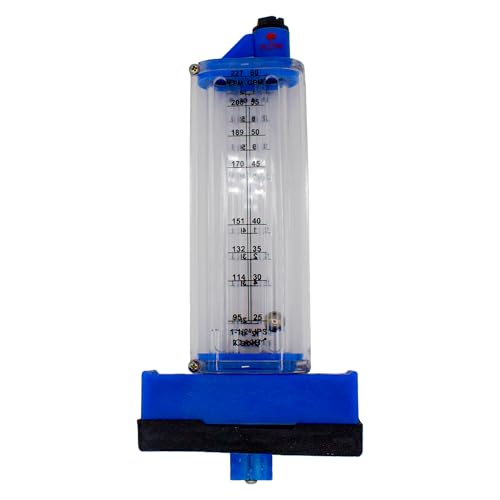
Rola-Chem 570341-T 1.5-inch is the 1.5-inch PVC top-mount choice with a 25–60 GPM range, placing its operating band below the 2-inch Rola-Chem model’s range. Its wide chamber is designed to reduce mineral buildup, a useful distinction where hard water or pool chemicals contribute to deposits. The maker describes it as suitable for pools, spas, and light commercial systems. It is intended for horizontal installation, so it is less flexible than the in-line meters that allow vertical or upside-down placement. Confirm the plumbing layout can accommodate a horizontal top mount before selecting it.
Bottom line: Pick this for a 1.5-inch PVC line with flow within its 25–60 GPM range.
Blue-White FLOWREAD R-315
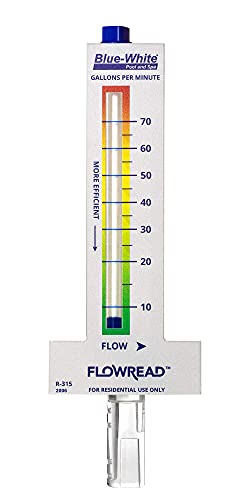
Blue-White FLOWREAD R-315 has the broadest low-end coverage in this group, with a 10–70 GPM scale for 1.50-inch inside-diameter PVC pipe. Unlike the top-mount models, it installs without pipe-cutting tools, primer, or cement. The maker reports ±5% flow-rate accuracy and says the meter is acceptable for outdoor installation, including direct sunlight. This choice suits owners who want a lower-range reading and a no-cut setup. Its pipe fit is based on inside diameter, so check that your pipe has a 1.50-inch ID before purchasing; pipe labels can refer to nominal size rather than actual inside diameter.
Bottom line: Choose this when your 1.50-inch ID pipe and 10–70 GPM flow fit its scale.
How to choose a swimming pool flow meter
Choose by pipe fit first, then confirm that your usual flow falls inside the meter’s range. Pool circulation flow is measured in GPM; a pump’s maximum-flow figure is not necessarily the flow through a filter, heater, and plumbing loop. Compare the meter range with the system’s actual operating conditions. A meter whose range begins above your normal flow cannot give a useful reading at that low end.
Installation style also changes the decision. In-line meters may allow more placement orientations, while top-mount models require the pipe layout to suit their mounting position. If a check valve is also needed, a meter with that function can combine two components. Before opening pool plumbing, turn off the pump and relieve system pressure; pressurized water can cause injury or flood the equipment area.
Pipe size and flow range
Pipe fit is not interchangeable: nominal pipe size and inside diameter are different measurements. For example, the FLOWREAD R-315 is specified for 1.50-inch ID PVC, while other models specify nominal 1.5-inch or 2-inch pipe. Confirm the actual pipe type and connection dimensions before selecting a meter, especially when replacing an existing component.
Use the meter’s range as a filter, not as a target for pump selection. The chart compares the specified ranges and pipe fits; where a range is absent, check that compatibility before ordering.
| Need | Relevant fit | Decision point |
|---|---|---|
| Lower-range reading | 10–70 GPM | Check for 1.50-inch ID PVC |
| 1.5-inch PVC, horizontal | 25–60 GPM | Layout must allow top mounting |
| 2-inch PVC, higher flow | 40–140 GPM | Confirm normal flow is in range |
| Combined meter and check valve | FV-C or FV-2 | Match the pipe fit and operating flow |
In-line and top-mount meters compared
In-line and top-mount meters differ mainly in how they join the plumbing and where they can sit. The FV-C and FV-2 can be installed in multiple orientations, while the Rola-Chem 570341-T calls for horizontal installation and the 570351T is a top-mount model. The FLOWREAD R-315 stands apart because its installation does not require pipe-cutting tools, primer, or cement.
Choose an in-line format when the existing pipe run and desired orientation favor it; choose a top mount when the layout supports that position. Straight-pipe needs are model-specific: the FV-2 maker says little-to-zero straight pipe is required without affecting accuracy, but that claim should not be generalized to other meters. A compact equipment pad may also make orientation and access more important than the scale range.
Installation and safe maintenance
Pool plumbing operates under pressure, so shut down the pump and release pressure before cutting or separating any pipe. Keep the pump off until fittings are secure and the system is ready to be restarted; never loosen a pressurized fitting. Follow the meter’s specified pipe size and mounting orientation, and avoid forcing a connection that does not match the pipe.
Read the scale at eye level and use the same units when comparing readings over time. GPM is gallons per minute; LPM is liters per minute, and the two scales should not be compared as though they were the same unit. Check the meter periodically for a readable scale, leaks, or deposits that could obscure a reading. Mineral deposits are a common plumbing concern in hard-water areas, but maintenance steps depend on the meter’s construction.
Frequently Asked Questions
What does a pool flow meter measure?
A pool flow meter measures the rate water moves through the circulation plumbing, commonly in gallons per minute (GPM). Use the reading to compare operating flow with equipment requirements, not as a substitute for checking the pump and filter specifications.
How do I match a meter to pool pipe?
Match the meter’s specified pipe size and type, and distinguish nominal pipe size from inside diameter. A meter specified for 1.50-inch ID PVC requires that inside diameter, even if a pipe is sold under a nominal size label.
Where should a swimming pool flow meter go?
Place it in the circulation line in the orientation its model allows, with the reading easy to see. Placement restrictions differ: for example, some models permit vertical or upside-down installation, while a horizontal top-mount model requires a suitable horizontal layout.
Can I install a flow meter next to an elbow?
Some meters are designed to work with little or no straight pipe, but that allowance is model-specific. The FV-2 maker says it can be installed with little-to-zero straight-pipe requirements without affecting accuracy; do not assume the same for another model.
Is it safe to open pool plumbing with the pump running?
No. Turn off the pump and relieve system pressure before opening or cutting plumbing, since pressurized water can cause injury or a sudden leak. Restart only after the fittings are secure and the system is ready.