
Taylor Swoden Electric Kettle: 4 Models Compared

Taylor Swoden 1.7L Glass Kettle suits most people who want a Taylor Swoden electric kettle because its 1.7-liter capacity is larger than the brand’s 1.0-liter model. Choose Taylor Swoden 1.0L Infuser Kettle instead for a smaller kettle with a keep-warm function and tea infuser; the other options are alternatives from different brands.
An electric kettle heats water on a powered base, so capacity and useful temperature features matter more than stovetop compatibility.
We earn a commission if you buy through links on this page. As an Amazon Associate I earn from qualifying purchases. Products are compared on manufacturer specifications, not hands-on testing.
- Best overall: Taylor Swoden 1.7L Glass Kettle – Its 1.7-liter capacity holds more than the Taylor Swoden 1.0-liter model.
- Best for small servings: Taylor Swoden 1.0L Infuser Kettle – Its 1.0-liter capacity and keep-warm function suit smaller batches.
- Best for plastic-free contact: Cosori 1.7L Glass Kettle – The maker says water does not contact plastic inside this 1.7-liter kettle.
| Product | Best for | Capacity | Power | Body material | Shop |
|---|---|---|---|---|---|
| Taylor Swoden 1.7L Glass Kettle | Larger batches | 1.7 L | 1,100 W | Glass and stainless steel | Check Price on Amazon |
| Taylor Swoden 1.0L Infuser Kettle | Small servings | 1.0 L | — | — | Check Price on Amazon |
| Chefman 1.8L Glass Kettle | Faster heating | 1.8 L | 1,500 W | Borosilicate glass | Check Price on Amazon |
| Cosori 1.7L Glass Kettle | Plastic-free contact | 1.7 L | 1,500 W | Borosilicate glass | Check Price on Amazon |
Taylor Swoden Electric Kettles and Alternatives
Compare capacity and useful features to find a kettle that fits your kitchen routine.
Taylor Swoden 1.7L Glass Kettle

The larger Taylor Swoden option holds 1.7 liters and uses a glass-and-stainless-steel construction. The maker says its 1,100-watt heating system boils water in a few minutes, and the kettle has automatic shutoff and boil-dry protection. Its larger capacity is useful when preparing several cups or hot water for oatmeal. The tradeoff is that it lacks the smaller model’s keep-warm function and tea infuser, so it is a less direct fit for brewing loose-leaf tea in the kettle.
Bottom line: Choose this for larger batches without a keep-warm function.
Taylor Swoden 1.0L Infuser Kettle

The Taylor Swoden 1.0-liter kettle is the compact choice, with a tea infuser and a keep-warm setting that holds water between 176°F and 185°F after boiling. The maker says it boils a liter in 3 to 5 minutes and automatically shuts off after heating. Its smaller capacity suits one or two servings better than filling a larger kettle for a single cup. Choose another option if you regularly need more than a liter at once or want a wattage for comparing heating power.
Bottom line: Pick this for smaller batches and a keep-warm setting.
Chefman 1.8L Glass Kettle

The Chefman alternative combines a 1.8-liter capacity with 1,500 watts, giving it more listed power than either Taylor Swoden model. The maker says it heats water in 3 minutes; it also has automatic shutoff, boil-dry protection, a stainless-steel filter, and a removable lid for cleaning. Its glass construction and larger capacity suit buyers prioritizing volume and stated power. It is not a Taylor Swoden kettle, and buyers seeking that brand should choose one of the two Taylor Swoden options instead.
Bottom line: Choose it if higher listed power and a removable lid matter.
Cosori 1.7L Glass Kettle
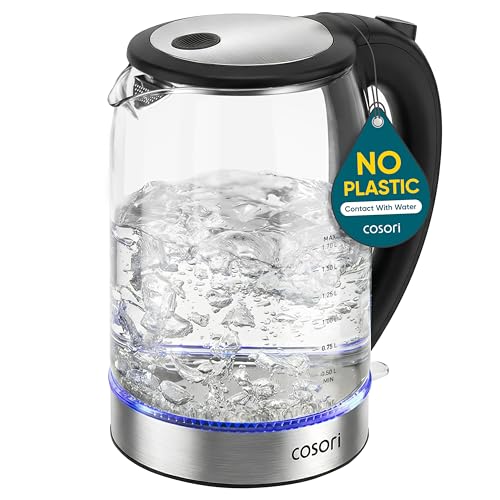
The Cosori alternative stands apart by specifying that water does not contact plastic inside the kettle. It holds 1.7 liters and uses 1,500 watts; the maker says it heats 0.5 liter in under 3 minutes. A wide opening and large-angle lid are intended to make interior cleaning easier, and the kettle includes automatic shutoff and boil-dry protection. This is a different brand from Taylor Swoden, and it does not offer the tea infuser and keep-warm function featured on the smaller Taylor Swoden model.
Bottom line: Pick it when plastic-free water contact is the priority.
How to choose an electric kettle
Choose capacity according to the largest batch you usually make: 1 liter covers a few cups, while 1.7 liters leaves more room for a group or cooking water. Wattage helps compare heating power, but a higher rating alone does not establish an exact boil time because starting water temperature and fill volume affect heating. For one or two cups, avoid repeatedly boiling a nearly full large kettle; for multiple servings, a larger capacity reduces refills. A keep-warm function is useful when you want another cup soon, while an infuser is relevant if you steep loose-leaf tea directly in the kettle.
Capacity, fill levels, and safe pouring
Fill an electric kettle between its minimum and maximum marks, rather than below the minimum or above the maximum. The minimum helps ensure the heating element remains covered, while overfilling can send boiling water out through the spout. A full 1.7-liter kettle is substantially more water to lift and pour than a 1.0-liter model, so consider who will handle it. Boiling water and escaping steam can burn; keep hands clear of the spout and pour slowly. Use a smaller kettle if a full-size batch would be awkward to carry or control.
Glass and stainless steel kettle differences
Glass bodies make the water level visible, while stainless steel bodies conceal the water from view; either material still needs regular descaling where mineral deposits build up. Borosilicate glass is used in the glass options here, but the specifications do not establish that all water-contact parts are glass or metal. Check the kettle’s interior and removable parts if avoiding plastic contact is a deciding condition. A wide opening or removable lid can make it easier to reach the interior for cleaning, while a tea infuser adds a part that must also be rinsed after steeping.
Electric kettle features compared
Automatic shutoff switches heating off after boiling, while boil-dry protection is intended to stop heating if the kettle has too little water. A keep-warm function is different: it maintains a temperature after the initial boil instead of simply turning off. Use the table to match a feature to the routine rather than assuming every kettle has the same controls. If you need hot water at a set temperature for a beverage, confirm that the kettle offers that exact control; a general keep-warm range is not the same as adjustable temperature settings.
| Need | Feature to prioritize |
|---|---|
| Tea brewed in the kettle | Tea infuser |
| Another hot cup soon | Keep-warm setting |
| Interior access for cleaning | Wide opening or removable lid |
| Less water per batch | Smaller capacity |
Frequently Asked Questions
How much water does a 1-liter kettle hold?
A 1-liter kettle holds 1,000 milliliters, or about four 8-ounce cups. Leave space below the maximum fill mark when boiling to reduce the chance of water escaping through the spout.
How long does an electric kettle take to boil?
Boil time depends on the amount of water, starting temperature, and kettle power. As a practical comparison, use the same water volume and starting temperature when evaluating times rather than comparing claims for different batch sizes.
Can I leave water in an electric kettle overnight?
Water can be left in a kettle, but emptying and drying it after use helps limit mineral buildup and stale-tasting water. In hard-water areas, deposits can build faster, so descale when visible scale appears.
How often should I descale an electric kettle?
Descale when mineral scale becomes visible or the kettle begins heating less efficiently; hard water generally requires more frequent cleaning than soft water. Follow the kettle maker’s cleaning guidance and rinse thoroughly before boiling drinking water again.
Is a keep-warm kettle the same as temperature control?
No; keep-warm maintains a designated range after boiling, while adjustable temperature control lets you choose a target. For delicate teas, check that a kettle has the specific temperature setting you need rather than assuming a keep-warm feature provides it.