
The Foldie Crossbody Bag: 4 Options Compared by Fit

The Foldie Compact Crossbody Bag is the better fit for most travelers because its 11.2-inch length, RFID-blocking card slots and cut-resistant strap are specified. Choose the larger Foldie sling if you want a pocketable bag, or another option if you need measured capacity or a defined side orientation.
We earn a commission if you buy through links on this page. As an Amazon Associate I earn from qualifying purchases. Products are compared on manufacturer specifications, not hands-on testing.
- Best overall: The Foldie Compact Crossbody Bag – Specified dimensions and a cut-resistant strap make its size and security easier to assess.
- Best for packability: The Foldie Medium-Large Sling – The sling is designed to fold into a pocket or backpack.
- Best for organization: BAGSMART 2.4L Puffer Crossbody – Two main compartments and five RFID-protected card slots divide daily essentials.
| Product | Best for | Dimensions (in.) | Security features | Shop |
|---|---|---|---|---|
| The Foldie Compact Crossbody Bag | Measured travel carry | 11.2 × 6.2 × 3.5 | RFID slots; lockable zippers | Check Price on Amazon |
| The Foldie Medium-Large Sling | Packable essentials | — | RFID protection; zipper lock | Check Price on Amazon |
| BAGSMART 2.4L Puffer Crossbody | Compartmented essentials | 8.7 × 6.1 × 2.8 | Five RFID card slots; anti-theft features | Check Price on Amazon |
| Grey Left-Shoulder Travel Sling | Left-shoulder carry | — | Blocking pockets; hidden zippers | Check Price on Amazon |
The Foldie Crossbody Bag Options
Compare the bags by folding design, size and stated security features before choosing one for travel or everyday carry.
The Foldie Compact Crossbody Bag

Unlike the other Foldie model here, this compact bag has measured dimensions and a cut-resistant strap. It folds into a pouch and includes RFID-blocking card slots, lockable zippers and a three-point release buckle. Its 11.2-inch length and 6.2-inch height suit travelers who want a compact form with its size clearly defined. The measurements help with packing checks, but they do not establish how much gear it holds; confirm the bag’s fit against your usual essentials before choosing it.
Bottom line: Pick this if defined dimensions and a cut-resistant strap matter most.
The Foldie Medium-Large Sling
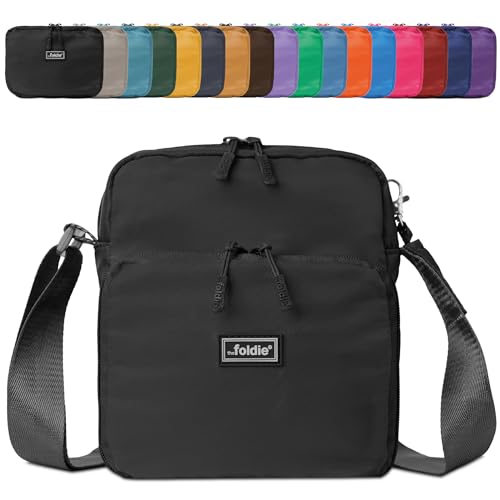
This Foldie is the packability-focused choice: its sling design folds small enough to fit in a pocket or backpack. The medium-to-large size includes RFID protection in inner pockets, a zipper lock and water-repellent fabric. It suits someone who wants a spare bag for travel or errands without carrying a full-size bag all day. Unlike the compact Foldie, no dimensions are provided, so shoppers who need to check a specific packing space should verify its unfolded measurements before buying.
Bottom line: Choose this for a foldable spare bag when exact dimensions are not essential.
BAGSMART 2.4L Puffer Crossbody

Unlike either Foldie, this BAGSMART purse gives a capacity and a divided layout rather than a fold-into-a-pouch design. It has two main compartments, five RFID-protected card slots, a front pocket and a secure back zipper pocket. At 2.4 liters and 0.3 pounds, it suits someone organizing a small everyday carry, while its water-resistant material adds some weather protection. It is a partial match for a Foldie search because its features do not include a folding design or cut-resistant strap.
Bottom line: Choose this for organized daily essentials and a 2.4-liter capacity.
Grey Left-Shoulder Travel Sling

This grey travel sling is the only option described for left-shoulder carry, while its security approach combines blocking pockets, hidden zippers and cut-resistant materials. Multiple compartments and breathable back padding are also described, making it a possible fit for commuters who prefer that shoulder orientation. The size measurements are zeros, so they cannot guide a fit check; shoppers who need to match the bag to a device or packing space should confirm usable dimensions before ordering.
Bottom line: Pick this if left-shoulder orientation is your deciding requirement.
How to choose a foldable crossbody bag
Choose by the load you carry and the security features you will actually use. A folded pouch is useful as a spare, but a bag’s unfolded dimensions and capacity determine whether it can hold a phone, wallet and travel documents together. For reference, a 2.4-liter bag is a small essentials carrier, not a general-purpose daypack. RFID-blocking pockets address contactless card skimming; zipper locks and cut-resistant straps target physical access, and neither replaces keeping the bag in view. If you carry a tablet or a passport wallet, compare its measurements with the bag’s interior before purchase. Prioritize a measured bag when a snug fit matters, and a foldable design when packed size matters more.
What RFID protection and anti-theft features do
RFID-blocking card pockets are intended to reduce radio-frequency reading of cards stored inside them; they do not secure cash, phones or items outside those pockets. A zipper lock can slow casual access, while a cut-resistant strap is intended to make slashing harder, not impossible. A three-point release buckle adds a specific fastening mechanism but still requires the wearer to keep the bag positioned securely. For crowded transit, wear the bag in front and keep valuables in zipped compartments. Treat water-resistant and water-repellent fabrics as splash protection, not a guarantee against submersion or prolonged rain. Security features work best as layers alongside awareness and sensible placement of valuables.
Compare packability, capacity and layout
Foldable designs prioritize compact storage; compartmented purses prioritize separating items. Use this comparison to match the bag’s format to your carry routine rather than assuming that every crossbody has the same usable space.
| Need | Useful feature | Trade-off |
|---|---|---|
| Backup bag in a pack | Folds into a pouch | Check unfolded fit |
| Measured compact carry | Dimensions given | Capacity may remain unknown |
| Separate small items | Multiple compartments | Not necessarily foldable |
Choose a folding sling when storage footprint is the main constraint. Choose a bag with a liter capacity when you want a clearer volume estimate, but remember that pocket layout affects what fits in practice. A 2.4-liter capacity and external dimensions are different measures: neither alone guarantees room for a particular item.
Check fit and care before travel
Measure the largest item you plan to carry and leave room for the zipper path and pockets; a bag’s exterior dimensions are not its internal usable space. For a bag intended to fold away, test the fold and confirm that it can be returned to its pouch without forcing seams or hardware. Water-repellent and water-resistant fabrics can shed light exposure, but keep electronics in a separate dry pouch during heavy rain. Do not overload a small sling or rely on an anti-theft feature as a substitute for keeping straps and zippers secured. For a shoulder-specific bag, confirm its intended orientation matches your preferred side before committing.
Frequently Asked Questions
Does RFID blocking protect every item in a crossbody bag?
No, RFID-blocking pockets are intended for cards placed inside those pockets. Cash, phones and cards carried elsewhere are not protected by that feature.
Can a water-repellent bag go out in heavy rain?
Water-repellent fabric is not the same as a waterproof seal. For heavy rain or electronics, use a separate waterproof pouch and keep the bag from prolonged exposure.
How do I know whether a compact bag will fit my phone?
Compare the phone’s length, width and thickness with the bag’s usable interior, not only its outer dimensions. Leave extra room for a case and for the zipper to close without pressure.
What does a cut-resistant strap protect against?
A cut-resistant strap is intended to make cutting through the strap more difficult, but it does not make a bag theft-proof. Keep the bag secured in front in crowded areas.