
Three Point Rock Rakes: Compare Fit and Features

For a standard Category 1 tractor hitch, the 60-inch YZONA is the clearest match because it specifies Category 1 compatibility and a 360-degree rotating head. Choose a different rake if you need Category 0 fit, a wider nominal head, or a rake with a fixed angle adjustment instead of full rotation.
A three-point rock rake attaches to a tractor’s hitch and uses tines to gather stones and other surface debris or groom soil. Confirm your tractor’s hitch category and the rake’s actual working width before choosing.
We earn a commission if you buy through links on this page. As an Amazon Associate I earn from qualifying purchases. Products are compared on manufacturer specifications, not hands-on testing.
- Best overall: YZONA 60-Inch Rock Rake – Specifies a Category 1 hitch and a 360-degree rotating rake head.
- Best for wider coverage: Garvee 5-Foot Landscape Rake – The name identifies a 5-foot rake, with 37 steel tines and Category 1/2 compatibility.
- Best for angle adjustment: MAXSA 50-Inch Rock Rake – Offers a 50-inch head, Category 0/1 fit, and five working-angle positions.
| Product | Best for | Working width | Hitch fit | Angle or rotation | Shop |
|---|---|---|---|---|---|
| YZONA 60-Inch Rock Rake | Category 1 tractors | 60 in | Category 1 | 360° rotation | Check Price on Amazon |
| Garvee 5-Foot Landscape Rake | Category 1/2 fit | 5 ft nominal | Category 1/2 | 360° rotation | Check Price on Amazon |
| MAXSA 50-Inch Rock Rake | Angle adjustment | 50 in | Category 0/1 | 0°–60°, 5 positions | Check Price on Amazon |
Three Point Rock Rakes
Compare hitch fit, working width, and head adjustment to narrow down the right rake for your tractor and terrain.
YZONA 60-Inch Rock Rake

The 60-inch YZONA makes its Category 1 hitch fit explicit, and its head rotates 360 degrees to direct gathered material to the left, right, or center. Its steel construction and reinforced teeth are intended for regular lawn, farm, and landscaping work, including pine needles, leaves, branches, and gravel-driveway leveling. The width suits buyers who want a middle-ground rake rather than a 50-inch head or a nominal 5-foot model. The maker says components ship in two packages, so plan for separate arrivals; verify your tractor’s hitch category before ordering.
Bottom line: Choose this if your tractor has a Category 1 hitch and you want full head rotation.
Garvee 5-Foot Landscape Rake

The Garvee is the option here that names both Category 1 and Category 2 tractor compatibility, and its rake uses 37 steel tines arranged in five groups. The product name identifies a 5-foot model, while the maker also reports a 72-inch length, so confirm the actual working width if precise coverage matters. The rake rotates 360 degrees and has a rust-resistant coating, making it relevant for buyers who need broad compatibility and want to redirect material while working. Its tractor limit is under 45 horsepower, so owners of larger tractors should check fit and operating limits before choosing it.
Bottom line: Pick this if Category 2 compatibility or the 37-tine layout is important.
MAXSA 50-Inch Rock Rake
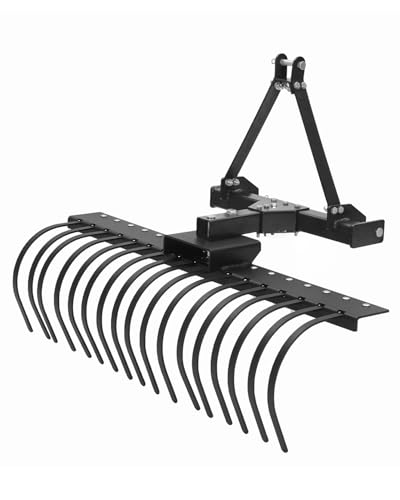
The MAXSA is the only option here that names Category 0 compatibility alongside Category 1, and it provides five working-angle positions from 0 to 60 degrees. Its 50-inch width is narrower than the 60-inch options, which can suit compact tractors or work areas where a smaller head is easier to maneuver. The rake uses replaceable spring-steel tines and a carbon-steel frame; the maker says the frame is rust-resistant. Buyers who need full 360-degree head rotation should note that this model instead emphasizes a limited angle adjustment. Confirm the hitch category and working width against your tractor and task.
Bottom line: Choose this for Category 0/1 fit or selectable rake angles.
How to Choose a Three Point Rock Rake
Start with hitch category, then compare width and head adjustment. Category 1 lower hitch pins are typically 7/8 inch in diameter, while Category 0 lower pins are typically 5/8 inch; the top-link pin and spacing also differ, so a category label alone is not a substitute for checking the tractor and implement measurements. A rake wider than the tractor’s tire track can cover the tracks in a pass, but a narrower head may be easier to position around beds and obstacles. Choose full rotation when you want to redirect gathered material, or angle positions when you mainly need to set the working direction. Match the rake’s tractor limits as well as its hitch.
Use this quick fit guide before comparing features:
| Need | What to compare |
|---|---|
| Correct tractor connection | Hitch category, pin diameters, and spacing |
| Coverage in each pass | Rake working width versus tire track and work area |
| Redirecting debris | Full rotation or selectable working angles |
Three Point Hitch Fit and Tractor Limits
Hitch category determines whether the rake’s pins and geometry match the tractor; Category 1 and Category 0 are not interchangeable without a compatible arrangement. Category 1 uses 7/8-inch lower pins in common ASABE-style implement dimensions, while Category 0 uses 5/8-inch lower pins. Check the upper link connection, lower-link spacing, and tractor’s lift capacity too, because a rake can fit the pin category yet still be too heavy or large for the tractor to handle safely. Keep the tractor on stable ground when connecting an implement, lower the rake before adjusting it, and keep clear of pinch points around the three-point linkage. Never work beneath a raised implement without proper mechanical support.
Rotation, Angle, and Tine Choices
A rotating rake head and an angle-adjustable rake solve related but different jobs. Full 360-degree rotation lets the operator turn the head to direct material, while a limited angle range sets the working direction without necessarily allowing the head to spin freely. Steel tine strength and replaceability matter when raking gravel or rough ground, where impacts can bend or wear teeth; spring steel is designed to flex under impact, but it does not remove the need to slow down over large rocks. For lawn cleanup, use a lighter touch than for driveway grading, since aggressive tine contact can disturb turf and expose soil. Clear large debris by hand only after lowering and securing the implement.
Working Width and Safe Operation
Choose a rake width that covers the tractor’s tire track without making tight areas difficult to reach. A 60-inch rake is 5 feet across, while a nominal 5-foot model may still have a different overall dimension, so use the working width rather than package dimensions when planning coverage. Before each pass, inspect tines, hitch pins, and retaining hardware; replace damaged parts before continuing. Travel slowly over uneven ground and keep bystanders well outside the rake’s path, since tines can throw stones and other debris. Raise the rake only enough for transport, and lower it before dismounting or making adjustments.
Frequently Asked Questions
How do I identify a Category 1 tractor hitch?
A common Category 1 hitch uses 7/8-inch lower pins, but pin diameter alone does not confirm fit. Check lower-link spacing, top-link pin size, and your tractor manual before attaching a rake.
Is a 60-inch rake wide enough for my tractor?
A 60-inch rake is 5 feet wide, so compare that width with your tractor’s tire track and the space you need to maneuver. A head that covers the tire tracks can reduce unworked strips, while a narrower head may suit confined areas.
Can a rock rake level a gravel driveway?
A three-point landscape rake can redistribute and smooth surface gravel, but it is not a substitute for deep grading equipment. Work slowly, avoid large embedded rocks, and use a lighter tine angle where you do not want to disturb the base.
What is the difference between rake rotation and angle adjustment?
A 360-degree rotating head can turn to direct material in different directions. An angle-adjustable head changes its working direction within a specified range, such as 0 to 60 degrees, without necessarily rotating all the way around.
How should I keep a three-point rake safe?
Inspect the tines and hitch retainers before each use, and keep people clear because rocks can be thrown by the teeth. Lower and secure the implement before making adjustments, and never go beneath a raised rake without mechanical support.