
Tommy Copper Back Support Bra: 3 Options Compared

Choose Tommie Copper Zip Up Shoulder Support Bra if a front zipper is the deciding feature: it pairs a low-profile closure with shoulder panels and compression fabric. Choose Tommie Copper Shoulder Support Bra for a shoulder support bra without a zipper, or Copper Fit Max Posture and Back Support if full-back coverage matters more than wearing a bra.
We earn a commission if you buy through links on this page. As an Amazon Associate I earn from qualifying purchases. Products are compared on manufacturer specifications, not hands-on testing.
- Best overall: Tommie Copper Zip Up Shoulder Support Bra – The low-profile zipper is designed to make the compression bra easier to put on and remove.
- Best for zipper-free wear: Tommie Copper Shoulder Support Bra – It has shoulder support panels and 4D stretch compression fabric, with no zipper mentioned in its name or features.
- Best for full-back coverage: Copper Fit Max Posture and Back Support – It is a separate support with reinforced panels and adjustable compression, rather than a bra.
| Product | Best for | Closure | Garment type | Size | Shop |
|---|---|---|---|---|---|
| Tommie Copper Zip Up Shoulder Support Bra | Easier dressing | Front zipper | Shoulder support bra | X-Large | Check Price on Amazon |
| Tommie Copper Shoulder Support Bra | Simple shoulder support | No zipper mentioned | Shoulder support bra | X-Large | Check Price on Amazon |
| Copper Fit Max Posture and Back Support | Full-back support | Adjustable compression | Full-back support | L/XL | Check Price on Amazon |
Tommy Copper back support bras and alternatives
Compare the two shoulder support bras with the separate full-back support to match the garment to your intended use.
Tommie Copper Zip Up Shoulder Support Bra

Tommie Copper Zip Up Shoulder Support Bra is the zip-front option in this group, with a low-profile zipper intended to make a snug compression bra easier to put on and take off. Its ergonomic seaming and multi-layer shoulder panels are designed to encourage posture through the upper back and shoulders while allowing movement. The brand says its 4D stretch compression fabric is intended for all-day comfort. The color is white in X-Large. A close compression fit may feel tighter than a conventional bra, so this choice is most useful if the zipper matters and you are comfortable with a snug garment.
Bottom line: Choose this if a front zipper is your priority and you want a shoulder support bra.
Tommie Copper Shoulder Support Bra

Tommie Copper Shoulder Support Bra provides the shoulder support design without the front zipper that distinguishes Tommie Copper Zip Up Shoulder Support Bra. The garment combines ergonomic seaming and multi-layer panels with 4D stretch compression fabric; the brand says these features are intended to encourage upper-back and shoulder posture while preserving mobility. It is white in X-Large and includes UPF 50 and Copper Znergy odor-control technology. This may suit someone who wants the panel design and sun-protection feature, but it lacks the easy-on, easy-off zipper convenience of the zip-front option.
Bottom line: Choose this if you want the shoulder panels and UPF 50 without a front zipper.
Copper Fit Max Posture and Back Support
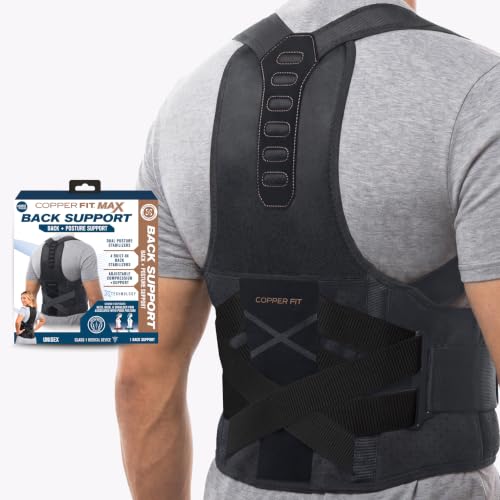
Copper Fit Max Posture and Back Support is not a bra; it is a separate back support with full-back coverage and adjustable compression. Reinforced panels are designed to provide back stability, while the maker says the garment is intended to support posture and spinal alignment. Its L/XL size fits a 34–48-inch waist measured at belly-button level, and the maker recommends sizing up when between sizes. It is the relevant alternative if a bra’s shoulder panels do not provide the coverage you want. The tradeoff is that it does not replace a bra, so it is not the right choice when you specifically need a support bra.
Bottom line: Choose this only if you want a separate full-back support instead of a bra.
How to choose a shoulder support bra
Start with the garment’s closure and coverage: a front zipper can simplify dressing, while shoulder panels are the defining support feature of these bras. Compression clothing should feel snug but should not cause pain, numbness, tingling, or restricted breathing; remove it if those symptoms occur. For bra fit, the band should sit level around the torso and feel secure without digging in, and straps should stay on the shoulders without carrying all the garment’s support. Use the maker’s size chart for the specific style rather than assuming the same letter size fits every bra. If mobility or dressing is a concern, favor a closure you can operate independently and check that the zipper lies comfortably when seated and moving.
How a support bra differs from a back support
A shoulder support bra combines bust coverage with panels around the shoulders and upper back, while a back support is a separate wrap or brace around the torso. The products here illustrate that distinction: two are bras, while the L/XL model is a full-back support with adjustable compression. Choose the bra form when you need a bra and want its shoulder-panel design; choose the separate support only when back coverage is the priority and you do not need that garment to function as a bra. A posture garment is not a substitute for evaluation of persistent pain, weakness, or injury. For a separate support with a waist-based fit, measure at the specified body location rather than using bra-band size.
How to size a full-back support
For the L/XL full-back support here, the maker gives a 34–48-inch waist range measured at belly-button level; S/M fits 28–34 inches and 2XL/3XL fits 48–60 inches. Those ranges are specific to that garment and should not be applied to a bra. Measure snugly around the waist at the level, then compare the result with the size range; if the measurement falls between sizes, the maker recommends sizing up. A measurable decision rule is to use the next larger stated size whenever your waist measurement is between ranges, rather than selecting by clothing size alone. The bra choices are supplied in X-Large, so use their style-specific sizing guidance to confirm that size before ordering.
How to wear compression garments comfortably
Compression should be close-fitting, but comfort and normal movement still matter; loosen or remove a garment that causes numbness, tingling, pain, or breathing difficulty. For a zip-front bra, keep the garment aligned and avoid forcing the zipper if fabric or skin catches; the product guidance recommends holding the bottom tab while zipping. Shoulder panels should lie flat rather than bunching or pulling the shoulders into an uncomfortable position. Begin by checking the fit during ordinary movement, such as reaching and sitting, before choosing to wear a compression garment for a longer period. If symptoms are persistent or the garment is intended for an injury, seek advice from a qualified clinician rather than relying on compression clothing alone.
Frequently Asked Questions
How tight should a shoulder support bra feel?
A compression bra should feel snug, but it should not cause pain, numbness, tingling, or restricted breathing. Remove it if those symptoms occur, and check that the band sits level and straps do not dig into the shoulders.
Can a back support replace a support bra?
Choose a support bra when you need a bra with shoulder panels; choose a separate support when full-back coverage is the priority.
How do I measure for the full-back support?
Measure around your waist at belly-button level and compare the result with the maker’s ranges: L/XL fits 34–48 inches. If you fall between sizes, the maker recommends sizing up.
What should I do if the zipper catches?
Do not force a caught zipper against skin or fabric. The zip-front bra’s guidance recommends holding the bottom tab while zipping, which can help keep the garment aligned.
When should I stop wearing a compression bra?
Remove a compression garment if it causes pain, numbness, tingling, or breathing difficulty. Persistent pain, weakness, or injury symptoms call for professional advice rather than relying on a support garment.