
Tool to Draw Circles: Compass and Template Options

For a tool to draw circles, the Westcott compass suits people who need circles up to 13 inches in diameter; it uses a point and pencil to trace a circle. Choose another option if you need a geometry kit, an adjustable template, or a combined protractor and circle maker.
We earn a commission if you buy through links on this page. As an Amazon Associate I earn from qualifying purchases. Products are compared on manufacturer specifications, not hands-on testing.
- Best overall: Westcott Ball Bearing Compass – Its 13-inch circle capacity is the largest among the compasses.
- Best for a geometry set: Nicpro 22-Piece Compass Geometry Set – The 22-piece kit includes multiple compasses, rulers, protractors, and pencils.
| Product | Best for | Circle capacity | Tool type | Material | Shop |
|---|---|---|---|---|---|
| Westcott Ball Bearing Compass | Large circles | Up to 13 in diameter | Compass | Nickel-plated metal | Check Price on Amazon |
| Mr. Pen Professional Compass | Precise drafting | Up to 8 in diameter | Bow compass | Nickel-plated metal | Check Price on Amazon |
| Nicpro 22-Piece Compass Geometry Set | Geometry projects | Up to 6 in diameter | Compass set | Metal compasses | Check Price on Amazon |
Tools to Draw Circles
Choose by the circle diameter you need and whether you want a compass, a template, or a multi-tool geometry set.
Westcott Ball Bearing Compass
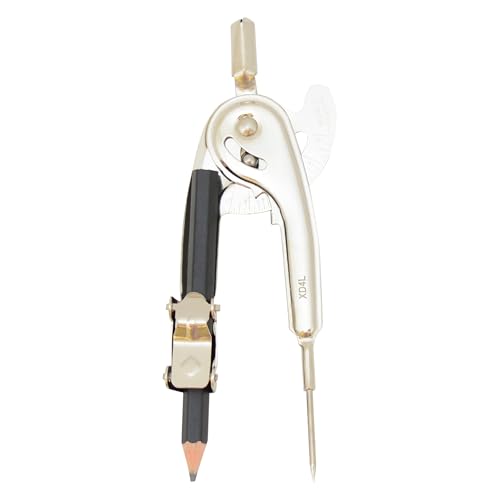
The Westcott compass handles the largest circle diameter here, up to 13 inches. Its ball-bearing design, ergonomic grip, and dual-scale capability suit drafting or classroom geometry where controlled, repeatable circles matter. The nickel-plated metal construction is useful for a tool that will be handled frequently. Choose it when a single compass is enough and circle size matters more than having a full geometry kit. Its main limitation is that it does not include the extra rulers and protractors found in a set.
Bottom line: Pick this compass for circles larger than 8 inches.
Mr. Pen Professional Compass

The Mr. Pen compass is a focused drafting tool with a spring bow head and center wheel intended to keep the legs from shifting unintentionally. Brand says it draws circles up to 8 inches in diameter, making it a fit for geometry, technical drawings, and smaller drafting work. Its all-metal nickel-plated build and included extra lead keep the kit compact. The limitation is its smaller stated capacity than the Westcott compass, so choose another option if your drawing needs exceed an 8-inch diameter.
Bottom line: Choose it for controlled drawing within an 8-inch diameter.
Nicpro 22-Piece Compass Geometry Set

The Nicpro set stands apart by supplying several geometry tools rather than one circle maker: three compasses, a divider, two protractors, a ruler, triangle squares, pencils, and accessories in a case. Its compasses draw circles up to 6 inches in diameter, and one has an adjustable pen holder for different drawing instruments. This range suits students who need measuring and drafting tools together. The tradeoff is the smaller circle capacity, so it is not the right fit for large-format circles.
Bottom line: Pick this set when geometry accessories matter as much as circles.
How to choose a circle-drawing tool
Start with the largest circle diameter you need, then choose the mechanism that fits the work. A compass uses two legs, one anchored at the center and one carrying a pencil or lead; a template guides a pencil around an opening, while an integrated circle maker uses stencils or an aperture. For circles over 8 inches, select a compass with a capacity above that size. For classroom tasks that also need angle and length measurements, a set with a protractor and ruler can reduce tool changes.
Diameter is twice the radius, so a 10-inch diameter circle needs a 5-inch radius from center point to pencil tip. Set the compass radius using that half-diameter before drawing. A template’s outside size does not necessarily equal its maximum circle size, so compare the actual usable opening when that figure is given.
Compass, template, and integrated circle maker types
A compass is the flexible choice when you need a range of diameters, while a fixed stencil is fast for repeated standard sizes. Adjustable templates change the opening through rings or a movable aperture; integrated protractor-circle tools combine measuring and drawing features. No mechanism is automatically more accurate: steady center placement and a secure pencil matter for every type.
The table separates the mechanisms and their size information. Use it to narrow the type first, then compare the actual capacity against your drawing.
| Type | How it draws | Size cue | Best fit |
|---|---|---|---|
| Compass | Pivoting legs rotate around a center point | Compare stated maximum diameter | Variable circle sizes |
| Adjustable template | Pencil traces a changing aperture | Check usable opening, not only outer size | Repeated craft circles |
| Integrated circle maker | Stencil or rotating disk guides drawing | Distinguish tool length from circle capacity | Geometry with angle work |
Set compass radius and draw clean circles
Set the distance between the compass point and pencil tip to half the desired diameter: for a 6-inch circle, use a 3-inch radius. Anchor the point firmly at the center and rotate the compass without changing that spacing. A slipping pivot or loose pencil can distort the curve, so test the point and lead on scrap paper before a final drawing.
Compass points are sharp, so keep the tool closed or covered when it is stored and direct the point away from hands while adjusting it. For larger circles, keep the legs from flexing and use a broad, flat work surface; a small shift at the center becomes more noticeable as the radius grows.
Common circle-drawing mistakes
The most common sizing error is confusing radius with diameter: a 4-inch radius produces an 8-inch circle. Another is treating the total length of a tool as its circle capacity; a tool’s physical size and the maximum circle it can draw are different measurements. Confirm the maximum circle diameter before ordering if your required span is not given as a capacity.
For templates, trace with the pencil held upright and avoid forcing it against the aperture edge, which can move the template. For compasses, use a sharp, stable lead and consistent pressure. Keep pointed drafting tools away from children unless an adult is supervising, because compass points can puncture skin.
Frequently Asked Questions
How do I set a compass for a 6-inch circle?
Set the distance from the center point to the pencil tip to 3 inches, half the 6-inch diameter. Keep the pivot anchored while rotating the legs.
What is the difference between circle radius and diameter?
Diameter is the full distance across a circle through its center, and radius is half that distance. A 10-inch circle has a 5-inch radius.
Can a circle template replace a geometry compass?
A template can guide repeated circles through its openings, but it does not use a pivoting center point like a compass. Choose a compass when you need freely adjustable radii or a maximum diameter above the template’s usable opening.
How can I keep a compass from slipping?
Press the center point firmly into the paper and rotate without changing the spacing between the legs. Test the lead and pivot on scrap paper first, especially for circles with a radius over 4 inches.
Are drawing compasses safe for children?
Compass points are sharp and can puncture skin, so store them closed or covered and supervise children during use. Keep the point directed away from hands while adjusting the legs.