
Topping D70 Pro OCTO: Connections and Variants Compared

The Topping D70 Pro OCTO is an eight-chip DAC with RCA and XLR outputs, and the black model with the clearest connection and format details is the most useful starting point. Choose another variant if you specifically want a silver finish or need the preamp mode wording in its product name.
A DAC converts digital audio into an analog signal for an amplifier or preamp; it does not power passive speakers or headphones on its own.
We earn a commission if you buy through links on this page. As an Amazon Associate I earn from qualifying purchases. Products are compared on manufacturer specifications, not hands-on testing.
- Best overall: Topping D70 Pro OCTO (Black) – Its inputs include USB, AES, Bluetooth, optical and coaxial, alongside RCA and XLR outputs.
- Best for silver finish: Topping D70 Pro OCTO (Silver) – This variant identifies its silver color and lists Bluetooth codecs including LDAC and aptX Adaptive.
- Best for preamp mode: Topping D70 Pro OCTO (Preamp Mode) – Its product name specifically identifies preamp mode for a headphone amp or speakers.
| Product | Best for | Finish | Connections/features | Shop |
|---|---|---|---|---|
| Topping D70 Pro OCTO (Black) | Input flexibility | Black | USB, AES, Bluetooth, optical, coaxial | Check Price on Amazon |
| Topping D70 Pro OCTO (Black, Aurora UI) | Color display | Black | RCA/XLR; Bluetooth 5.1 | Check Price on Amazon |
| Topping D70 Pro OCTO (Silver) | Silver finish | Silver | RCA/XLR; Bluetooth 5.1 | Check Price on Amazon |
| Topping D70 Pro OCTO (Preamp Mode) | Preamp setup | — | RCA/XLR; Bluetooth 5.1 | Check Price on Amazon |
Topping D70 Pro OCTO DAC variants
These entries describe the same D70 Pro OCTO model, with differences in finish and in which features are called out.
Topping D70 Pro OCTO (Black)

This black variant is the clearest fit when you need a range of digital inputs: its product name lists USB, AES, Bluetooth, optical and coaxial, plus RCA and XLR outputs. Its maker identifies eight CS43198 chips and support for PCM up to 768 kHz/32-bit and DSD512. The maker also gives dimensions of about 8.9 × 6.9 × 1.9 inches and weight of about 3.4 pounds. Topping says it supports LDAC, aptX Adaptive, aptX HD, aptX, AAC and SBC over Bluetooth 5.1. Verify that the specific input you use is available in your intended setup.
Bottom line: Choose this variant if you want the widest set of named input connections.
Topping D70 Pro OCTO (Black, Aurora UI)

This black variant emphasizes the Aurora UI: its features describe a full-color screen with three touch buttons and selectable playback information, FFT or VU displays. It shares the model’s eight CS43198 chips, RCA and XLR outputs, Bluetooth 5.1, and stated support for PCM up to 768 kHz/32-bit and DSD512. The screen-focused controls may suit a desktop or rack setup where you want playback visuals on the unit. Its distinguishing detail is the display interface, not a different DAC model. The input connections beyond Bluetooth are not called out in this entry, so confirm your required digital input before choosing it.
Bottom line: Pick this one if the full-color interface is your priority.
Topping D70 Pro OCTO (Silver)
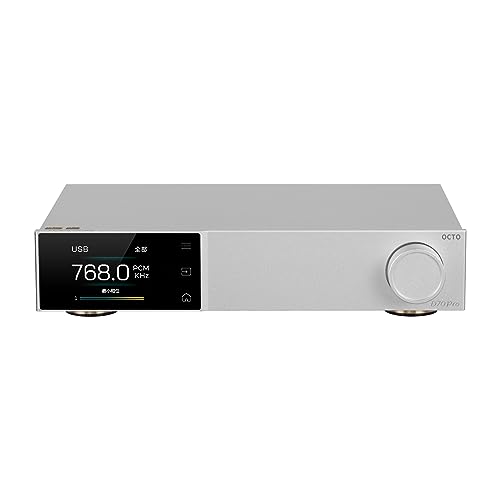
The D70 Pro OCTO uses eight CS43198 chips and supports PCM up to 768 kHz/32-bit and DSD512, with RCA and XLR outputs. The described screen can switch among playback information, FFT and VU views. The silver finish is the meaningful difference from the black entries here, rather than a change in the core model. Buyers who need a particular wired digital input should confirm that input before selecting this variant.
Bottom line: Choose it when the silver finish is the deciding factor.
Topping D70 Pro OCTO (Preamp Mode)

This entry is the only one whose product name explicitly calls out preamp mode for a headphone amplifier or speakers. It also identifies eight CS43198 chips, XMOS XU316 USB, Bluetooth 5.1 with LDAC and aptX Adaptive, balanced XLR and RCA outputs, and PCM 768 kHz/32-bit and DSD512 support. That makes it relevant if you want the DAC to be part of a preamp-style signal chain rather than only a digital-to-analog converter. Its name does not identify a finish, so buyers matching components by color should verify the version before ordering.
Bottom line: Select this entry if preamp mode is central to your system plan.
How to choose a D70 Pro OCTO variant
Choose by the connection you need first, then by finish or display preference. A DAC accepts a digital source and converts it to an analog signal; your amplifier or preamp still handles amplification. RCA is an unbalanced analog connection, while XLR is balanced; use the output that matches your next component rather than assuming one is automatically better. For digital inputs, check whether the source connects by USB, optical, coaxial or AES. Bluetooth is useful for wireless playback, but its codec is negotiated between the source and DAC, so both devices must support a codec for it to be used. If your setup depends on a specific input, confirm it is available on the variant you select.
RCA and XLR outputs in a home audio system
Match the D70 Pro OCTO’s analog output to an input on the next component: RCA connects to an RCA line input, and XLR connects to an XLR input. Balanced XLR connections can help reject noise on longer cable runs when both connected components support balanced signaling; a short connection in a quiet home setup may not benefit in the same way. Neither output is a speaker-level output, so passive speakers need an amplifier between the DAC and speakers. Likewise, headphones need a headphone amplifier unless another component in the chain provides one. Before connecting, check whether the receiving device expects a fixed line-level signal or can accept a DAC used in preamp mode.
PCM, DSD and Bluetooth format compatibility
PCM and DSD are digital audio formats, and the D70 Pro OCTO entries state maximum decoding support of PCM 768 kHz/32-bit and DSD512. Those maximums do not guarantee that every source, application or connection can send those formats; the source chain must also support the chosen format and output path. Bluetooth adds another compatibility step: LDAC, aptX variants, AAC and SBC are supported codecs in the described variants, but a phone or computer must share the codec for that mode to work. For routine listening, match the DAC’s supported format to what your source can actually deliver instead of treating the maximum rate as a quality target.
Where the D70 Pro OCTO fits in a system
A DAC belongs between a digital source and an analog component, not directly between a digital source and passive speakers. A typical chain is computer or streamer → DAC → integrated amplifier → speakers; a headphone setup usually adds a headphone amplifier after the DAC. Preamp mode can be useful when the DAC is intended to manage the signal level into a power amplifier or active speakers, but confirm the connected equipment’s input and volume-control needs first. Keep a powered amplifier muted while making or changing connections, then raise volume gradually to reduce the risk of a sudden loud signal reaching speakers or headphones.
Frequently Asked Questions
Does the Topping D70 Pro OCTO power passive speakers?
No, a DAC’s analog outputs are not speaker-level outputs. Connect an amplifier between the D70 Pro OCTO and passive speakers; active speakers with line inputs may accept the DAC output directly.
Can I use the D70 Pro OCTO with headphones?
Yes, when it feeds a headphone amplifier or another device with a headphone output.
Do both Bluetooth devices need LDAC support?
Yes, the source and receiver need a shared Bluetooth codec to use that codec. If they do not share LDAC, playback may use another mutually supported codec such as AAC or SBC.
Will every USB source play DSD512 on this DAC?
No, the DSD512 maximum does not mean every source can send DSD512. The source, playback software and connection path must all support that format and rate.
Should I connect with RCA or XLR cables?
Use the connection supported by both the DAC and the receiving component. Balanced XLR can help reject interference over longer runs when both ends support balanced signaling; RCA is suitable for compatible unbalanced inputs.