
Torque Screwdriver Sets for Gunsmithing Compared by Fit

For a torque screwdriver set for gunsmithing, Wheeler FAT Wrench is the straightforward pick for scope and firearm fasteners because it adjusts from 10 to 65 inch-pounds and includes accuracy figures. Choose Real Avid Armorers Tool Kit instead if you want a broader bit assortment and illuminated driver; Wheeler 100-Piece Professional FAT Wrench Set suits buyers who need a large mixed bit collection.
A torque screwdriver applies a controlled turning force to a fastener; use the fastener or firearm maker’s torque specification rather than guessing.
We earn a commission if you buy through links on this page. As an Amazon Associate I earn from qualifying purchases. Products are compared on manufacturer specifications, not hands-on testing.
- Best overall: Wheeler FAT Wrench – Its 10–65 in-lb range and stated accuracy make it a focused fit for firearm screws.
- Best for bit variety: Real Avid Armorers Tool Kit – The kit combines an 83-bit assortment with a 10–70 in-lb torque driver.
- Best for broad bit selection: Wheeler 100-Piece Professional FAT Wrench Set – The 100-piece set includes multiple bit styles, a fixed driver and a storage case.
| Product | Best for | Torque range | Bit count | Shop |
|---|---|---|---|---|
| Wheeler FAT Wrench | Scope screw work | 10–65 in-lb | 10 | Check Price on Amazon |
| Real Avid Armorers Tool Kit | Illuminated access | 10–70 in-lb | 83 | Check Price on Amazon |
| Wheeler 100-Piece Professional FAT Wrench Set | Large bit assortment | — | 100 | Check Price on Amazon |
Torque screwdriver sets for gunsmithing
Compare the torque range, bit assortment and included driver features to match a kit to your firearm work.
Wheeler FAT Wrench
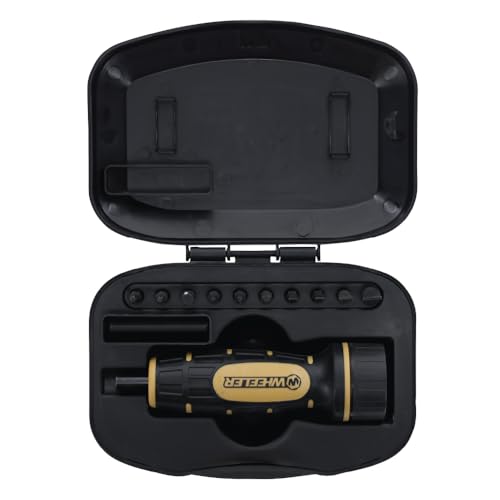
Wheeler FAT Wrench is the focused option for scope rings, bases and other firearm screws, with a 10–65 inch-pound adjustment range. Wheeler says accuracy is ±2 inch-pounds up to 40 inch-pounds and ±5% from 40 to 65 inch-pounds. The package includes 10 bits, including hex, Torx and flat-blade options, plus a hex-to-square adapter and case. It suits buyers who want a compact torque tool rather than a larger general-purpose kit. The limitation is the smaller bit selection; buyers needing many bit shapes or sizes should consider a broader assortment.
Bottom line: Choose this if the accuracy range and compact firearm-focused bit set suit your fasteners.
Real Avid Armorers Tool Kit

Real Avid Armorers Tool Kit stands apart with a long screwdriver whose bit driver has an LED, alongside a separate torque wrench and smaller bit driver. Its torque range is 10–70 inch-pounds, with 1 inch-pound increments and visual and audible click feedback, according to Real Avid. The 83-bit assortment and auxiliary handle are useful when the job involves varied screws or a stuck fastener. This kit suits maintenance tasks that benefit from illumination and multiple driver formats. It occupies more space than a focused wrench-and-bits kit, so buyers wanting only a torque driver may not need its extra tools.
Bottom line: Pick this for varied gun maintenance where an illuminated driver and multiple bit formats matter.
Wheeler 100-Piece Professional FAT Wrench Set

Wheeler 100-Piece Professional FAT Wrench Set is the broadest assortment here, pairing a FAT Wrench with a fixed driver, extension and 100 total pieces. Its contents include hollow-ground flat bits, hex bits, nut drivers, Torx, Phillips, specialty and square bits; the maker says the hollow-ground bits are designed for a precise screw fit. Rubber over-molding on the wrench and fixed driver provides a non-slip grip. This set suits a bench with varied firearm fasteners and a need to keep many bits together. The torque range and accuracy figures are not available in the specifications, so confirm those before choosing it for a job with a defined torque target.
Bottom line: Choose this when a large organized selection matters more than a torque range.
How to choose a gunsmithing torque screwdriver
Start with the torque value required for the specific fastener, then choose a tool whose range contains that value. Never substitute a general estimate for the firearm or accessory maker’s torque specification; scope rings, bases and other fasteners can have different requirements. A tool with fine increments helps set a value precisely, while an accuracy figure tells you how close the reading is expected to be. Bit fit matters too: a correctly sized driver reduces the chance of slipping or damaging a screw head. Compare the torque range, calibration accuracy and included bit types before prioritizing a larger case or extra drivers.
For firearm work, verify that the firearm is unloaded before handling or adjusting screws, and keep ammunition away from the work area.
Torque ranges and bit fit for firearm screws
Choose a torque driver whose usable range covers the manufacturer’s specification without falling below its minimum or exceeding its maximum. A torque value is not interchangeable across different fasteners, even on one firearm; use the value supplied for the exact screw or accessory. The included bit must seat fully in the screw recess without rocking. A poor fit can slip under turning force and damage the fastener. Hollow-ground flat bits are shaped to engage slotted screws more fully than a tapered general-purpose blade. Hex and Torx bits must also match both the fastener style and size, not merely appear close.
Use this quick decision guide to prioritize tool features:
| Need | Compare |
|---|---|
| One defined torque target | Range coverage and accuracy |
| Many fastener styles | Bit shapes and sizes included |
| Confined or dim access | Driver length and illumination |
| Bench organization | Case and bit organization |
Torque wrench versus standard screwdriver
A torque screwdriver is useful when a fastener needs a repeatable turning force; a standard screwdriver has no torque-setting function. Click feedback can signal that a preset has been reached, but it does not replace choosing the correct target value first. A driver with a wide range may cover more tasks, while a focused range can offer clearer fit for a narrower set of fasteners. A fixed driver or auxiliary handle can help with general turning, but should not be treated as a calibrated torque setting. Keep the torque tool reserved for controlled work and avoid using it as a breaker bar on a stuck screw.
Safe handling and storage for gunsmithing tools
Unload the firearm before beginning work, remove the magazine where applicable, and visually and physically check the chamber. Keep the muzzle pointed in a safe direction while working, and keep ammunition in a separate area. Use the correct bit to avoid cam-out, and stop if a screw resists rather than applying uncontrolled force. Store bits in their case so sizes remain identifiable and the driver is protected from dirt or damage. Torque tools depend on accurate settings, so keep the adjustment mechanism clean and handle it according to its maker’s care guidance. Recheck the firearm maker’s torque instruction whenever the fastener, mount or accessory changes.
Frequently Asked Questions
Why does scope screw torque matter?
The specified torque gives a target turning force for the particular screw and mount. Use the scope, mount or firearm maker’s value because the correct setting can differ between fasteners.
Can one torque screwdriver fit every firearm screw?
No single included bit fits every screw head. Match the bit shape and size to the recess, and make sure the driver’s torque range includes the required value.
What does inch-pound torque measure?
An inch-pound is a unit of torque, the turning force applied around a fastener. It is different from foot-pounds; 12 inch-pounds equal 1 foot-pound.
Should I use a torque driver on a stuck screw?
Avoid using a calibrated torque driver as a breaker tool on a stuck screw. Stop if the fastener does not turn normally, since excess force can damage the screw or surrounding material.
How should a firearm be prepared before gunsmithing?
Unload it, remove the magazine where applicable, and check the chamber visually and physically before work. Keep ammunition away from the work area and maintain a safe muzzle direction.