
TORQX Random Orbital Polisher Options Compared

For most buyers, Chemical Guys TORQX 9-Piece Kit is the TORQX random orbital polisher to choose because its 9-piece kit pairs the 800W, 9mm-orbit tool with detailing accessories. Choose Chemical Guys TORQX One-Step Kit if you want a one-step correction kit, or Chemical Guys BUF503 TORQX Polisher if you need only the polisher.
A random orbital polisher combines rotary and orbital pad movement; that motion is designed to make paint polishing more controlled than a rotary-only tool.
We earn a commission if you buy through links on this page. As an Amazon Associate I earn from qualifying purchases. Products are compared on manufacturer specifications, not hands-on testing.
- Best overall: Chemical Guys TORQX 9-Piece Kit – Its 9-piece kit includes the 800W, 9mm-orbit polisher for polishing and paint correction.
- Best for one-step correction: Chemical Guys TORQX One-Step Kit – The 8-piece kit includes one-step compound polish and correction pads.
- Best for tool-only buyers: Chemical Guys BUF503 TORQX Polisher – This is the standalone TORQX polisher rather than a bundled correction kit.
| Product | Best for | Kit size | Motor and orbit | Shop |
|---|---|---|---|---|
| Chemical Guys TORQX 9-Piece Kit | All-around detailing | 9 pieces | 800W; 9mm orbit | Check Price on Amazon |
| Chemical Guys TORQX One-Step Kit | One-step correction | 8 pieces | 800W; 9mm orbit | Check Price on Amazon |
| Chemical Guys BUF503 TORQX Polisher | Tool-only purchase | 1 item | — | Check Price on Amazon |
TORQX Random Orbital Polishers
Compare the three TORQX configurations by what comes with the tool and the correction setup each one targets.
Chemical Guys TORQX 9-Piece Kit

As a general-purpose TORQX bundle, this 9-piece kit combines the polisher with accessories for detailing. Chemical Guys says the tool has an 800W motor, a 9mm orbit, and a 4.7-pound weight, and is intended for polishing, waxing, and correcting paint. The random-orbital motion is designed to reduce the risk of burns and holograms compared with less forgiving polishing approaches. It suits someone starting with a coordinated kit rather than assembling supplies separately. The limitation is that the kit is not presented as a one-step compound-and-pad system; buyers focused on that specific workflow may prefer Chemical Guys TORQX One-Step Kit.
Bottom line: Choose this kit for a versatile TORQX setup spanning polishing, waxing, and correction.
Chemical Guys TORQX One-Step Kit
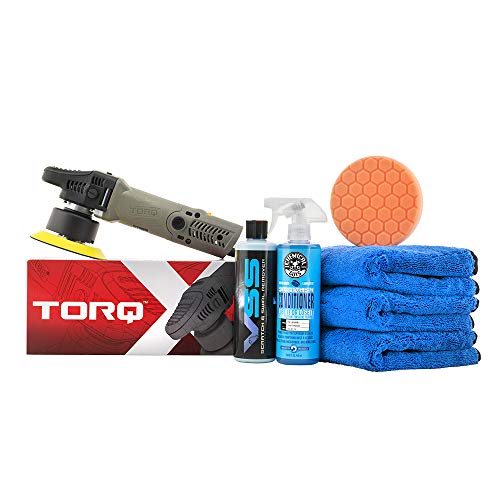
This TORQX bundle is the most focused choice for single-stage paint correction: it pairs the 800W, 9mm-orbit polisher with one-step compound polish, pads, and towels. Chemical Guys says the compound is designed to cut light-to-moderate defects and finish in one step, so the workflow is aimed at people who want correction and gloss without a separate finishing product. The kit is also described for use on clear coat, single-stage paint, polished metal, and glass. Its limitation is the narrower one-step focus; buyers who want a broader detailing bundle or just the tool may find Chemical Guys TORQX 9-Piece Kit or Chemical Guys BUF503 TORQX Polisher a better match.
Bottom line: Choose this kit when a one-step correction setup is the priority.
Chemical Guys BUF503 TORQX Polisher

Unlike the bundled TORQX options, this BUF503 is a standalone polishing tool, with no kit contents called out in the product name. Its product type is a polishing and buffing tool, and its name identifies it as a TORQX random orbital polisher. That makes it the natural fit for a buyer who already has suitable pads and compounds and wants the machine rather than another set of supplies. The trade-off is that the maker does not establish a motor wattage or orbit size, so buyers who need those figures to match a particular pad setup should confirm them before ordering.
Bottom line: Choose it if you already have pads and compounds and want the standalone tool.
How to choose a TORQX polisher configuration
Choose by workflow first: a standalone tool suits buyers who already own compatible pads and compounds, while a kit is useful when you need those supplies together. The 9-piece kit is the broadest described TORQX bundle here, while the 8-piece set is specifically organized around one-step correction. A dual-action machine moves the pad in an orbit as it rotates, helping make polishing more controllable than a rotary-only motion, but the pad and compound still determine how aggressively paint is corrected. Start with the least aggressive pad and polish that can address the defect, and make a test spot before treating a whole panel. If a scratch catches a fingernail, do not assume polishing can remove it safely; deeper damage may extend through the clear coat.
What the 9mm orbit means for paint correction
A 9mm orbit describes the distance the pad travels away from its center during the orbital motion, not the pad diameter. The two TORQX kits that give an orbit figure specify 9mm, while a 5-inch or 6-inch pad measurement describes a different dimension. Match the backing plate and pad diameter to the tool before use, and keep the pad flat against the panel to avoid uneven contact. Work a small section at a time, typically about 2 by 2 feet, so compound does not dry across a large area before you can wipe it away. Use light, even pressure; excess pressure can slow pad movement and reduce control rather than improve correction.
How to use a dual-action polisher safely
Use a dual-action polisher with a clean pad, a small amount of product, and a test area before expanding to the full vehicle. Wash and dry the paint first, since trapped grit can mar the finish as the pad moves. Keep the cord clear of the paint and work in the shade on cool panels; heat and dried residue make polishing harder to control. Check the pad often and clean away spent compound, because a loaded pad can spread residue and cut inconsistently. Paint correction removes some clear coat, so it is not a routine substitute for washing or waxing; stop when the finish is acceptable rather than repeatedly polishing the same area.
Frequently Asked Questions
What does a 9mm orbit mean on a polisher?
A 9mm orbit is the pad’s orbital travel distance, not its diameter. Pad diameter and orbit size describe separate measurements, so match pads to the backing plate rather than the orbit figure.
Can a dual-action polisher remove deep scratches?
A dual-action polisher can address light surface defects, but a scratch that catches a fingernail may be too deep for safe polishing. Removing it could cut through clear coat, so avoid repeated correction in that spot.
How large an area should I polish at once?
A section around 2 by 2 feet is a practical starting size for machine polishing. Smaller sections help keep compound workable and make it easier to maintain even pad contact.
Should I use a polisher on hot paint?
No; work on cool paint in the shade because heat can make compound dry and harder to wipe clean. Wash and dry the surface first so grit does not become trapped beneath the pad.