
Training Chopsticks for Adults: 4 Options Compared

Edison Friends Adult Training Chopsticks is the closest fit for most adults learning with a right-handed grip because silicone rings guide finger placement and can be removed as confidence grows. Left-handed learners or people seeking a helper designed for either hand should consider Wood Chopstick Helper Set instead.
Training chopsticks use rings or clip-on guides to help learners practice a controlled opening-and-closing motion before switching to standard sticks.
We earn a commission if you buy through links on this page. As an Amazon Associate I earn from qualifying purchases. Products are compared on manufacturer specifications, not hands-on testing.
- Best overall: Edison Friends Adult Training Chopsticks – Silicone finger rings guide a right-handed grip and can be detached progressively.
- Best for either hand: Wood Chopstick Helper Set – The wood-and-helper set is designed for left- or right-handed use.
- Best for group practice: Five-Pair Fiberglass Trainer Set – The set includes five pairs in different colors.
| Product | Best for | Handedness | Material | Set size | Shop |
|---|---|---|---|---|---|
| Edison Friends Adult Training Chopsticks | Right-handed learners | Right-handed | Silicone and chopsticks | 1 pair | Check Price on Amazon |
| Wood Chopstick Helper Set | Either-hand practice | Left or right-handed | Wood sticks; helper | 1 pair | Check Price on Amazon |
| Five-Pair Fiberglass Trainer Set | Family practice | — | Fiberglass | 5 pairs | Check Price on Amazon |
| Eight-Pair Fiberglass Trainer Set | Large groups | — | Fiberglass | 8 pairs | Check Price on Amazon |
Training Chopsticks for Adults
Compare the grip guidance, materials, and pair counts to find a practice setup that fits your hands and routine.
Edison Friends Adult Training Chopsticks
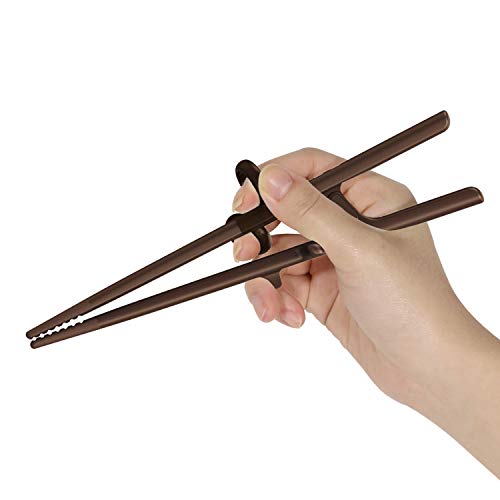
For a right-handed beginner, Edison Friends Adult Training Chopsticks uses silicone rings to cue finger placement rather than relying on a clip-on helper. The maker says learners can gradually detach the rings as their grip becomes more familiar. The maker’s instructions place the index and middle fingers in the rings, the thumb on its prop, and the ring finger on its prop. That guided arrangement suits someone who wants to learn a particular hand position. The main limitation is handedness: left-handed learners should choose a set designed for either hand instead.
Bottom line: Choose this if you are right-handed and want ring-based grip guidance.
Wood Chopstick Helper Set

Unlike a hand-specific ring guide, Wood Chopstick Helper Set is designed for left- or right-handed use and pairs a helper with natural wood sticks. The maker says its V-hinge keeps the tips aligned, while the wood grip is intended to feel steadier than slippery plastic. Its adult-oriented appearance may suit learners who want to practice at a meal without a childlike design. The specifications give a 9.5-inch length for the set. One limitation is that the helper is the central learning aid, so learners who prefer finger rings should look at a different format.
Bottom line: Pick this for either-hand use and a wood-stick helper.
Five-Pair Fiberglass Trainer Set

For a household practicing together, Five-Pair Fiberglass Trainer Set supplies five reusable pairs rather than a single learner’s set. The maker says the angular body is designed to resist slipping and that the helper position can be adjusted to personal habits. Different colors help distinguish whose pair is whose during shared practice. The set is for beginners generally, rather than being specifically described for adult hands, so adults should consider whether the fit feels comfortable before relying on it for regular use. Its five-pair count makes it the group-oriented alternative to the adult-focused options.
Bottom line: Choose this for shared beginner practice across several people.
Eight-Pair Fiberglass Trainer Set

Eight-Pair Fiberglass Trainer Set offers the largest group set here, with eight fiberglass pairs and matching clip-on helpers. The maker says those helpers support positioning and can be removed as learners become more comfortable; eight colors also make pairs easier to tell apart. That format suits a class, family, or group that wants multiple guided practice pairs at once. The product is presented for beginners rather than specifically for adults, so adults seeking a tailored grip should compare its clip-on format with the hand-oriented guides in Edison Friends Adult Training Chopsticks or Wood Chopstick Helper Set.
Bottom line: Pick this when a larger group needs matching guided practice pairs.
How to Choose Training Chopsticks for Adults
Choose by the kind of grip cue you want: finger rings position the hand, while a hinge or clip keeps the sticks aligned. A conventional grip keeps the lower stick relatively still against the ring finger and thumb base, with the upper stick moved by the thumb, index finger, and middle finger. For solo learning, a hand-specific ring arrangement can offer a clear starting position; for mixed-handed practice, seek a helper expressly designed for either hand. A measurable rule helps: if learners include both left- and right-handed people, select an ambidextrous helper rather than a right-hand-only design. Remove or reduce guidance gradually only after you can open and close the tips without losing control.
Adult Chopstick Length and Fit
Adult chopsticks commonly fall around 9 to 10 inches long, though hand size and the food being picked up affect comfort. A 9.5-inch pair is a useful middle-of-range reference, not a universal fit requirement. Shorter sticks can be easier to control for smaller hands; longer sticks offer more reach but may feel unwieldy to a beginner. Check that the tips meet cleanly and that the upper stick can move without the lower one rolling. Training helpers change the grip and tip alignment, so length alone does not guarantee a comfortable fit. Before choosing a set for regular use, compare the length with a pair you already hold comfortably.
Ring Guides and Clip-On Chopstick Helpers
Ring guides and clip-on helpers teach different parts of the motion: rings cue finger placement, while a hinge or clip helps maintain the sticks’ relative position. A learner who struggles to place fingers may find a ring arrangement easier to understand; someone whose sticks slide apart may prefer a connected helper. Standard chopstick technique moves the top stick while the bottom stick remains steadier, so avoid squeezing both sticks together as one rigid unit. A useful practice progression is to start with the guide in place, pick up larger easy-to-grip pieces, then reduce assistance and try smaller pieces. These are training aids, not a substitute for checking that the tips close securely.
Cleaning and Safe Practice
Cleaning depends on the materials and the maker’s care guidance: fiberglass sets may be labeled dishwasher-safe, while wood can warp or crack with prolonged soaking or high heat. Dry wood sticks promptly after washing and store them fully dry. During practice, use bite-size food and keep sharp, pointed tips directed away from faces and eyes; never swing chopsticks or leave them where a small child can access them unsupervised. For a first meal, choose soft, larger pieces rather than slippery noodles or tiny grains, which demand finer control. If the helper loosens, shifts, or leaves the tips misaligned, stop and reposition it before continuing.
Frequently Asked Questions
How long does it take adults to learn chopsticks?
Practice time varies, but short sessions of 10 to 15 minutes give beginners time to repeat the opening-and-closing motion without tiring their fingers. Progress from larger pieces to smaller or slippery foods once the tips meet reliably.
Can left-handed adults use training chopsticks?
Yes, if the design is intended for either hand; some ring guides are specifically right-handed. Check handedness before choosing, especially when the helper fixes finger positions.
Are fiberglass training chopsticks dishwasher safe?
Some fiberglass training sets are labeled dishwasher-safe, but that claim does not apply to every material or helper. Separate removable parts only as directed, and hand-wash wood sticks to avoid prolonged heat and moisture.
When should I remove the chopstick helper?
Reduce the helper once you can repeatedly open and close the tips while keeping them aligned. Try a few bites without assistance, then put the guide back if the sticks begin crossing or slipping.
What foods are easiest for chopstick beginners?
Larger, soft pieces such as dumplings or chunks of cooked vegetables are easier to grip than tiny grains or slippery noodles. Begin with pieces around 1 inch across, then move to smaller foods as tip control improves.