
TRQ Brake Rotors: Kits Compared by Vehicle Fit

For a TRQ brake rotor kit covering both axles, TRQ Front & Rear Ceramic Kit includes four rotors and front and rear ceramic pad sets; choose a front-only kit if you need parts for just the front axle. These are vehicle-specific replacement kits, so match the exact year, model, trim and brake configuration before ordering.
Choose a different kit when its vehicle range matches your car or truck instead; a similar model name alone does not establish fit.
We earn a commission if you buy through links on this page. As an Amazon Associate I earn from qualifying purchases. Products are compared on manufacturer specifications, not hands-on testing.
- Best overall: TRQ Front & Rear Ceramic Kit – Includes two front and two rear rotors plus front and rear ceramic pad sets.
- Best for Silverado and Escalade: TRQ Front Ceramic Kit for GM Trucks and SUVs – Front kit covers the Silverado, Tahoe, Suburban, Avalanche, Express 1500 and Escalade ranges.
- Best for Subaru front and rear: TRQ Front & Rear Ceramic Kit for Subaru – Includes front and rear pads and rotors, with a specified 300 mm rear-rotor fit for WRX.
| Product | Best for | Axle coverage | Ceramic pad sets | Rotors | Shop |
|---|---|---|---|---|---|
| TRQ Front & Rear Ceramic Kit | Front and rear | Front and rear | 2 | 4 | Check Price on Amazon |
| TRQ Front Ceramic Kit for Subaru and Scion | Subaru front axle | Front | 1 | 2 | Check Price on Amazon |
| TRQ Front Ceramic Kit for Hyundai and Kia | Hyundai front axle | Front | 1 | 2 | Check Price on Amazon |
| TRQ Front Ceramic Kit for GM Trucks and SUVs | GM front axle | Front | 1 | 2 | Check Price on Amazon |
| TRQ Front & Rear Ceramic Kit for Subaru | Subaru both axles | Front and rear | 2 | 4 | Check Price on Amazon |
TRQ Brake Rotor Kits Compared
Compare axle coverage and the vehicle range before selecting a kit.
TRQ Front & Rear Ceramic Kit

Unlike the front-only kits here, this set covers both axles with two front rotors, two rear rotors, and ceramic pad sets for the front and rear. Its applications include Lexus ES and UX models, Toyota Avalon, Camry, Corolla Cross, RAV4 and Venza across specified years. That makes it the broadest axle-coverage option for a buyer whose vehicle is in that range. The fit range spans multiple model lines, so verify the exact year and brake configuration before choosing; a shared model name does not guarantee the same rotor fit.
Bottom line: Choose this when your listed Lexus or Toyota application needs front and rear brake parts.
TRQ Front Ceramic Kit for Subaru and Scion

This front-axle kit is the option here for listed Subaru Impreza WRX, Crosstrek, Forester, Legacy, Outback and BRZ applications, as well as Scion FR-S. It includes one front ceramic pad set and two front rotors, rather than rear-axle parts. The range crosses several vehicles and model years, so identify the precise vehicle before selecting it. Buyers replacing the rear brakes too need a separate rear-axle solution; this kit should not be treated as a complete four-wheel brake set.
Bottom line: Choose this for a matching Subaru or Scion that needs front-axle parts only.
TRQ Front Ceramic Kit for Hyundai and Kia
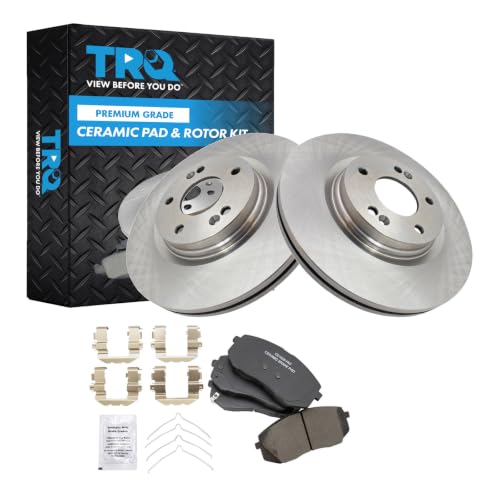
This front-only kit is distinguished by its Hyundai Sonata and Kona Electric and Kia Optima applications. One ceramic pad set and two front rotors are included, so it addresses the front axle rather than all four wheels. Check the exact year and brake configuration for the vehicle, especially across the different model ranges named for this kit. If the repair includes rear brakes, this package does not provide rear pads or rotors.
Bottom line: Choose this for a Sonata, Kona Electric or Optima needing front-axle parts.
TRQ Front Ceramic Kit for GM Trucks and SUVs

This front-axle set targets the Chevrolet Silverado, Tahoe, Suburban, Avalanche and Express 1500 applications, plus Cadillac Escalade. It contains one ceramic pad set and two rotors for the front, making it distinct from the passenger-car kits in its vehicle range. Because the application span includes multiple years and vehicle variants, confirm the precise brake fit for the truck or SUV. The kit does not include rear parts, so it is not the choice for a complete four-wheel replacement.
Bottom line: Choose this for a matching Chevrolet or Cadillac that needs front brakes.
TRQ Front & Rear Ceramic Kit for Subaru

This Subaru-oriented kit includes front and rear ceramic pad sets and four rotors, unlike the front-only Subaru set. The applications include WRX with 300 mm rear rotors and Legacy and Outback applications. That rear-rotor dimension is a key fit condition: do not assume a WRX with another rear rotor size uses this kit. Verify year and configuration before selecting it, and note that the package is intended to cover both axles rather than only a front brake job.
Bottom line: Choose this for a Subaru needing both axles and the specified rear-rotor fit.
How to choose a TRQ brake rotor kit
Choose first by vehicle fit, then by whether the job covers one axle or both. A front kit includes two rotors and one front pad set; a front-and-rear kit includes four rotors and front and rear pad sets. Brake components are axle-specific, and vehicle year, trim, engine and brake package can change fit even within one model line. Use the vehicle identification number and the vehicle’s brake configuration to check compatibility. For a WRX, the specified 300 mm rear-rotor condition in TRQ Front & Rear Ceramic Kit for Subaru is a concrete example of why a model name alone is not enough. If you are replacing pads as well, a kit with the matching pad set avoids sourcing that axle’s pads separately.
Front-only versus front-and-rear brake kits
Front-only kits suit a repair limited to the front axle; front-and-rear kits supply parts for all four wheels. The front and rear components are not interchangeable, and rotor diameter, thickness and hat offset can differ by axle. Replacing rotors in axle pairs helps keep braking behavior balanced from side to side. The table shows what each package covers, not which vehicle it fits; use the exact vehicle application to confirm fit.
| Repair need | Kit coverage | Included parts |
|---|---|---|
| Front axle only | Front | 2 rotors and 1 front pad set |
| Both axles | Front and rear | 4 rotors and 2 pad sets |
Do not buy a front-only set for a four-wheel job simply because its vehicle range looks similar. Confirm whether the repair calls for front, rear or both axles.
Rotor thickness and brake fit checks
Rotor fit depends on more than diameter: thickness, center bore, bolt pattern and rotor height must match the vehicle’s brake assembly. A rotor’s minimum discard thickness is commonly stamped on the rotor itself; measure the friction surface with a micrometer and replace a rotor at or below that limit. Check for a specified rear diameter as well as axle coverage, since a different rear-rotor size can rule out an otherwise similar application. Before beginning work, confirm the vehicle’s rotor specifications and replacement procedure. A rotor that bolts on but falls outside the correct dimensions is not a safe substitute.
Safe brake installation and bedding
Brake work involves supporting a heavy vehicle and handling components that directly affect stopping, so use rated jack stands on firm, level ground and never rely on a jack alone. Keep grease and oil off the rotor and pad friction surfaces; contamination can reduce braking. Clean the hub face before fitting a rotor, since rust or debris trapped behind it can cause runout and pedal pulsation. Tighten wheel fasteners in a star pattern to the vehicle maker’s torque specification, not an assumed universal value. New pads and rotors also need the bedding procedure specified for the friction material; avoid hard stops until that process is complete.
Frequently Asked Questions
Should brake rotors be replaced in pairs?
Yes, replace rotors on both sides of the same axle to keep braking response consistent left to right. A front-and-rear kit is needed only when both axles are part of the repair.
How can I tell if my brake rotors are too thin?
Measure rotor thickness with a micrometer and compare it with the minimum thickness marked on the rotor or specified for the vehicle. Replace a rotor at or below that limit; visual appearance alone cannot establish thickness.
Do new brake pads need a break-in procedure?
Yes, new pads and rotors generally need bedding so the friction surfaces mate properly. Use the procedure specified for the pad material, and avoid aggressive stops until bedding is complete.
Can I install ceramic pads with another rotor type?
Ceramic pads are designed for compatible rotor surfaces, but matching the vehicle’s rotor dimensions and brake specification still matters. Do not mix components based only on the pad material.
What causes brake pedal pulsation after rotor replacement?
Uneven rotor runout can cause pulsation, and rust or debris between the hub and rotor can contribute. Clean the hub face before installation and use the vehicle’s specified wheel-fastener torque.