
Ultra Thin Door Mats: 5 Low-Profile Options Compared

For most indoor entries, Color&Geometry 24 x 36-Inch Mat is the strongest fit because its 24 by 36-inch surface has a 0.08-inch profile. Choose a smaller mat if your doorway has limited floor space, or compare other sizes if you need a wider landing area.
Ultra thin door mats are low-profile textile mats designed to fit beneath doors with less clearance than thicker rugs; check the gap beneath your door before choosing a thickness.
We earn a commission if you buy through links on this page. As an Amazon Associate I earn from qualifying purchases. Products are compared on manufacturer specifications, not hands-on testing.
- Best overall: Color&Geometry 24 x 36-Inch Mat – Its 24 by 36-inch size pairs with a 0.08-inch profile.
- Best for compact entries: BEISIFLOOR 17 x 29-Inch Mat – Its 17 by 29-inch footprint takes up less floor space.
- Best for narrow spaces: LYGLIGH 16 x 24-Inch Mat – The 16 by 24-inch mat has a 0.1-inch profile.
| Product | Best for | Size | Thickness | Backing | Shop |
|---|---|---|---|---|---|
| Color&Geometry 24 x 36-Inch Mat | Larger entryways | 24 x 36 in | 0.08 in | TPR | Check Price on Amazon |
| BEISIFLOOR 17 x 29-Inch Mat | Compact entries | 17 x 29 in | 0.15 in | Rubber | Check Price on Amazon |
| LYGLIGH 16 x 24-Inch Mat | Small doorways | 16 x 24 in | 0.1 in | Natural rubber | Check Price on Amazon |
| LEKEEPGO 24 x 36-Inch Mat | Dirt and moisture | 24 x 36 in | 0.15 in | Rubber | Check Price on Amazon |
| LUMI 24 x 36-Inch Mat | Rolled delivery | 24 x 36 in | 0.14 in | Waterproof rubber | Check Price on Amazon |
Ultra thin door mats compared
Compare dimensions, thickness and backing to find a low-profile mat that fits your entry.
Color&Geometry 24 x 36-Inch Mat

The 24 by 36-inch footprint gives this mat more coverage than the compact options, while its 0.08-inch thickness is the slimmest of these choices. A polyester woven surface has a mixed-color charcoal gray pattern, and the TPR bottom is intended to grip the floor. Choose it for a wider indoor doorway where a broad landing area matters. The larger size needs more clear floor space, so measure the entry before settling on it.
Bottom line: Choose this mat when you want broad coverage with the lowest profile.
BEISIFLOOR 17 x 29-Inch Mat

The 17 by 29-inch size makes this the smallest option by area, useful when a full 24 by 36-inch mat would crowd a narrow entry. Its polyester herringbone surface is described as absorbing moisture and scraping dirt from shoes, and a rubber backing is intended to limit movement. The 0.15-inch thickness is greater than the thinnest picks here, so check a tight door gap rather than assuming every low-profile mat will clear it. The mat is shipped rolled.
Bottom line: Pick this size for a compact doorway where floor coverage is limited.
LYGLIGH 16 x 24-Inch Mat

The 16 by 24-inch footprint is the smallest rectangular option, and the 0.1-inch profile suits buyers prioritizing a narrow door clearance. LYGLIGH pairs a gray surface with natural rubber backing and describes the mat as washable, pet-friendly, dirt-trapping and absorbent. Its compact dimensions leave less room for multiple steps than a 24 by 36-inch mat, so it is better suited to a small landing than a wide entry. The maker also gives a slip-resistance coefficient of 0.54.
Bottom line: Choose this mat for a small landing where a slim profile is the priority.
LEKEEPGO 24 x 36-Inch Mat
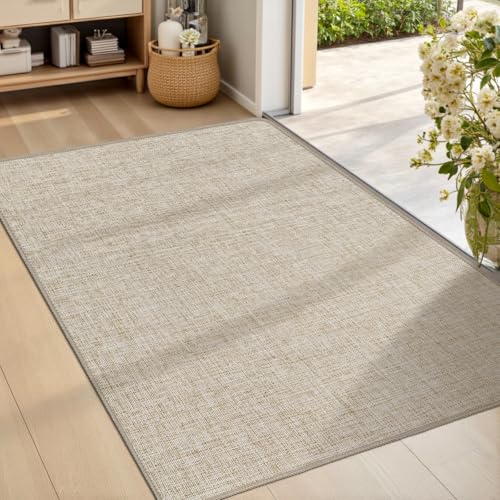
The 24 by 36-inch size offers the same broad coverage as the largest option, but this mat is 0.15 inches thick. Its simulated-linen woven surface is intended to absorb moisture and scrape dirt from shoes, and rubber backing is intended to help it stay in place. The khaki color and finished edges suit an entry where appearance is a consideration alongside everyday debris. Its profile is thicker than the slimmest choices, so measure the door clearance if the door nearly meets the floor.
Bottom line: Pick this mat for a larger entry where dirt and moisture capture matter.
LUMI 24 x 36-Inch Mat

The 24 by 36-inch LUMI mat combines broad coverage with a 0.14-inch thickness, slightly slimmer than the other 24 by 36-inch alternatives here. Its taupe-beige herringbone surface is designed to catch everyday dirt and moisture, while the waterproof rubber backing is intended to provide grip. The mat arrives rolled to minimize fold creases. This is a practical choice for a larger entry or hall; the 0.14-inch profile still needs checking against a particularly low door sweep.
Bottom line: Choose this option for a full-size entry mat with rolled packaging and waterproof backing.
How to choose an ultra thin door mat
Start with the door gap, then choose the footprint that covers the landing without obstructing the door. Measure the smallest clearance as the door swings over the intended mat position; if the gap is under 0.1 inch, even a mat around one-tenth inch thick may catch. Also measure the available floor area so the mat does not extend into a walkway. A larger 24 by 36-inch mat covers more approach area than a 16 by 24-inch option, but needs more open floor. For a tight gap, pick a thickness below the measured clearance rather than relying on the word “thin.”
Backing matters on smooth hard floors. Place the mat on a clean, dry surface and check that its edges lie flat; grit or curled edges can make any mat shift or catch a shoe.
Mat sizes and door clearance
Common entry mat dimensions include 18 by 30 inches and 24 by 36 inches; the first is a compact footprint, while the second gives more room for incoming steps. The options here range from 16 by 24 to 24 by 36 inches, so use the measured floor area rather than assuming a standard doorway size. Measure width and depth where the mat will sit, including nearby trim and furniture. Leave enough room for the door to travel over the mat without dragging it.
Thickness is only one part of clearance: a door sweep or uneven floor can reduce the usable gap. Open and close the door over a paper-thin test layer or measure the gap at several points before selecting a mat. A door that scrapes at one edge needs a slimmer profile or a different placement.
Backing and surface materials
Textile tops catch loose dirt and moisture, while rubber or TPR backing helps keep a mat from sliding on smooth floors. The products here use polyester or simulated-linen surfaces and rubber-based backings; backing material alone does not guarantee a secure hold on every floor. Dust, water and floor polish can reduce grip, so clean and dry both the floor and underside before placement. A mat that shifts should be repositioned or removed until it rests securely.
Absorbent surfaces are useful for routine dampness, but a door mat is not a substitute for removing pooled water. If an entry is regularly wet, dry the floor promptly and check that the mat itself dries thoroughly. For washable mats, follow the care directions supplied with the product to avoid damaging its backing.
Using an indoor entry mat safely
A mat should lie flat with its edges settled, and it should not slide when stepped on. Check its position after cleaning and whenever it gets wet; a curled corner or moving backing can become a trip hazard. Keep the mat fully within the entry area rather than allowing an edge to project into a walking route. Pets, children and older adults may move mats during normal traffic, so inspect placement regularly.
Use the size and thickness together: a 24 by 36-inch mat needs more clear floor area than a 16 by 24-inch one, while an extra fraction of an inch can affect door movement. If the door touches a mat or the mat shifts on the floor, do not force the door over it; select a thinner fit or reposition it.
Frequently Asked Questions
How thin should a mat be for a door sweep?
Choose a mat thinner than the measured gap beneath the door sweep. For example, a gap under 0.1 inch calls for a profile below one-tenth inch, with extra clearance if the floor is uneven.
What size indoor door mat fits a small entry?
A 16 by 24-inch mat uses less floor area than a 24 by 36-inch mat. Measure the available width and depth first, including the door’s swing path.
Can a thin door mat stop a door from closing?
Yes, if the mat is thicker than the door’s clearance or the sweep drags over it. Compare the mat thickness with the smallest measured gap along the door’s path.
How do I keep an entry mat from slipping?
Set the mat on a clean, dry floor and press it flat so the backing contacts the surface evenly. Recheck it after damp conditions or cleaning, since moisture and residue can reduce grip.
How often should an indoor door mat be cleaned?
Clean it when visible grit builds up or the surface becomes damp or soiled; trapped debris can work back onto the floor. For washable models, use the care directions for that mat.