
UV Bright Water Bottle: 5 UV-C Bottles Compared

UVBRITE Beam+ 22 oz is the closest match for shoppers seeking a UV bright water bottle because it pairs UV-C cleaning with a filter in a 22-ounce insulated bottle. Choose a different option if you want a lighter, noninsulated bottle, an app-linked straw, or a smaller capacity.
We earn a commission if you buy through links on this page. As an Amazon Associate I earn from qualifying purchases. Products are compared on manufacturer specifications, not hands-on testing.
- Best overall: UVBRITE Beam+ 22 oz – Combines a filter and UV-C cleaning in an insulated 22-ounce bottle.
- Best for light carry: LARQ Movement 24 oz – Its single-wall, noninsulated design weighs less than the insulated options.
- Best for filter-straw use: LARQ PureVis 2 23 oz – Adds a filter straw and app water-intake tracking.
| Product | Best for | Capacity | Insulation | UV cycle | Shop |
|---|---|---|---|---|---|
| UVBRITE Beam+ 22 oz | UV plus filtration | 22 oz | Insulated; cold 24 hours | Every 6 hours | Check Price on Amazon |
| First Health UV-C 18 oz | Short UV cycle | 18 oz | Insulated; hot 12 hours, cold 24 hours | 3-minute cycle | Check Price on Amazon |
| LARQ Movement 24 oz | Lightweight carry | 24 oz | Not insulated | Every 2 hours | Check Price on Amazon |
| LARQ PureVis 2 23 oz | Filtered straw use | 23 oz | Insulated; cold 24 hours | Every 2 hours | Check Price on Amazon |
| LARQ PureVis 17 oz | Compact insulation | 17 oz | Insulated; cold 24 hours, hot 12 hours | Every 2 hours | Check Price on Amazon |
UV bright water bottles compared
Compare capacity, insulation, filtration and cleaning cycles to match a bottle to your routine.
UVBRITE Beam+ 22 oz

UVBRITE Beam+ 22 oz stands apart by combining UV-C cleaning with a DuoCore filter in one insulated bottle. The brand says its filter reduces chlorine, lead and PFAS, and says the bottle’s UV-C cycle runs automatically every 6 hours; the bottle is 22 ounces and keeps drinks cold for 24 hours. That combination suits someone who wants to address both taste and microbial concerns in one bottle. UV-C does not remove dissolved chemicals, so filtration is the relevant feature for those contaminants. The limitation is its larger 22-ounce capacity if you want a compact bottle.
Bottom line: Pick this if you want UV-C cleaning and filtration together.
First Health UV-C 18 oz

First Health UV-C 18 oz is the smaller insulated option among these bottles, with an 18-ounce capacity and a rechargeable UV-C cap. The brand says the UV cycle disinfects a beverage in 3 minutes and also describes the cap as a standalone handheld sanitizer. It suits someone who prefers a compact bottle and wants a defined cycle rather than an automatic repeating schedule. The bottle is insulated for hot or cold drinks, but unlike UVBRITE Beam+ 22 oz and LARQ PureVis 2 23 oz, its features do not include filtration; UV-C does not remove dissolved chemicals or improve taste by filtering them.
Bottom line: Choose this for an 18-ounce insulated bottle with a rechargeable UV-C cap.
LARQ Movement 24 oz
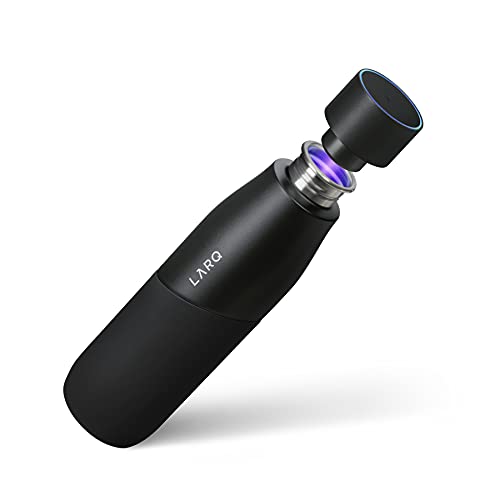
LARQ Movement 24 oz is the noninsulated choice, built as a single-wall stainless-steel bottle rather than a vacuum-insulated one. The brand says its PureVis UV-C LED cycles every 2 hours and neutralizes bacteria such as E. coli in the water and on inner surfaces. At 24 ounces, it offers more capacity than First Health UV-C 18 oz or LARQ PureVis 17 oz, while its narrower 2.8-inch width and 0.668-pound weight suit a lighter carry. The tradeoff is explicit: it will not keep drinks cold or hot, and ice water can cause exterior condensation, so it is less suited to temperature retention.
Bottom line: Choose this when low carry weight matters more than insulation.
LARQ PureVis 2 23 oz
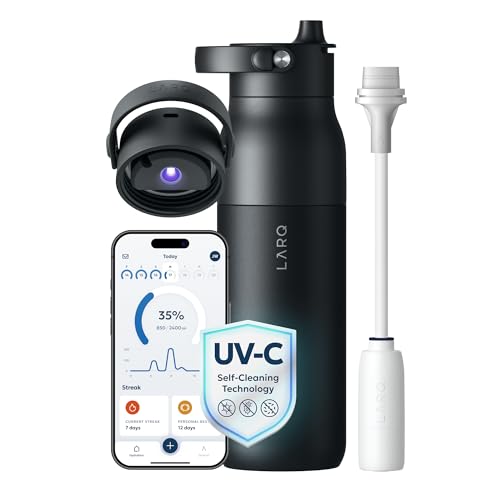
LARQ PureVis 2 23 oz adds a filter straw and app water-intake tracking, features that distinguish it from the other options. The brand says the UV-C LED activates every 2 hours and eliminates 99% of bio-contaminants; its filter straw is rated for 40 gallons or about 2 months and reduces chlorine, VOCs, PFAS and pharmaceuticals. The 23-ounce insulated bottle is a fit for someone who wants filtration while drinking through a straw. The filter adds draw resistance, so buyers who prefer an unrestricted sip may prefer a bottle without a straw filter.
Bottom line: Pick this for a filter straw, UV-C cycle and intake tracking.
LARQ PureVis 17 oz
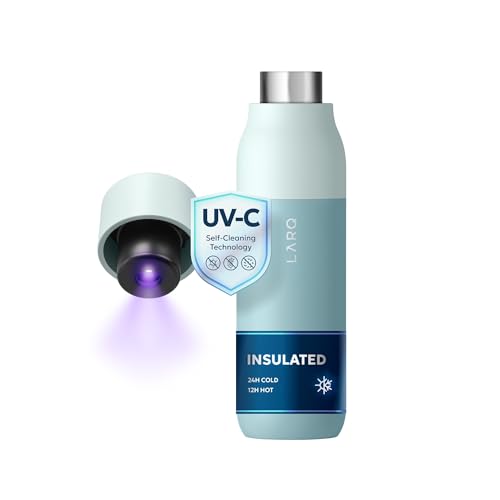
LARQ PureVis 17 oz is the smallest-capacity insulated option here, with a 17-ounce size and a 2.68-inch width. The brand says its PureVis UV-C LED activates every 2 hours, while the double-wall vacuum insulation keeps drinks cold for 24 hours or hot for 12 hours. A light ring on the cap signals the purification cycle and warns when the battery runs low, according to the brand. This bottle suits a smaller bag or shorter outing. Its 17-ounce capacity means more frequent refills than the 22- to 24-ounce choices.
Bottom line: Choose this for a compact insulated bottle with a UV-C cycle.
How to choose a UV bright water bottle
Start with whether you need filtration as well as UV-C: UV-C addresses microbes but does not remove dissolved lead, PFAS or chlorine. A filter can reduce certain dissolved contaminants, but its capabilities depend on the filter media and its tested claims. For a typical day, 17 to 24 ounces is the capacity range in these choices; select the larger end if refill access is limited. Insulation is a separate decision: vacuum-insulated steel holds temperature, while single-wall metal is lighter but does not. If you need both taste filtration and UV-C, choose a combination model; if reducing carry weight is the priority, consider noninsulated construction.
What UV-C cleaning can and cannot do
UV-C works by exposing microbes to ultraviolet light, but it is not a substitute for removing particles or dissolved chemicals. A filter is needed for contaminants such as chlorine, lead or PFAS, and filter claims apply only to the substances the particular filter addresses. UV treatment also depends on light reaching the water and bottle surfaces; opaque liquid, debris or surfaces outside the illuminated area can affect exposure. For safer handling, use potable water rather than assuming a UV bottle can make any water source safe. Treat UV-C as one part of a water routine, not as proof that unknown water is drinkable.
Insulated versus single-wall UV bottles
Insulated bottles use a sealed vacuum layer between metal walls to slow heat transfer; single-wall bottles lack that layer and can sweat with ice water. Choose insulation if you need temperature retention or want to avoid condensation on a desk. Choose a single-wall design when reducing carried weight matters more than keeping a drink cold or hot. The capacities here span 17 to 24 ounces, so a capacity increase may also mean a larger, heavier bottle once filled. Check that a bottle fits your cup holder or bag pocket by comparing its width and height with the available space.
| Need | Type to consider | Tradeoff |
|---|---|---|
| Temperature retention | Vacuum-insulated bottle | More construction than single wall |
| Lower carry weight | Single-wall bottle | No hot or cold retention |
| Taste or dissolved contaminant reduction | Model with a compatible filter | Filter needs replacement |
Filter and UV-C care basics
Filter life is measured by volume or time, and the interval depends on the specific filter; one option here gives a 40-gallon or roughly 2-month rating. Replace a filter at its limit rather than assuming UV-C extends its life. UV-C cycling also does not clean away visible residue, so wash the bottle and cap regularly with the cleaning method permitted by their materials. Keep the cap’s light source unobstructed during a cycle and do not look directly at an active UV-C emitter. With filter-straw bottles, rinsing after use can help clear beverage residue, especially after drinks other than plain water.
Frequently Asked Questions
Does UV-C remove lead or PFAS from water?
No, UV-C disinfects microbes but does not remove dissolved lead or PFAS. Use a filter specifically rated for the contaminant you want to reduce.
Can a UV water bottle make creek water safe?
Do not assume a UV bottle makes untreated creek water safe to drink. Water with sediment or other contaminants may need additional treatment, and UV-C does not remove chemicals or particles.
How often should I replace a water bottle filter?
Follow the filter’s capacity or time limit, whichever comes first. One filter straw in this group is rated for 40 gallons or about 2 months.
Can I put sports drinks in a UV-C bottle?
Check whether the specific bottle permits beverages other than water before using one. Sugary or colored drinks can leave residue, and UV-C does not remove that residue.
How do I clean a UV-C bottle cap?
Wash the bottle and cap according to the materials’ permitted cleaning method, and keep the UV-C emitter free of residue. Never look directly at an active UV-C light.