
Velo Plush Bike Seat: Saddles Compared by Fit

The Velo Plush Pace Men’s Saddle is the closest match for a Velo plush bike seat if you want a 175 mm-wide saddle designed for men. Choose a different option if you need a wider unisex shape, gel padding, or a saddle suited to a more upright position.
We earn a commission if you buy through links on this page. As an Amazon Associate I earn from qualifying purchases. Products are compared on manufacturer specifications, not hands-on testing.
- Best overall: Velo Plush Pace Men’s Saddle – Its 272 by 175 mm shape is the named Velo Plush Pace saddle, with a pressure-relieving top for upright riding.
- Best for a wider fit: Velo Voam Cloud O Saddle – The unisex Cloud O is 211 mm wide and uses memory foam with a center cutout.
- Best for gel padding: Velo VL-6263 Plush Saddle – The unisex VL-6263 uses gel padding and is intended for cruiser, hybrid, urban, and commuting bikes.
| Product | Best for | Width | Padding | Rail material | Shop |
|---|---|---|---|---|---|
| Velo Plush Pace Men’s Saddle | Men’s fit | 175 mm | — | Steel | Check Price on Amazon |
| Velo Voam Cloud O Saddle | Wider upright fit | 211 mm | Memory foam | Steel | Check Price on Amazon |
| Velo VL-6263 Plush Saddle | Gel comfort bikes | 194 mm | Gel | Steel | Check Price on Amazon |
| Velo Bio:Logic Saddle | Spin bike use | 175 mm | — | — | Check Price on Amazon |
Velo plush bike seats
Compare the Velo options by width, padding, and the riding position or bike type each is intended to suit.
Velo Plush Pace Men’s Saddle

The Velo Plush Pace is the men’s-specific option in this group, with a narrower 175 mm width than the 194 mm VL-6263 and 211 mm Cloud O. Its U-shaped top is intended to relieve pressure in an upright riding position, and it has a polyurethane cover with silver steel rails. Choose it if you want a Velo saddle sized and shaped for a men’s fit rather than a broad unisex saddle. The maker does not identify its padding material, so riders who specifically want memory foam or gel should consider another option.
Bottom line: Pick this if a men’s-specific 175 mm saddle suits your fit and upright posture.
Velo Voam Cloud O Saddle
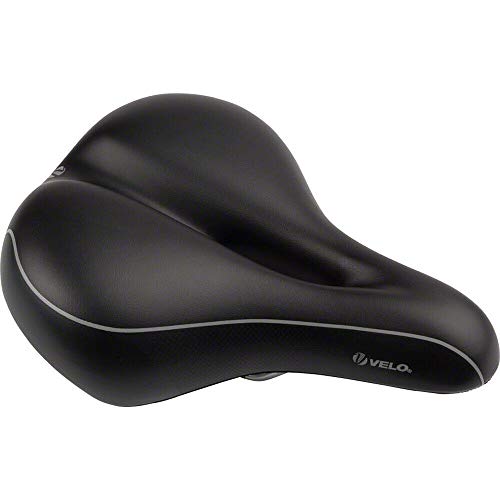
The Velo Voam Cloud O is the widest Velo option here at 211 mm, and its memory foam distinguishes it from the Pace and gel-padded VL-6263. The unisex saddle measures 274 by 211 mm and pairs silver steel rails with elastomer bumpers. Its U-shaped top and center cutout are intended for pressure relief, making it a possible choice for upright riding when a broad saddle is preferred. The width may be too much for riders whose sit-bone spacing or riding posture calls for a narrower saddle.
Bottom line: Choose this if you want a broad unisex saddle with memory foam.
Velo VL-6263 Plush Saddle

The Velo VL-6263 uses gel padding rather than the Cloud O’s memory foam and is explicitly aimed at comfort, cruiser, hybrid, urban, and commuting bikes. It is a unisex saddle measuring 265 by 194 mm, with a PU leather cover and steel rails. Velo describes its ArcTech rail-to-shell connection as allowing some flexibility. This makes it the most specifically bike-type-oriented option among these Velo saddles. At 194 mm wide, it is narrower than the Cloud O; riders seeking a men’s-specific saddle should compare its shape with the Pace instead.
Bottom line: Choose this for a gel-padded unisex saddle for a cruiser, hybrid, or city bike.
Velo Bio:Logic Saddle
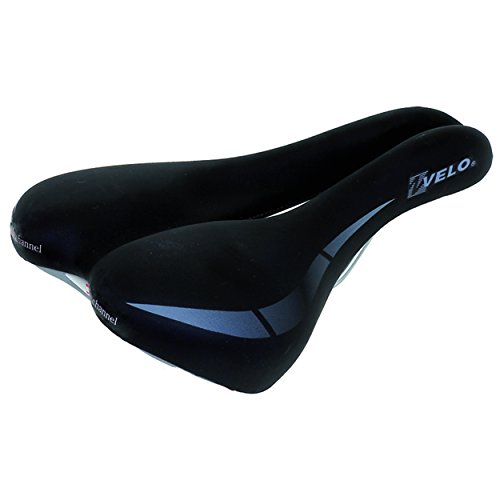
The Velo Bio:Logic is the option here explicitly intended as a replacement for spin-bike saddles, including Peloton, NordicTrack, and ProForm models. It measures 270 by 175 mm and weighs 358 grams, with an O-Zone cut and a wide channel. The feature set also names ARC-TECH suspension, distinguishing it from the road- and comfort-bike-oriented saddles in this group. Its 175 mm width may suit riders seeking a narrower replacement, but riders choosing by rail compatibility should confirm that the saddle rails match their spin bike’s clamp before ordering.
Bottom line: Choose this for a spin-bike replacement when its width and clamp fit your bike.
How to choose a Velo plush bike seat
Choose a saddle by matching its width and shape to your sit-bone spacing and riding posture, not by padding thickness alone. A common starting point is a saddle about 20 to 30 mm wider than measured sit-bone width; a more upright position can call for a broader support area than a low, forward posture. Compare the 175 mm Pace, 194 mm VL-6263, and 211 mm Cloud O as different width choices, not as a ranking of comfort. Cutouts and channels also vary in shape, so they are not interchangeable. If you have a choice between widths, use a sit-bone measurement and intended posture to narrow the options before buying.
Check saddle width and seatpost fit
Confirm the seatpost clamp can hold the saddle’s rails before replacing a seat. Many conventional bicycle saddles use round rails about 7 mm in diameter, but some posts require different rail shapes or dimensions; check the post and clamp rather than assuming compatibility. Saddle height and fore-aft position also affect comfort: make small adjustments, then check that your knee remains slightly bent at the bottom of the pedal stroke and that you can reach the handlebars without rocking your hips. Width alone does not guarantee fit. For a replacement, also verify that the saddle can be positioned far enough forward or back to preserve a comfortable pedaling position.
Foam, gel, and saddle cutouts
Foam and gel describe padding materials, while a cutout or channel changes the saddle’s center shape; these are separate design choices. The Cloud O uses memory foam and a center cutout, while the VL-6263 uses gel padding, and the Bio:Logic has a wide channel. More padding is not automatically more comfortable on a long ride: excessive softness can increase movement and pressure where the body contacts the saddle. A relief opening only helps if its width and placement match the rider. Compare the intended posture and width alongside the padding rather than choosing by material name alone.
Set up a new bicycle saddle safely
Install a replacement saddle with the rails fully seated in the clamp, then tighten the fasteners to the seatpost or bicycle maker’s torque specification; do not guess at a torque value. A loose saddle can rotate under load, while overtightening can damage rails or clamp parts. Begin with the saddle approximately level, then make small angle and height changes rather than tilting the nose sharply down to address pressure. After adjustment, check that the saddle does not shift during a short ride and recheck fasteners as the bicycle maker directs. A wrench or adapter does not remove the need to confirm clamp compatibility.
Frequently Asked Questions
How do I measure my sit-bone width for a saddle?
Sit on corrugated cardboard or a purpose-made measuring pad on a firm, flat surface, then measure the center-to-center distance between the two impressions. A common starting saddle width is about 20 to 30 mm wider than that measurement, with posture influencing the final choice.
Does a wider bicycle saddle always feel more comfortable?
No; a saddle should support the sit bones without extending so far that the inner thighs rub. A width around 20 to 30 mm beyond sit-bone spacing is a common initial fit range, but upright posture can favor a broader support area.
How level should a bicycle saddle be installed?
Start with the saddle approximately level, then adjust in small increments for comfort. A sharply nose-down angle can make the rider slide forward and place more weight on the hands.
Can I put any saddle on my existing seatpost?
No; the seatpost clamp must match the saddle rail shape and diameter. Many conventional saddles use 7 mm round rails, but confirm compatibility with the clamp before installation.
How high should a replacement bike saddle sit?
Set saddle height so the knee remains slightly bent when the pedal is at the bottom of its stroke. If the hips rock to reach the pedal, lower the saddle; make small changes and recheck the pedaling position.