
Victor Rodent Repeller Plug-In Options Compared

Victor M751PS PestChaser is the Victor rodent repeller plug-in to choose if you want an extra outlet alongside a nightlight; both Victor options are intended for average-size rooms. Choose Victor PestChaser Nightlight 6-Pack if you need multiple rooms covered, while Three-Mode Ultrasonic Pest Repeller 6-Pack is a different-brand, multi-pest alternative rather than a Victor model.
Plug-in ultrasonic repellers emit high-frequency sound; they are deterrent devices, not a substitute for sealing rodent entry points or removing food sources.
We earn a commission if you buy through links on this page. As an Amazon Associate I earn from qualifying purchases. Products are compared on manufacturer specifications, not hands-on testing.
- Best overall: Victor M751PS PestChaser – It combines average-room use with a nightlight and an extra outlet.
- Best for multiple rooms: Victor PestChaser Nightlight 6-Pack – The package contains six Victor repellers, each with a nightlight.
- Best for multiple pest types: Three-Mode Ultrasonic Pest Repeller 6-Pack – Its multi-frequency range is listed as 10 kHz–65 kHz, and it targets several pest types.
| Product | Best for | Pack size | Room coverage | Added feature | Shop |
|---|---|---|---|---|---|
| Victor M751PS PestChaser | Outlet and nightlight | 1 unit | Average-size rooms | Nightlight; extra outlet | Check Price on Amazon |
| Victor PestChaser Nightlight 6-Pack | Several indoor rooms | 6 units | Average-size rooms | Nightlight | Check Price on Amazon |
| Three-Mode Ultrasonic Pest Repeller 6-Pack | Multiple pest types | 6 units | Indoor use | 3 modes; 10–65 kHz | Check Price on Amazon |
Victor Rodent Repeller Plug-In Options
Compare the two Victor plug-ins with a multi-pest alternative by intended room use, package count and built-in extras.
Victor M751PS PestChaser
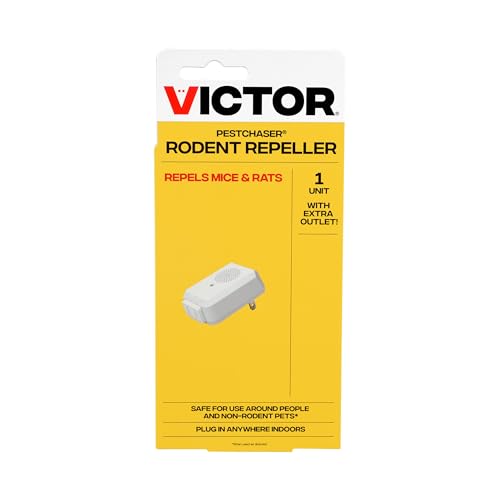
The M751PS stands apart from the other Victor option by adding an extra outlet, so it keeps a receptacle available while plugged in. Victor says the device emits high-frequency sound to repel mice and rats in average-size rooms such as living rooms, bedrooms and kitchens; it also has a soft-illumination nightlight. Its small white body measures 2.63 inches high, 1.75 inches long and 1.69 inches wide. This single-unit choice suits one room where the outlet and light are useful. It does not cover multiple rooms by itself, so larger homes may need a separate approach for each space.
Bottom line: Choose this for one average-size room when an extra outlet and nightlight matter.
Victor PestChaser Nightlight 6-Pack

The six-unit package is the Victor choice for placing a repeller in several average-size rooms rather than buying a single unit. Victor says each device produces high-frequency sound intended to repel mice, rats and other rodents; the sound is described as inaudible to humans. Each plug-in includes a nightlight, and the devices are designed for rooms such as bedrooms, dining rooms and kitchens. This option suits a household that wants a unit in multiple rooms. Unlike Victor M751PS PestChaser, it does not list an extra outlet, so check whether the receptacle needs to remain available before choosing a location.
Bottom line: Choose this when you want Victor units in multiple average-size rooms.
Three-Mode Ultrasonic Pest Repeller 6-Pack
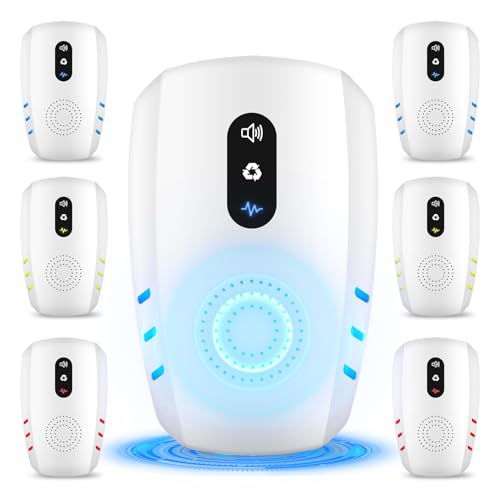
This alternative differs from the Victor devices by targeting several indoor pest types, including rodents, insects and spiders, rather than being a Victor-branded rodent repeller. Its ultrasonic frequency range is 10 kHz–65 kHz, and the product name identifies three modes. The six-pack suits buyers seeking a broader pest-deterrent approach across indoor spaces. It is not the right pick if you specifically want the Victor PestChaser or its nightlight and outlet features.
Bottom line: Choose this only if a multi-pest, non-Victor device fits your needs.
How to Choose a Plug-In Rodent Repeller
Choose by room count and outlet needs first: one plug-in is intended for an average-size room, while a multi-pack lets you place units in separate rooms. Ultrasonic sound does not pass effectively through walls or closed doors, so a device in a hallway should not be treated as coverage for every room beyond it. For rodent control, pair any deterrent with exclusion: mice can squeeze through gaps about 1/4 inch wide, so inspect around pipes, doors and foundation openings. Seal openings with rodent-resistant materials rather than relying on sound alone. A plug-in can be a supplemental measure, but it does not remove food, nesting material or access points.
Where to Place a Rodent Repeller
Place a plug-in in the room where rodent activity is a concern and keep its sound path as open as practical. Furniture, stored boxes and walls obstruct sound, so a receptacle behind a cabinet is a poor location compared with an unobstructed wall outlet. For an average-size room, use the product’s room intent as the boundary; do not assume one unit serves adjoining closed rooms. Keep the receptacle accessible, especially with models that include an extra outlet, and avoid plugging in a unit where another device blocks its face. If you find droppings or gnaw marks, remove accessible food and inspect nearby gaps as well as adjusting placement.
Ultrasonic Repellers and Other Rodent Controls
Ultrasonic plug-ins, snap traps and exclusion address rodents in different ways: a sound repeller aims to deter, a trap captures, and exclusion blocks entry. No one method fixes the others’ weaknesses, so combine entry-point sealing and food control with any deterrent. For a gap, use the rodent size as a practical threshold: mice can pass through openings around 1/4 inch, while rats generally need openings around 1/2 inch. A sound device is most relevant when you want a plug-in deterrent in an occupied indoor room; a trap or sealed opening addresses a specific access or activity point. Never leave a trap or bait where children or pets can reach it.
Common Plug-In Repeller Mistakes
The most common mistake is expecting one plug-in to cover a whole home. Sound is blocked by solid barriers, and a unit in one room cannot be assumed to reach through walls into another; plan by room and keep the front unobstructed. Another mistake is leaving entry gaps and food sources untouched. Mice can enter through gaps about 1/4 inch wide, so inspect utility penetrations and door edges and store food in sealed containers. Finally, do not interpret a claimed sound feature as proof that rodents have left. Check for fresh droppings or gnawing and use exclusion or a suitable trap if activity continues.
Frequently Asked Questions
Do ultrasonic rodent repellers work through walls?
No; ultrasonic sound is blocked by walls and other solid barriers, so treat each enclosed room separately. Keep the unit’s face unobstructed for the room where it is plugged in.
How many plug-in repellers do I need for a house?
Plan one device per room where you want the sound, because walls and closed doors impede ultrasonic sound. A multi-pack can be useful when several separate rooms need units.
Can mice enter through a quarter-inch gap?
Yes; mice can squeeze through openings about 1/4 inch wide. Inspect around pipes, doors and foundation edges, and seal access points with rodent-resistant material.
Are ultrasonic rodent repellers safe around pets?
The Victor products say they are safe around people and non-rodent pets when used as directed, but that claim does not include rodents kept as pets. Keep pet rodents away from the device and follow its use directions.
Should I use traps with an ultrasonic repeller?
A repeller does not capture rodents or seal entry points, so traps and exclusion address different problems. Keep any trap inaccessible to children and pets, and remove food sources that can attract rodents.