
Wall Clock Replacement Mechanisms Compared by Shaft Fit

For most wall clock repairs, TLARTDF Two-Mechanism Kit is the most adaptable choice because its two mechanisms fit panels from 3 to 13 mm thick. Measure the dial before choosing: a shaft that is too short will not leave enough thread for the retaining nut.
Choose Youngtown 12888 Long-Spindle Mechanism for a thinner 1–3 mm panel or longer hands, and Toughwild Three-Mechanism Kit for small dials that need several short-hand styles.
We earn a commission if you buy through links on this page. As an Amazon Associate I earn from qualifying purchases. Products are compared on manufacturer specifications, not hands-on testing.
- Best overall: TLARTDF Two-Mechanism Kit – Includes short and long mechanisms for panels from 3 to 13 mm thick.
- Best for long hands: Youngtown 12888 Long-Spindle Mechanism – Its movement is specified for hands from 10 to 450 mm.
- Best for small dials: Toughwild Three-Mechanism Kit – Includes short hands designed for clock faces 3 to 6 inches across.
| Product | Best for | Panel thickness fit | Thread length | Included hand sets | Shop |
|---|---|---|---|---|---|
| TLARTDF Two-Mechanism Kit | More panel options | 3–6 mm; 9–13 mm | 8 mm; 15.4 mm | 5 sets | Check Price on Amazon |
| Youngtown 12888 Long-Spindle Mechanism | Longer hands | 1–3 mm | 5 mm | 4 hands | Check Price on Amazon |
| Toughwild Three-Mechanism Kit | Small clock faces | 0–4 mm; 4–8 mm; 8–12 mm | — | 8 pairs | Check Price on Amazon |
Wall Clock Replacement Mechanisms
Match the threaded shaft to the dial thickness, then check that the hands suit the clock face.
TLARTDF Two-Mechanism Kit
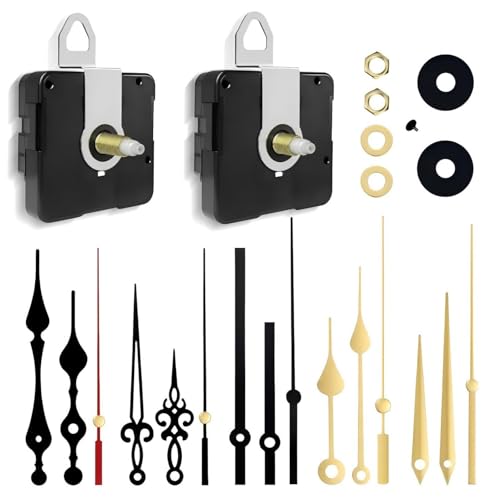
The two shaft lengths make this kit a flexible option when replacing a mechanism in a wall clock with a thicker panel. One mechanism has a 16 mm total shaft and 8 mm of thread for 3–6 mm panels; the other has a 23 mm total shaft and 15.4 mm of thread for 9–13 mm panels. Five sets of aluminum hands are included, and the movements are battery-powered with a sweep design the maker describes as quiet. The kit does not include a battery. Its panel ranges leave a gap between 6 and 9 mm, so measure carefully if your dial falls near that interval.
Bottom line: Choose this kit if your dial measures 3–6 mm or 9–13 mm thick and you want two shaft options.
Youngtown 12888 Long-Spindle Mechanism
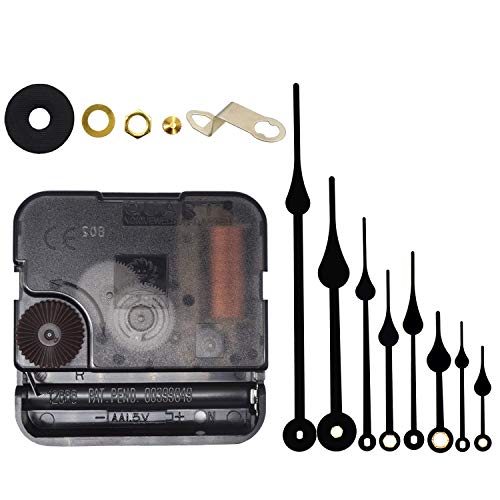
For a thin clock panel and longer hands, this Youngtown movement is the distinct fit: its 18 mm total shaft has 5 mm of thread, and it is specified for 1–3 mm panels. The kit includes two hour hands, two minute hands, mounting hardware and a hook. Its maker says it can drive hands from 10 to 450 mm, giving it a broader stated hand-length range than the small-dial kit. The narrow panel range is its main limitation; a thicker dial can leave too little threaded shaft for secure fastening. Confirm the hand lengths and clearances against your clock face before assembly.
Bottom line: Pick this movement for a 1–3 mm panel or a clock designed for longer hands.
Toughwild Three-Mechanism Kit
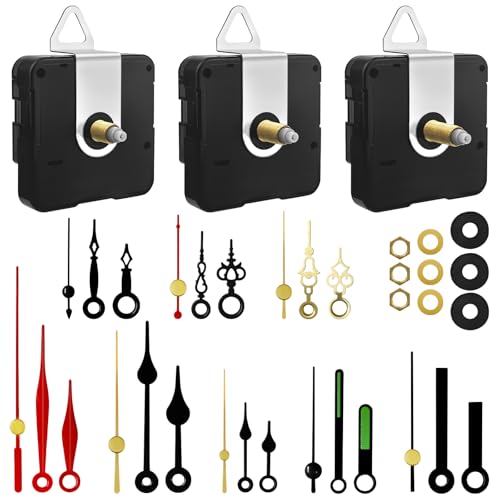
Small clock faces are the focus of this three-mechanism kit: the eight pairs of short hands are designed for dials 3–6 inches across. It includes short, middle and long shaft options with total lengths of 16, 20 and 23 mm, respectively; the maker gives corresponding panel ranges of 0–4 mm, 4–8 mm and 8–12 mm. The hand assortment includes modern and retro styles. Unlike the long-hand option, these hands are intended for small dials, so this set is a less suitable match for a large face that needs long pointers. Measure both the panel and dial before choosing a shaft and hand set.
Bottom line: Choose this kit for a 3–6 inch dial that needs multiple short-hand styles.
How to Choose a Wall Clock Replacement Mechanism
Start by measuring the clock panel where the shaft passes through, not the depth of the entire clock frame. The threaded portion must extend through the panel and leave room for the washer and retaining nut; a shaft can be long enough overall but still have too little usable thread. Match the panel measurement to the mechanism’s range, and avoid choosing one at the edge of a range if the dial has raised trim or a spacer. Then check the hand hub opening and the clearance between the hands and the dial cover. A useful rule: if the panel is 9–13 mm thick, select a mechanism with a range that includes that measurement, such as the longer option in TLARTDF Two-Mechanism Kit.
How Shaft Length Fits Clock Panel Thickness
Panel thickness determines how much shaft and thread remain on the front of the dial for fastening the hands and retaining hardware. Measure at the mounting hole with calipers or a ruler, including any fixed backing layer that the shaft must pass through. A fit range ending below your measurement is too short; a much longer shaft may still fit, but can leave a gap or require a different hand stack. The three kits cover distinct ranges, with overlap between some options and a gap between 6 and 9 mm in TLARTDF Two-Mechanism Kit’s specified panel ranges. Use this quick fit guide as a starting point, then verify the particular kit’s thread length against your panel and hardware.
| Panel thickness | Mechanism option | Fit note |
|---|---|---|
| 1–3 mm | Youngtown 12888 Long-Spindle Mechanism | 5 mm threaded portion |
| 3–6 mm or 9–13 mm | TLARTDF Two-Mechanism Kit | Two shaft choices |
| 0–12 mm | Toughwild Three-Mechanism Kit | Three overlapping ranges |
Matching Clock Hands to the Dial
Hand length should suit the dial radius: a minute hand generally reaches toward the outer minute markings without striking the rim, numerals or glass. Measure from the center hole to the tip of the existing hand, and compare that distance with the replacement hand rather than judging by its total length. For a 3–6 inch dial, Toughwild Three-Mechanism Kit’s short-hand assortment is the direct match. Youngtown 12888 Long-Spindle Mechanism is specified for hands from 10 to 450 mm, but the face still needs enough clearance for those hands to rotate freely. Before powering the clock, check that the hour and minute hands are parallel and do not rub against one another or the dial.
Common Wall Clock Mechanism Replacement Mistakes
The most common fit mistake is confusing total shaft length with threaded length: only the threaded section can accept the front retaining hardware. A second mistake is selecting by clock frame depth rather than the thickness at the mounting hole. Remove the old hands carefully and note their order and orientation; replacement hands must match the movement’s shaft fitting, and longer hands need unobstructed clearance. Keep fingers clear of the hand pivots while positioning them, and do not force a hand onto a mismatched hub. If a movement binds after assembly, remove the hands and check alignment and clearance before trying the battery again.
Frequently Asked Questions
How do I measure a wall clock panel for a replacement mechanism?
Measure the thickness at the shaft hole, including any permanent layer the shaft passes through. Compare that figure with the mechanism’s panel range and check that enough thread remains for the washer and nut.
Does total shaft length equal threaded length?
No. Total shaft length includes the full shaft, while threaded length is only the portion that accepts the retaining hardware. For example, Youngtown 12888 Long-Spindle Mechanism has an 18 mm total shaft and 5 mm of thread.
What size clock hands fit a small dial?
For a 3–6 inch clock face, use short hands intended for that dial size, such as those included with Toughwild Three-Mechanism Kit. Check that the tips clear the rim, numerals and cover as they rotate.
Can one replacement mechanism fit different panel thicknesses?
Some kits include multiple shaft choices. TLARTDF Two-Mechanism Kit has options for 3–6 mm and 9–13 mm panels, while Toughwild Three-Mechanism Kit provides three mechanisms covering 0–12 mm in separate ranges.
Why do replacement clock hands rub after installation?
Hands can rub when they are not parallel, are pressed too close together, or lack clearance from the dial or cover. Recheck their alignment and free rotation before powering the mechanism.