
Warmest Hunting Boot Covers for Men: 5 Compared

For the clearest cold-weather warmth claim, choose Hunthor 600D Insulated Boot Covers, X-Large: the maker says its 5 mm pearl cotton and foil insulation keep feet cozy to -4°F. These over-boot covers add a layer around hunting footwear; choose ArcticShield Men’s Boot Insulators, X-Large instead if packability and a size range for men’s boots matter more.
We earn a commission if you buy through links on this page. As an Amazon Associate I earn from qualifying purchases. Products are compared on manufacturer specifications, not hands-on testing.
- Best overall: Hunthor 600D Insulated Boot Covers, X-Large – Its maker specifies 5 mm pearl cotton and claims warmth down to -4°F.
- Best for packability: ArcticShield Men’s Boot Insulators, X-Large – The cover rolls up for a pocket or backpack and has a draw cord and zipper.
| Product | Best for | Size | Warmth or lining | Weather protection | Shop |
|---|---|---|---|---|---|
| Hunthor 600D Insulated Boot Covers, X-Large | Cold-weather warmth | X-Large | 5 mm pearl cotton, foil | Water-resistant upper and sole | Check Price on Amazon |
| Hunthor 600D Insulated Boot Covers, XX-Large | Roomier boot fit | XX-Large | 5 mm pearl cotton, foil | Waterproof upper and sole | Check Price on Amazon |
| Berlune Insulated Hunting Boot Covers, X-Large | Lightweight carry | X-Large | Insulated layer | Water-resistant coating | Check Price on Amazon |
| ArcticShield Men’s Boot Insulators, X-Large | Compact storage | X-Large (12–13) | Patented heat-retention technology | Windproof; water-resistant | Check Price on Amazon |
Hunting Boot Covers for Men
Compare insulation, fit, closures and weather protection before choosing covers for your hunting boots.
Hunthor 600D Insulated Boot Covers, X-Large
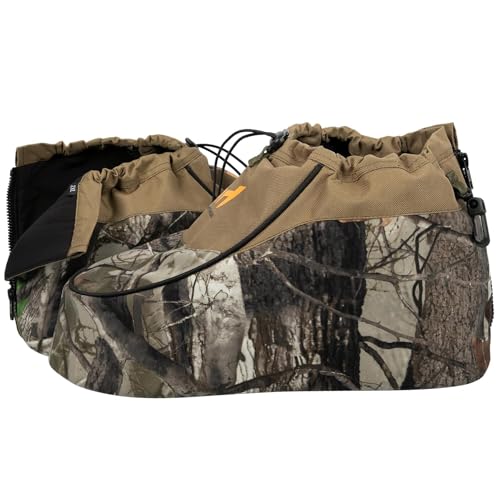
For the strongest cold-weather claim here, these Hunthor covers combine 5 mm pearl cotton with aluminum foil insulation; the maker says they keep feet cozy to -4°F. A zipper and adjustable elastic drawstring make them easier to put on and snug around boots. The upper is water-resistant, and the PU leather sole is described as non-slip. This X-Large pair suits buyers whose boot dimensions match that size. The temperature claim is not a substitute for checking fit: a cover that compresses a boot’s insulation may matter to hunters relying on the boot’s own warmth.
Bottom line: Choose these if their X-Large fit works and the maker’s -4°F warmth claim is your deciding factor.
Hunthor 600D Insulated Boot Covers, XX-Large

The XX-Large sizing is the key difference from the X-Large Hunthor option, while the insulation is the same: aluminum foil and 5 mm pearl cotton. The maker says these covers keep feet cozy to -4°F, and the product uses a zipper, adjustable elastic drawstring and skid-proof PU leather sole. Choose this size when it accommodates the outside dimensions of your hunting boots without squeezing them. The maker describes the upper and sole as waterproof, unlike the water-resistant wording on the other Hunthor size; neither description establishes how the cover performs after prolonged immersion.
Bottom line: Pick this pair when XX-Large gives your boots room without compromising their fit.
Berlune Insulated Hunting Boot Covers, X-Large

Portability sets these Berlune covers apart: the maker gives a weight of about 370 g per pair and says they fold for carrying in a backpack or vehicle. A water-resistant coating helps block rain, snow, mud and dew, and the maker describes the insulated layer as helping retain warmth. The X-Large camouflage covers are intended to go over hunting boots. The dimensions are 14.57 inches long, 4.72 inches wide and 2.76 inches high, so compare those measurements with your boots before choosing. No temperature threshold is given, making them a less precise pick if a specific cold rating is essential.
Bottom line: Choose these if a packable pair matters more than a temperature claim.
ArcticShield Men’s Boot Insulators, X-Large
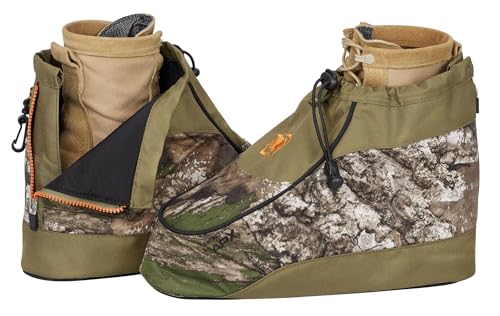
These ArcticShield insulators focus on compact storage and a defined men’s boot-size range: the X-Large fits sizes 12–13 and the covers roll up for a pocket or backpack. The maker says its patented heat-retention technology adds warmth. The covers use windproof, water-resistant polyester tricot, a draw-cord adjustment and a heavy-duty locking zipper. The maker advises sizing up between sizes or when covering thick, heavily insulated boots.
Bottom line: Choose these if your boots are sizes 12–13 and packable, wind-resistant coverage is the priority.
How to choose warm hunting boot covers
Fit and insulation should decide which hunting boot covers you choose, not a warmth label alone. Measure the outside of the boot at its widest point and compare it with the cover’s usable opening; a snug cover can compress the boot’s insulation and reduce the air space that helps retain warmth. Covers add a barrier around footwear but do not replace insulated boots or dry socks. For long, stationary hunts, prioritize a fit that does not restrict circulation and a closure that stays secure. If your boots are already bulky or heavily insulated, choose a roomier size rather than forcing them into a close-fitting cover. A cover’s warmth claim also depends on the wearer’s boots, socks, activity and exposure.
Boot cover sizing and fit over hunting boots
Use boot dimensions as well as the printed size when choosing an over-boot cover. Men’s boot sizes do not describe the full outside shape, and thick uppers, large lugs or insulation can make two boots of the same labeled size fit differently. Measure boot length and width, then check the cover’s dimensions or size guidance; allow enough room to close the zipper without pressing tightly against the boot. When choosing between sizes for a thick insulated boot, a larger cover is generally the safer fit. A loose cover can snag or shift, so secure its draw cord and check sole contact before walking.
Waterproof and water-resistant hunting covers
Waterproof and water-resistant are not interchangeable claims: waterproof denotes a stronger barrier, while water resistance can shed moisture without guaranteeing a dry interior in prolonged wet exposure. Covers with waterproof soles also differ from models whose descriptions specify only a coated upper. Wet feet lose warmth faster, so match the cover to conditions such as dew, slush or standing water rather than relying on camouflage or insulation alone. Outsole grip matters on mud, ice and wet leaves; tread and sole material affect traction, but no cover makes slick ground safe. With repeated wet exposure, check for moisture inside the boot between sits and dry the gear before storage to limit lingering dampness.
Staying warm and safe in hunting boot covers
Dry socks and uncompressed footwear are practical starting points for cold-weather warmth. Wool socks retain more insulating ability when damp than cotton, while socks that are too thick can make boots tight and restrict circulation. Heating pads require particular care: use only a pad intended for the placement and conditions, and follow its package directions to reduce burn risk, especially if sensation is reduced by cold. A heating-pad interlayer does not establish compatibility with every pad. Before a hunt, walk briefly in the covers to confirm the sole grips and the cover does not catch on brush or interfere with the boot closure. Avoid treating a temperature claim as a safety limit for exposure.
Frequently Asked Questions
Do boot covers make hunting boots warmer?
Boot covers add a layer around the boot and can help limit heat loss, but they do not generate warmth or replace insulated footwear. A tight cover that compresses insulation or restricts circulation can work against warmth.
How should hunting boot covers fit over boots?
The cover should close without compressing the boot, and its sole should sit securely underfoot. Compare the cover’s dimensions with the boot’s outside length and width, especially for thick insulation or large tread.
Are water-resistant boot covers waterproof?
No; water resistance and waterproofing describe different levels of moisture protection. For prolonged wet exposure or standing water, favor a product specifically described as waterproof and keep an eye on moisture inside the boot.
Can I wear heating pads inside boot covers?
Only use a pad intended for the placement and conditions, and follow its package directions. A cover interlayer does not guarantee that every heating pad fits or is safe for that use.
Are thicker socks always warmer in hunting boots?
No; socks that make boots tight can restrict circulation and undermine warmth. Choose a sock thickness that leaves room in the boot, and wool is generally a better choice than cotton when dampness is possible.