
Watch Magnifier Glasses and Loupes Compared by Fit

For watch repair, Watch Loupe Set, 3x–15x suits most buyers because its 3x–15x loupe set includes a hands-free holder for different close-work needs. Choose another option if you want built-in lighting or a glasses-style mount instead of a headband loupe.
We earn a commission if you buy through links on this page. As an Amazon Associate I earn from qualifying purchases. Products are compared on manufacturer specifications, not hands-on testing.
- Best overall: Watch Loupe Set, 3x–15x – The 3x–15x set offers several magnifications with a detachable hands-free holder.
- Best for rechargeable lighting: GUOUBUO Rechargeable Headband Magnifier – It combines rechargeable lighting with interchangeable lenses up to 23x.
- Best for lens variety: LXIANGN LED Magnifier Glasses – Eight interchangeable lens powers run from 2.5x to 25x.
- Best for low-light work: Beileshi Watch Repair Magnifier Set – It has two adjustable LED lights and eight interchangeable lens powers.
| Product | Best for | Magnification | Lighting | Mount | Shop |
|---|---|---|---|---|---|
| Watch Loupe Set, 3x–15x | Flexible loupe work | 3x–15x | None stated | Adjustable wire headband | Check Price on Amazon |
| GUOUBUO Rechargeable Headband Magnifier | Rechargeable illumination | 2x–23x | Rechargeable | Switchable headband | Check Price on Amazon |
| LXIANGN LED Magnifier Glasses | Eight lens powers | 2.5x–25x | LED | Head-mounted glasses | Check Price on Amazon |
| Beileshi Watch Repair Magnifier Set | Adjustable LED lighting | 2.5x–25x | Two adjustable LEDs | Interchangeable bracket and headband | Check Price on Amazon |
Watch Magnifier Glasses and Loupes
Compare the lens ranges, lighting and mounting styles to match a magnifier to your watch work.
Watch Loupe Set, 3x–15x

Unlike the head-mounted glasses-style options, this set uses a portable loupe with a detachable wire headband. It includes 3x, 5x, 10x and 15x magnification, so you can switch between a broader view and closer inspection. The maker says its glass lens provides clear, distortion-free magnification and that the adjustable holder keeps the loupe in place hands-free. This suits watch work as well as jewelry and circuit inspection. The trade-off is that no built-in light is described, so it is a weaker fit for dim workspaces.
Bottom line: Pick this set if you want several loupe powers and a detachable headband.
GUOUBUO Rechargeable Headband Magnifier

GUOUBUO Rechargeable Headband Magnifier is the option here with rechargeable lighting and a focal-length range of 0.85 to 9.84 inches. Its five pairs of interchangeable lenses provide 2x, 4x, 6x, 10x and 13x powers, which the maker says can combine up to 23x. The maker recommends observing with one eye at a time at high magnification and switching eyes during longer sessions. That makes this a fit for someone who wants lens choices and illumination in a hands-free mount. The product’s single-eye approach may not suit buyers who prefer viewing through both eyes at once.
Bottom line: Choose it if rechargeable lighting and a wide lens selection matter most.
LXIANGN LED Magnifier Glasses
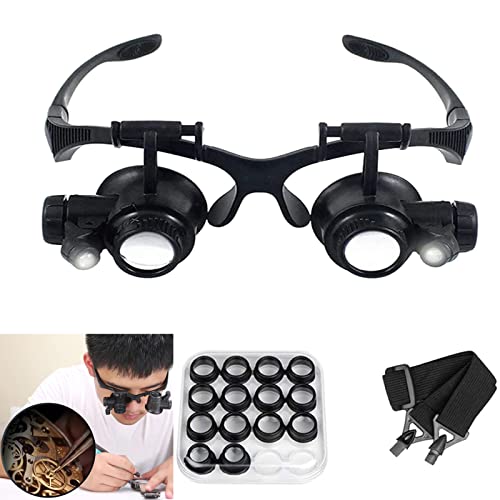
LXIANGN LED Magnifier Glasses offers the broadest upper magnification in this group, with eight interchangeable powers from 2.5x to 25x. Its LED light and spectacle-style head mount keep both hands available for close work. The maker describes the frame as lightweight and designed to stay secure during extended use. This range suits buyers who want many steps between lower and higher magnification. The product is identified as not for reading, so it is a poor choice if you need a general-purpose page magnifier rather than a close-work tool.
Bottom line: Pick it if you want eight lens choices in a glasses-style mount.
Beileshi Watch Repair Magnifier Set
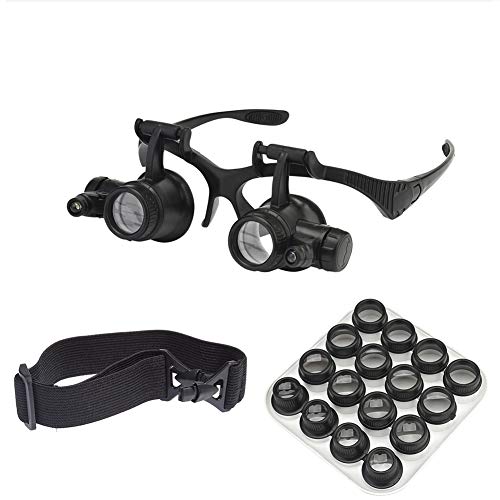
Beileshi Watch Repair Magnifier Set stands out for its two adjustable LED lights, with button batteries included, and an interchangeable bracket and headband. Eight lens powers span 2.5x to 25x, matching the widest range in this comparison. The maker specifies a working distance of 0.2 to 2 inches and says the magnifier is for single-eye observation, not simultaneous use with both eyes. That close, one-eye setup can suit small watch components, especially where extra light is useful. It may be less convenient for buyers who need a longer working distance or binocular viewing.
Bottom line: Choose it for adjustable built-in lights and a close single-eye working setup.
Choosing magnification for watch work
For routine inspection, start with a lower power around 2.5x to 5x; reserve 10x and above for tiny features that need closer examination. Higher magnification narrows the visible area and brings the lens closer to the object, so a 20x–25x lens can make positioning tools and keeping the part in view more demanding. A practical rule: if you need to see surrounding components while handling a tool, begin at 2.5x–6x; move higher only when the detail is too small at that range. Compare working distance as well as power, since a lens that forces the watch very close may leave little room for tweezers or a screwdriver.
Picking a mount and keeping both hands free
Headband and glasses-style magnifiers hold lenses near the eye, while a handheld loupe requires one hand unless its holder supports it. For watch repair, where one hand may steady a part and the other guides a tool, a stable head-mounted setup can reduce juggling. Single-eye loupes are common for high-power inspection because they present one magnified view; avoid forcing a two-eye view if the lens alignment causes blur. Before settling in, position the watch, tool and light so you can maintain a comfortable posture without pressing the lens against the work. Buyers needing to work more than 2 inches from the watch should confirm working distance before choosing a high-power option.
Comparing watch magnifier types
A loupe offers a compact lens, while a head-mounted magnifier carries interchangeable lenses in front of the eye; the right type depends on how often you need to change powers and whether a fixed hands-free position helps. This comparison separates the mount and illumination choices at a glance.
| Type | Useful when | Trade-off |
|---|---|---|
| Portable loupe with holder | You want a set of separate loupe powers | Lighting may need to come from elsewhere |
| Headband magnifier | You want a hands-free mount | Higher powers can require very close positioning |
| LED head-mounted set | You need light directed at close work | Check whether its viewing setup is single-eye |
Magnification numbers alone do not determine fit: the mount, working distance and light source affect how easily a lens can be used over a watch.
Using a watch loupe without losing detail
Set the watch and lens at a steady distance before bringing tools into the view, then begin with the lowest useful magnification. At higher power, even small movement shifts the image, and the shorter working distance can obstruct tool access. Direct light across the surface rather than straight into the lens to make reflective metal and glass easier to inspect. Take brief breaks during prolonged one-eye work; alternating eyes can help reduce the strain of holding one viewing position. Keep lenses clean with a soft lens cloth, and store interchangeable pieces in their case or holder to avoid scratches and mix-ups.
Frequently Asked Questions
What magnification is good for watch repair?
A 2.5x–5x lens is a useful starting range for general inspection, while 10x or higher can help with very small features. Higher power narrows the view and usually requires closer positioning, so use the lowest power that reveals the detail.
Can I use a watch loupe with both eyes?
Many high-power watch loupes are designed for one-eye viewing because the magnified image may not align comfortably for both eyes. If the view blurs when both eyes are open, use one eye and take breaks during extended work.
How far should a watch magnifier be from the watch?
Working distance depends on the lens power and design; higher magnification generally requires bringing the lens closer. One of these sets specifies a 0.2–2-inch working distance, so check the target distance if you need room for tools.
Do watch magnifiers need built-in lights?
Built-in LEDs are useful when the work area is dim or the watch casts a shadow, but they are not essential in a well-lit workspace. Position light from an angle to reduce glare on reflective watch parts.
How do I avoid eye strain with a watch loupe?
Use the lowest magnification that makes the feature visible and keep the watch at a stable, comfortable distance. For single-eye designs, take short breaks and switch viewing eyes when practical.