
Wheels for Kayak Transportation: 5 Options Compared

For replacement wheels, METER STAR 10-Inch Solid Wheel Pair is the clearest match because it includes a pair of 10-inch solid tires and axle dimensions to check against your cart. Choose VEVOR 10-Inch Solid-Tire Kayak Cart instead if you need a complete cart rather than spare wheels; carts include a frame and carry the kayak as a unit.
We earn a commission if you buy through links on this page. As an Amazon Associate I earn from qualifying purchases. Products are compared on manufacturer specifications, not hands-on testing.
- Best overall: METER STAR 10-Inch Solid Wheel Pair – A pair of 10-inch puncture-proof wheels includes a 0.9-inch central shaft diameter and retaining D-pins.
- Best for a single spare: Lyrlody 10-Inch Trolley Wheel – One 10-inch replacement wheel has a 330-pound maximum load.
- Best for a complete cart: VEVOR 10-Inch Solid-Tire Kayak Cart – A foldable dolly includes 10-inch solid tires and has a 250-pound capacity.
| Product | Best for | Wheel size | Load capacity | Wheel type | Shop |
|---|---|---|---|---|---|
| METER STAR 10-Inch Solid Wheel Pair | Pair replacements | 10 in | 330 lb | Solid rubber | Check Price on Amazon |
| Lyrlody 10-Inch Trolley Wheel | Single replacement | 10 in | 330 lb | TPU and nylon | Check Price on Amazon |
| VEVOR 10-Inch Solid-Tire Kayak Cart | Complete cart | 10 in | 250 lb | Solid tires | Check Price on Amazon |
| Bonnlo Universal Kayak Carrier | Strap-secured cart | 10 in | 200 lb | Solid PU | Check Price on Amazon |
| Onefeng Sports Plastic-Wheel Kayak Cart | Light loads | 8 in | 100 lb | Plastic | Check Price on Amazon |
Kayak Transportation Wheels and Carts
Match replacement wheels to the axle and choose a complete cart only when you need its frame and support system, too.
METER STAR 10-Inch Solid Wheel Pair

For replacing both wheels at once, this pair stands apart from the single-wheel option by including two 10-inch solid tires, two anti-loss D-pins and a 0.9-inch central shaft diameter. The maker says the pair supports up to 330 pounds. Solid tires need no inflation, which avoids punctures and pressure checks. Before choosing replacement wheels, compare the shaft diameter and hub width with your cart’s axle; diameter alone does not confirm compatibility. Solid wheels also trade air cushioning for puncture resistance, a factor to consider on rough paths.
Bottom line: Choose this pair if your cart axle matches the 0.9-inch shaft and you need two replacement wheels.
Lyrlody 10-Inch Trolley Wheel
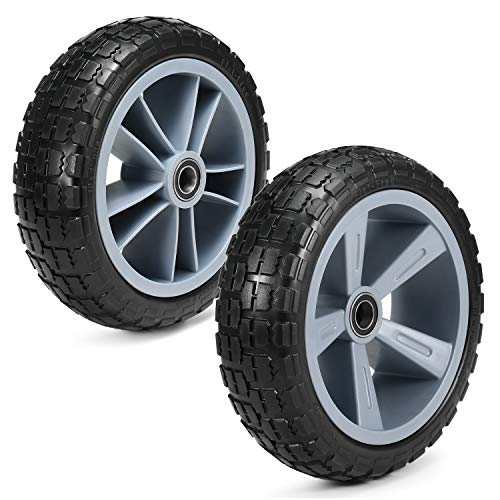
Unlike the paired replacement set, this is a single spare wheel, making it a fit when only one wheel needs replacement. The wheel uses TPU and nylon, and the maker says it supports up to 330 pounds. It is described as compatible with most kayak carriers, but a broad fit claim cannot establish a match for every axle or hub. Check the existing wheel’s attachment and dimensions before ordering, especially if your trolley uses a pin or a specific axle diameter.
Bottom line: Pick this when you need one spare and have confirmed its attachment fits your trolley.
VEVOR 10-Inch Solid-Tire Kayak Cart

Unlike the replacement wheels, this product is a complete foldable dolly with an aluminum frame, tie-down strap and two 10-inch solid tires. The maker says the cart carries up to 250 pounds; the dimensions are 23.6 inches long, 14.2 inches wide and 12.6 inches high. The wheels require no inflation, and the cart is presented for grass, sand beaches and gravel. Its capacity is lower than the 330-pound ratings of the replacement options, and it replaces a whole cart rather than repairing an existing one.
Bottom line: Choose this if you need a complete foldable dolly rated for up to 250 pounds.
Bonnlo Universal Kayak Carrier

Unlike wheel-only spares, this carrier provides a foldable cart with two ratchet straps and solid PU tires measuring 10 inches in diameter by 3 inches wide. The maker gives it a 200-pound weight limit and describes the tires as suitable for sand, lawns and rough terrain. The wider tire profile is a distinguishing dimension to compare with the replacement wheel options. The capacity is below the 250- and 330-pound ratings elsewhere in this group, so account for the kayak and any carried gear when judging whether it fits.
Bottom line: Pick this complete carrier if its 200-pound limit covers your loaded kayak and you want ratchet straps.
Onefeng Sports Plastic-Wheel Kayak Cart

Unlike the higher-capacity carts, this complete carrier is rated for 100 pounds and uses plastic wheels measuring 20 by 6 centimeters, or about 7.9 by 2.4 inches. It includes a cam-buckle tie-down strap and has an M-shaped kickstand intended to stabilize the trolley during loading. The aluminum frame breaks down for storage. Its smaller wheels and lower load rating make the fit more limited than the 10-inch options; check the kayak’s loaded weight and the path to the water before choosing it.
Bottom line: Choose this cart for a kayak and gear load within 100 pounds and a compact breakdown design.
How to choose kayak transportation wheels
Start by deciding whether you need a replacement wheel or a complete cart, then compare axle fit and loaded weight. For a spare, measure the axle diameter and the wheel hub width, and check how the wheel is retained; matching the wheel diameter alone is not enough. For a cart, add the kayak, accessories and any gear carried on it, and keep the total below the cart capacity. A practical rule is to reject any option whose rated capacity is below that combined load. Solid tires avoid inflation and puncture concerns, while wheel diameter and width affect how the wheel meets uneven or soft ground. A complete cart also needs a suitable frame and secure tie-downs, not just wheels.
Solid kayak wheels versus air-filled tires
Solid wheels do not need air pressure checks and cannot go flat from a puncture, while pneumatic tires can provide more cushioning over uneven ground. Tire choice changes the maintenance tradeoff: solid wheels favor avoiding flats, and air-filled wheels need periodic pressure checks and inspection for punctures. Wide tires generally spread a load over more ground than narrow tires, which can help on soft sand, but wheel width alone does not guarantee easy travel because load, sand softness and tire design matter. For travel over loose sand, compare tire width as well as diameter; for rocky or uneven paths, consider cushioning and impact. Do not assume a solid tire’s “all-terrain” label means it will roll equally well on every surface.
Check wheel fit before replacing a kayak cart wheel
Measure the existing axle and hub before buying a replacement: a wheel can have the right 10-inch diameter and still fail to attach securely. The METER STAR pair gives a 0.9-inch central shaft diameter and includes retaining D-pins, while the single-wheel option does not give matching axle dimensions. Compare the wheel’s hub width, axle diameter and retention method with the trolley; if any of those differ, confirm the fit before ordering. Replace both wheels together only when both are worn or when matching wheel dimensions matter to the cart. After installation, confirm the wheel is retained and spins freely before loading a kayak.
Load and secure a kayak on its cart
Keep the complete carried load below the cart’s rated limit, including the kayak and gear placed on the trolley. Center the kayak over the supports and use the strap to limit shifting; a weight rating does not guarantee stability if the load sits unevenly. Load the kayak on level ground where possible, and keep hands clear of pinch points around the frame and wheels. On a slope, control the cart rather than relying on the strap to stop it rolling. A loose strap or side-heavy kayak can shift during transport even when the total weight is within the capacity.
Frequently Asked Questions
How do I measure a kayak cart wheel axle?
Measure the axle’s outside diameter and the wheel hub’s width, then compare both with the replacement wheel. Also check whether the cart uses a pin, clip or another retainer, since a matching diameter alone does not establish fit.
Are solid kayak cart tires better than pneumatic tires?
Solid tires cannot go flat and do not need inflation, while pneumatic tires offer air cushioning over uneven ground. Choose solid tires when avoiding punctures matters most, and consider pneumatic tires when cushioning is the priority.
What size kayak cart wheels work on sand?
Wider wheels generally spread the load over more ground than narrow wheels, which can help on soft sand. Sand firmness, kayak load and tire construction also affect rolling, so do not choose by diameter alone.
Does kayak cart capacity include my gear?
Treat the rating as the limit for the complete load being carried, including the kayak and gear on the cart. Weigh or estimate that combined load and leave a margin rather than operating at the maximum.
How should I secure a kayak on a transport cart?
Center the kayak on the cart supports and snug the tie-down so the hull cannot shift sideways. Check that the cart remains stable while loading and keep control of it on slopes; a strap does not prevent a cart from rolling.