
10-Liter Ultrasonic Cleaner: 5 VEVOR Models Compared

For a 10-liter ultrasonic cleaner with the most listed cleaning features, choose VEVOR 10L Ultrasonic Cleaner, 600W: it combines 600W power, four transducers, gentle mode and degassing. Choose a different model if you want a lower wattage, a compact footprint, or a unit specifically labeled for gun parts.
An ultrasonic cleaner uses high-frequency sound waves in a liquid bath to loosen soil from small objects and hard-to-reach surfaces.
We earn a commission if you buy through links on this page. As an Amazon Associate I earn from qualifying purchases. Products are compared on manufacturer specifications, not hands-on testing.
- Best overall: VEVOR 10L Ultrasonic Cleaner, 600W – Its 600W rating, four transducers, gentle mode and degassing provide the broadest feature set.
- Best for gun parts: VEVOR 10L Ultrasonic Gun Cleaner – This 300W model is specifically labeled for gun parts and includes a timer, heater and basket.
- Best for jewelry: VEVOR 10L Ultrasonic Cleaner, 180W – This 180W model is presented for jewelry and other small items, with a digital display and basket.
| Product | Best for | Power | Shop |
|---|---|---|---|
| VEVOR 10L Ultrasonic Cleaner, 600W | Feature versatility | 600 W | Check Price on Amazon |
| VEVOR 10L Ultrasonic Gun Cleaner | Gun components | 300 W | Check Price on Amazon |
| VEVOR 10L Professional Ultrasonic Cleaner | Small parts | — | Check Price on Amazon |
| VEVOR 10L Sonic Cleaner, 240W | Metal components | 240 W | Check Price on Amazon |
| VEVOR 10L Ultrasonic Cleaner, 180W | Jewelry cleaning | 180 W | Check Price on Amazon |
10-liter ultrasonic cleaners
Compare these five VEVOR models by their power, controls and intended cleaning tasks.
VEVOR 10L Ultrasonic Cleaner, 600W

Four transducers and 600W power distinguish this model, which also adds gentle mode and degassing. VEVOR says it operates at 40 kHz and has a 0–80°C heating system; the controls are aimed at users cleaning items with delicate surfaces as well as parts with seams or holes. That makes it the most feature-rich option here for varied small-batch work. The limitation is its 14.99 lb weight, which matters if you need to move a full tank often; check the work surface and clearance before setting it up.
Bottom line: Choose this if you want the widest set of cleaning modes and controls.
VEVOR 10L Ultrasonic Gun Cleaner

Unlike the other models, this 10L cleaner is specifically labeled for gun parts, bullets and military supplies. Its 300W rating, 40 kHz frequency, timer, heater and basket make it a focused option for users cleaning small components in a bath. The dimensions are 20.87 × 6.5 × 11.65 inches, so its long, narrow footprint is worth considering when choosing a bench location. It is less suited to buyers seeking a general-purpose jewelry-focused model or a more powerful unit.
Bottom line: Choose this when gun-part cleaning is the primary task and its elongated footprint fits your workspace.
VEVOR 10L Professional Ultrasonic Cleaner

This professional model pairs a digital timer and heater with a SUS304 stainless steel tank and basket. VEVOR describes a 40 kHz system with three sandwich-type piezoelectric transducers, and positions the cleaner for glasses, watches, rings and small parts. Its dimensions are 10.43 × 6.5 × 8.86 inches, making the footprint a useful differentiator for a crowded bench. The power rating is not available in the specifications, so buyers who need to compare wattage should confirm that specification before choosing.
Bottom line: Choose this if the compact dimensions and stainless steel tank and basket suit your setup.
VEVOR 10L Sonic Cleaner, 240W

The 240W rating places this model between the 180W and 300W options, and its applications emphasize lab tools, carburetors, brass and automotive or engine parts. The cleaner operates at 40 kHz and includes a heater, timer and basket. At 12.91 × 10.55 × 11.5 inches, it has a broader footprint than the compact 10.43 × 6.5-inch model. Its appeal is task focus rather than extra modes; choose another option if degassing or gentle mode is a priority.
Bottom line: Choose this for the tool and metal-part applications when 240W suits your needs.
VEVOR 10L Ultrasonic Cleaner, 180W
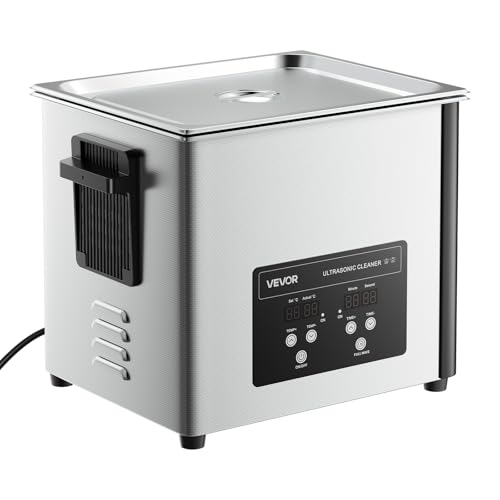
At 180W, this is the lowest-power model in the group with a rating, and its intended items include jewelry, coins, watches and razors. It has a digital display, cleaning basket, and SUS304 stainless steel tank and basket. VEVOR says its 40 kHz waves work with a heating function to reach grime in small spaces.
Bottom line: Choose this for the small-item uses if 180W and its display-and-basket setup fit your needs.
How to choose a 10-liter ultrasonic cleaner
Choose by task, then compare controls and rated power rather than assuming that tank volume alone determines cleaning. These five models all list a 10L capacity and 40 kHz frequency, while stated power ranges from 180W to 600W; the 600W model also lists gentle mode and degassing. Heating can help loosen oily soil, but ultrasonic baths still need a compatible cleaning solution and the correct temperature for the item. For delicate items, use a gentler setting when available and start with a short cycle; do not assume every jewelry stone or finish is safe for immersion. Compare the intended uses with what you plan to clean, and confirm dimensions when the machine must fit a particular bench space.
What 40 kHz means for cleaning
A 40 kHz cleaner vibrates its liquid bath at 40,000 cycles per second, producing cavitation bubbles that collapse and loosen soil from crevices. Frequency is only one factor: transducer output, load arrangement, solution, temperature and cycle time also affect results. Keep objects separated in the basket so sound and liquid can reach their surfaces; stacking parts or letting them rest on the tank floor can impede cleaning and risk damage to the tank. Use a cleaning solution made for ultrasonic equipment rather than assuming plain water will remove grease. Avoid flammable solvents in an ultrasonic bath because cavitation and electrical heating can create fire hazards.
Compare power, controls and intended use
Choose the power and features that match your workload: the ratings span 180W to 600W, while the intended applications range from jewelry to gun components and automotive parts. The table separates the models by their main stated distinction, rather than treating the shared capacity and frequency as advantages.
| Model | Stated distinction | Best matched task |
|---|---|---|
| VEVOR 10L Ultrasonic Cleaner, 600W | 600W, gentle mode, degassing | Varied small-batch cleaning |
| VEVOR 10L Ultrasonic Gun Cleaner | 300W, gun-parts focus | Gun components |
| VEVOR 10L Professional Ultrasonic Cleaner | Three transducers, digital timer | Glasses, watches, rings |
| VEVOR 10L Sonic Cleaner, 240W | 240W, metal-part focus | Tools and automotive parts |
| VEVOR 10L Ultrasonic Cleaner, 180W | 180W, digital display | Jewelry and small items |
Power figures are not directly comparable to guaranteed cleaning performance: tank loading and solution conditions matter. If degassing is important for work with internal holes or seams, select the model that expressly includes that mode.
Safe loading and care for an ultrasonic bath
Keep the tank below its fill line and place items in the basket, not directly on the tank bottom. Ultrasonic energy can loosen deposits, but it can also damage soft finishes, glued joints, some stones and delicate components; test uncertain items with a conservator or the item maker before immersion. Remove watches with electronic movements and avoid immersing any item unless its water resistance and materials make that safe. After each session, drain and clean the bath according to its equipment instructions, and inspect the tank and cord for damage before use. Never run the heater or transducers dry; the liquid level must cover the operating area.
Frequently Asked Questions
Can a 10-liter ultrasonic cleaner clean eyeglasses?
A 10L bath can accommodate eyeglasses if the frame fits in the basket without contacting the tank or crowding other items. Avoid immersing frames with delicate coatings, loose parts or components not rated for immersion.
Should jewelry go directly into an ultrasonic cleaner?
Use the basket and keep jewelry separated so the bath can reach its surfaces. Ultrasonic cleaning can harm porous stones, treated gems, glued settings and fragile pieces, so verify the material and setting are suitable before immersion.
How much liquid goes in a 10-liter ultrasonic cleaner?
Ten liters is the tank capacity, not necessarily the correct working fill; leave room for the basket and displaced liquid and stay below the tank’s fill mark. Keep the transducer area submerged during operation and never run the machine dry.
Can I use regular household cleaner in an ultrasonic bath?
Use a solution compatible with ultrasonic equipment and the item being cleaned; ordinary household products may foam, corrode metals or damage finishes. Never use flammable solvents in the bath because heat and cavitation can present a fire risk.
Does higher wattage always clean parts faster?
No: the 180W to 600W ratings in these models do not establish a guaranteed cycle time. Soil type, solution, temperature, load size and how parts are positioned all influence cleaning, so begin with a short cycle and inspect the result.