
100-Inch Hisense U7 TV: Specs and Alternatives

The 100-inch Hisense U7 is the clearest fit for a large-screen Hisense TV with Mini-LED, a native 165Hz refresh rate, and Google TV. Choose another model if you prefer Fire TV, want the U8’s peak-brightness and dimming-zone figures, or are comparing a QLED model without Mini-LED.
We earn a commission if you buy through links on this page. As an Amazon Associate I earn from qualifying purchases. Products are compared on manufacturer specifications, not hands-on testing.
- Best overall: Hisense U7 100U7SG – It pairs Mini-LED backlighting and a native 165Hz refresh rate with Google TV.
- Best for peak brightness: Hisense U8 100U8QG – Its maker cites up to 5,000 nits peak brightness and up to 5,600 local dimming zones.
- Best for Fire TV: Hisense E7 100E7SF – It combines Fire TV with Mini-LED backlighting and a native 144Hz refresh rate.
| Product | Best for | Refresh rate | Backlight or display | Smart platform | Shop |
|---|---|---|---|---|---|
| Hisense U7 100U7SG | Google TV gaming | 165Hz native | Mini-LED ULED | Google TV | Check Price on Amazon |
| Hisense U8 100U8QG | Brightness figures | 165Hz native | Mini-LED ULED | Google TV | Check Price on Amazon |
| Hisense E7 100E7SF | Fire TV gaming | 144Hz native | Mini-LED Hi-QLED | Fire TV | Check Price on Amazon |
| Hisense U6 Pro 100U6SF | Fire TV features | 144Hz native | Mini-LED ULED | Fire TV | Check Price on Amazon |
| Hisense E6 100E6QF | QLED alternative | 144Hz native | QLED | Fire TV | Check Price on Amazon |
100-Inch Hisense TVs
Compare the U7 with related 100-inch Hisense models by refresh rate, screen technology, and smart platform.
Hisense U7 100U7SG

The U7 is the named 100-inch Hisense U7 option, with a native 165Hz refresh rate and Google TV. Its Hi-QLED Mini-LED system uses thousands of backlights, and its features include VRR 288, HDR10+, and Dolby Vision IQ. That mix suits buyers who want a large display for gaming and streaming within the U7 line.
The maker says its Hi-View AI Engine Pro analyzes content. The screen dimensions are 87.8 inches wide and 50.5 inches high, so measure the room and access path before choosing this size. The U7’s feature set does not give a peak-brightness figure, which matters if you are comparing it specifically by brightness.
Bottom line: Choose this if you want a 100-inch U7 with Google TV and native 165Hz.
Hisense U8 100U8QG

The U8 is the closest alternative for buyers who want the same native 165Hz rate and Google TV but prioritize a specified brightness and dimming-zone ceiling. Its maker cites up to 5,000 nits peak brightness and up to 5,600 local dimming zones; those are stated maximums, not guaranteed output in every scene.
The model also includes QLED, HDR10+, Dolby Vision IQ, IMAX Enhanced, and 4.1.2-channel audio. The width is 74.8 inches, which conflicts with the 100-inch screen size and other dimensions, so confirm the cabinet dimensions before planning a stand or installation. Choose the U7 instead if you want the maker’s consistent 87.8-inch width and named U7 series.
Bottom line: Pick this when its cited brightness and dimming-zone figures matter most.
Hisense E7 100E7SF
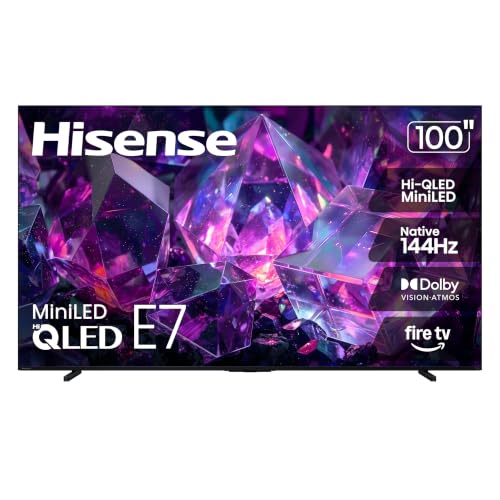
The E7 changes the smart platform to Fire TV and the native refresh rate to 144Hz, while retaining Mini-LED backlighting in a 100-inch Hi-QLED set. Its features include Dolby Vision IQ, Dolby Atmos, HDR10+ Adaptive, and MEMC, making it a related option for buyers who prefer Fire TV over the U7’s Google TV.
The maker says its Mini-LED system has thousands of light zones. Its dimensions are 87.8 inches wide and 50.6 inches high, and its weight is 120.2 pounds. The lower native refresh rate is the main tradeoff against the U7 for someone comparing these models for high-refresh gaming.
Bottom line: Choose this if Fire TV matters more to you than the U7’s 165Hz rate.
Hisense U6 Pro 100U6SF

The U6 Pro is a 100-inch Mini-LED ULED alternative with Fire TV and a native 144Hz refresh rate. Its feature set includes Hi-QLED, Motion Rate 480, Dolby Vision IQ, Dolby Atmos, HDR10+, and Glare-Free. This makes it a fit for someone seeking a Fire TV-based large screen who does not require the U7’s 165Hz native rate or Google TV.
The dimensions are 87.8 inches wide and 50.5 inches high, with a weight of 136.7 pounds.
Bottom line: Pick this for a 100-inch Fire TV with Mini-LED and native 144Hz.
Hisense E6 100E6QF

The E6 is the display-technology alternative in this group: it uses QLED rather than the Mini-LED backlighting found on the U7, U8, E7, and U6 Pro. Its features include a native 144Hz rate, Dolby Vision IQ, Dolby Atmos, HDR10+, Motion Rate 240, and Game Mode Pro. It suits buyers who want a 100-inch QLED Fire TV model rather than specifically seeking Mini-LED.
The set measures 87.8 inches wide and 50.6 inches high, and weighs 120.2 pounds. Since the feature set identifies QLED but not Mini-LED, it is not the closest match for someone shopping specifically for the U7’s backlight approach.
Bottom line: Choose this if QLED and Fire TV are a better fit than Mini-LED.
How to choose a 100-inch Hisense TV
Start with the viewing and room setup, then compare display technology and platform. A 100-inch 16:9 screen is about 87 inches wide and 49 inches tall before its stand or bezel; allow extra room for the cabinet and installation. For a 4K screen, a typical comfortable viewing range is roughly 8 to 12 feet, with closer seats making fine picture detail easier to see.
For gaming, distinguish native refresh rate from motion-rate marketing: native 144Hz or 165Hz describes the panel’s refresh capability, while labels such as Motion Rate 480 are separate product specifications. For streaming interface preference, compare Google TV with Fire TV. If gaming at high refresh is your priority, favor a model explicitly offering native 165Hz; if platform preference decides, start with Google TV versus Fire TV.
Mini-LED and QLED differences
Mini-LED describes the backlight, while QLED describes a color technology; the terms are not interchangeable. A Mini-LED LCD television uses many small backlights and local dimming to adjust brightness across screen zones, while QLED uses quantum dots to produce color. A set can combine both, as several models here do.
Local dimming uses groups of backlights rather than controlling every pixel independently, so bright objects against dark scenes can still produce halos. Zone count alone does not guarantee identical picture quality: dimming algorithms, panel behavior, and content all matter. Compare the named technologies and concrete figures rather than assuming that every QLED television is Mini-LED or that the model with the largest zone number will look best in every room.
Room fit and installation for a 100-inch TV
A 100-inch screen needs more than 100 inches of wall width: the cabinets in this group are about 87.8 inches wide, but stands, bezels, packaging, and mounting hardware affect the space needed. Measure the wall, stand, doorway, hallway turns, and stair route before arranging delivery or installation. Leave room for ventilation and access to ports and power.
Large televisions are heavy loads. Several models here weigh over 120 pounds, so use a stand or wall mount rated for the television’s actual weight and compatible mounting pattern; secure the mount into structural framing rather than drywall alone. The U8’s width figure conflicts with the other dimensions, so confirm its cabinet measurements before planning its space.
Frequently Asked Questions
How far away should you sit from a 100-inch 4K TV?
A typical viewing distance for a 100-inch 4K screen is about 8 to 12 feet. Sit nearer if you want a more immersive view; sit farther back if the screen dominates your field of view.
How wide is a 100-inch 16:9 television?
A 100-inch 16:9 screen is about 87 inches wide and 49 inches tall, measured as the screen rather than the full cabinet. Add space for the bezel and stand when checking a console or wall.
Does QLED mean the TV has Mini-LED backlighting?
No; QLED refers to quantum-dot color technology, while Mini-LED describes a backlight system. A television can use both, but the E6 is identified as QLED and the U7 as Mini-LED ULED.
What does a 144Hz or 165Hz refresh rate mean?
A 144Hz or 165Hz native refresh rate indicates how often the panel can refresh each second. To benefit in gaming, the connected source and game must also output a compatible high frame rate.
Can a wall mount hold a 100-inch television?
Yes, if the mount is compatible with the TV’s mounting pattern and rated above its weight. These models weigh about 120 to 140 pounds, so secure a suitable mount to wall framing rather than relying on drywall alone.