
Reolink Go PT Ultra: 4K Cellular Camera Compared

The Reolink Go PT Ultra is the right pick for remote monitoring when a site has cellular service but no Wi-Fi, since it combines 4K video with 4G LTE. If the camera will be within Wi-Fi coverage, consider a Wi-Fi model instead; the Argus PT Ultra and Altas PT Ultra are alternatives with different night-vision and battery features.
We earn a commission if you buy through links on this page. As an Amazon Associate I earn from qualifying purchases. Products are compared on manufacturer specifications, not hands-on testing.
- Best overall: Reolink Go PT Ultra – Pairs 4K resolution with 4G LTE for off-grid monitoring where cellular service is available.
- Best for Wi-Fi homes: Reolink Argus PT Ultra – Uses 2.4/5 GHz Wi-Fi 6 and includes a 3W solar panel.
- Best for color night vision: Reolink Altas PT Ultra – Uses ColorX night vision without spotlights or infrared.
| Product | Best for | Connection | Resolution | Pan and tilt | Shop |
|---|---|---|---|---|---|
| Reolink Go PT Ultra | Remote LTE sites | 4G LTE | 4K, 8MP | 355° pan; 140° tilt | Check Price on Amazon |
| Reolink Argus PT Ultra | Wi-Fi installations | 2.4/5 GHz Wi-Fi 6 | 4K, 8MP | 355° pan; 140° tilt | Check Price on Amazon |
| Reolink Altas PT Ultra | Color night vision | Dual-band Wi-Fi 6 | 4K | 355° pan; 90° tilt | Check Price on Amazon |
| Reolink 4K LTE Pan-Tilt Camera | LTE solar coverage | 4G LTE | 4K | 355° pan; 140° tilt | Check Price on Amazon |
| Reolink 2K+ LTE Camera | Lower resolution LTE | 4G LTE | 2K+, 5MP | 355° pan; 140° tilt | Check Price on Amazon |
Reolink Go PT Ultra and Alternatives
Compare each camera’s connection type, video resolution and pan-tilt range against the needs of the installation.
Reolink Go PT Ultra
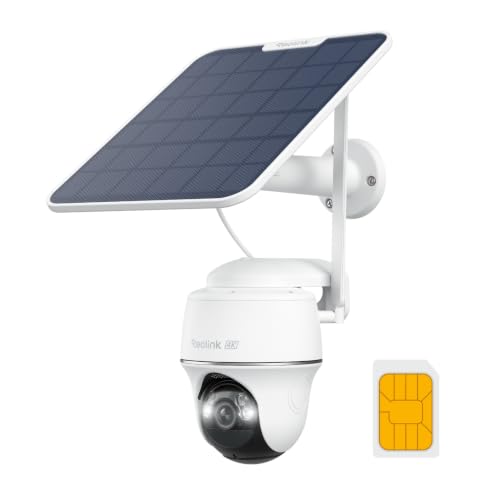
The Go PT Ultra is the named 4G LTE model, unlike the Wi-Fi alternatives here. It suits remote cabins, farms and job sites with cellular coverage but no Wi-Fi. The key limitation is connectivity: cellular coverage is essential, so check signal at the camera location before choosing it.
Bottom line: Choose this when the camera location has LTE coverage but no Wi-Fi.
Reolink Argus PT Ultra

The Argus PT Ultra replaces cellular service with 2.4/5 GHz Wi-Fi 6, making it the closest fit for a home or outbuilding with reliable Wi-Fi. It captures 4K 8MP video and includes a 3W solar panel for ongoing charging. Its 355° pan and 140° tilt match the Go PT Ultra’s movement range, but the connection requirement changes where it can work: a remote site without Wi-Fi is a poor fit. Choose it when wireless networking is available and LTE is unnecessary.
Bottom line: Pick this for a Wi-Fi-connected location that needs 4K pan-tilt coverage.
Reolink Altas PT Ultra

The Altas PT Ultra stands apart with ColorX night vision that uses an F1.0 aperture and 1/1.8-inch sensor, rather than spotlights or infrared. It also offers 10-second pre-recording and a high-capacity battery with solar charging; the maker says the battery can last up to 500 days in PIR mode under its recording assumptions. Its 90° tilt is less than the other PT models’ 140°, so it suits scenes where low-light color matters more than vertical sweep. It connects over dual-band Wi-Fi 6, not LTE.
Bottom line: Choose this for Wi-Fi sites where spotlight-free color night vision matters.
Reolink 4K LTE Pan-Tilt Camera

This 4K LTE camera shares the Go PT Ultra’s cellular-and-solar approach, with a SIM card that uses AT&T and T-Mobile networks. Its 355° horizontal and 140° vertical movement are suited to broad outdoor areas where a fixed view would leave gaps. The features say it offers local or optional cloud storage, unlike the more explicit local-storage wording in the Go PT Ultra’s name. The exact model name is not clear in the product name, so treat it as a related LTE option rather than the named Go PT Ultra.
Bottom line: Consider this related LTE option if broad pan-tilt movement is the priority.
Reolink 2K+ LTE Camera

The 2K+ LTE camera offers a lower-resolution alternative to the 4K Go PT Ultra while retaining cellular connectivity and solar power. Its 5MP sensor records 2K+ video, and it includes a preconfigured SIM managed through the Reolink app. The 355° pan and 140° tilt provide broad coverage, and color night vision is included. This model is a fit for remote locations that need LTE but do not require 4K capture; buyers who need the higher resolution should stay with a 4K option.
Bottom line: Pick this for remote LTE monitoring when 2K+ resolution is sufficient.
How to choose between LTE and Wi-Fi cameras
Choose LTE when the camera location lacks Wi-Fi but has a reliable cellular signal; choose Wi-Fi when the site already has dependable 2.4 or 5 GHz coverage. Cellular cameras can reach remote properties without a router, but video access depends on mobile-network coverage and the included SIM arrangement. Wi-Fi models avoid that cellular dependency, but a distant building may need a mesh node or outdoor access point; ordinary indoor Wi-Fi often weakens through exterior walls. For a location with neither network, neither connection type solves the problem by itself. Before selecting LTE, check signal where the camera will be mounted, not just at the nearest house or road.
What pan and tilt range means outdoors
A 355° pan covers nearly a full horizontal circle, while tilt determines how much ground and sky the camera can inspect from its mount. Most of these models list 140° tilt, but the Altas PT Ultra lists 90°, so mounting height and the target’s vertical position matter. For a wide yard, mount the camera where nearby walls, eaves or tree trunks will not block the turning path. A pan-tilt camera cannot see through obstructions, and the base still has a rear sector outside a 355° sweep. Aim the initial view toward the area with the most activity instead of assuming movement alone removes blind spots.
Night vision and solar power trade-offs
Spotlight color night vision adds visible light to a scene, while the Altas PT Ultra uses a large-aperture ColorX design advertised for full-color low-light video without spotlights or infrared. Choose based on whether visible illumination is acceptable in the monitored area. Solar charging also depends on exposure: a panel shaded by eaves, trees or winter shadows cannot collect the same sunlight as an unobstructed panel. The Altas battery’s maker cites more than two hours of direct sunlight per day above 32°F for pre-recording and gives its long runtime figure under a defined PIR recording schedule. Mount panels with a clear sun path and keep lenses unobstructed.
Match camera type to the installation
Cellular PT cameras serve remote locations, Wi-Fi PT cameras suit connected homes, and resolution determines how much image detail is captured. Use this comparison to narrow the type before deciding where to mount a camera.
| Installation need | Camera type | Trade-off |
|---|---|---|
| No Wi-Fi, cellular signal present | 4G LTE solar PT | Depends on mobile coverage |
| Reliable home Wi-Fi | Dual-band Wi-Fi solar PT | Needs network reach at the mount |
| Spotlight-free color night view | ColorX Wi-Fi PT | Lists 90° tilt rather than 140° |
| LTE with less than 4K resolution | 2K+ LTE PT | Lower pixel resolution |
For installations below a roofline, check the camera’s full turn clearance and leave room for the solar panel to face unobstructed daylight. Keep outdoor electrical connections protected from rain and do not mount equipment where it can fall onto people or vehicles.
Frequently Asked Questions
Does the Reolink Go PT Ultra work without Wi-Fi?
Yes, the Go PT Ultra connects over 4G LTE, so it can operate without Wi-Fi where cellular service is available. Check that the mounting location receives a usable signal.
How far can a pan-tilt camera rotate?
These models list 355° of pan, just short of a full horizontal circle. Tilt differs: most list 140°, while the Altas PT Ultra lists 90°.
Can a solar security camera work in shade?
Solar charging works best with direct sunlight and can be reduced by shade from trees, eaves or walls. The Altas PT Ultra’s maker specifies more than two hours of direct sunlight daily for pre-recording above 32°F.
Is 4K better than 2K+ for outdoor cameras?
4K records more pixels than 2K+ and can preserve finer image detail when the scene is well lit and in focus. Choose 4K when that added resolution matters; 2K+ is a lower-resolution option in the same LTE category here.
What does ColorX night vision mean on a camera?
The Altas PT Ultra’s ColorX system is described as using an F1.0 aperture and 1/1.8-inch sensor for color night scenes without spotlights or infrared. That differs from models whose features call out spotlight-assisted color night vision.