
12V to 5V Car Adapter: 4 Types Compared

For a straightforward 12V-to-5V car adapter, Weewooday 5V 3A USB Buck Converter stands out because it accepts 12V/24V input and provides a USB output rated up to 3A. Choose PlusRoc 5V 5A USB-C Buck Converter 2-Pack instead when a USB-C output and higher stated current limit matter; choose a connector kit when your device uses a matching barrel or other plug rather than a USB port.
We earn a commission if you buy through links on this page. As an Amazon Associate I earn from qualifying purchases. Products are compared on manufacturer specifications, not hands-on testing.
- Best overall: Weewooday 5V 3A USB Buck Converter – It takes 12V/24V input and provides a 5V USB output rated up to 3A.
- Best for higher current: PlusRoc 5V 5A USB-C Buck Converter 2-Pack – Its USB-C output is rated up to 5A and 25W.
- Best for plug variety: 12V Car Charger Kit with 11 Connectors – It includes multiple USB and round connector styles plus a 59.05-inch car cable.
| Product | Best for | Input | 5V output | Cable or connector | Shop |
|---|---|---|---|---|---|
| Weewooday 5V 3A USB Buck Converter | USB automotive projects | 12V/24V DC | USB, up to 3A / 15W | USB female output | Check Price on Amazon |
| PlusRoc 5V 5A USB-C Buck Converter 2-Pack | USB-C projects | 8–32V DC | USB-C, up to 5A / 25W | USB-C output; 2-pack | Check Price on Amazon |
| 12V Car Charger Kit with 11 Connectors | Multiple plug types | 12V/24V vehicles | 5V cable; current not given | 11 connector sizes; 59.05-in car lead | Check Price on Amazon |
| GutReise 12V Car Charger and 5V Cable | Two cable formats | 12V vehicle charger | 5V cable; current not given | 11 connectors; 1.5-m car / 1-m USB cable | Check Price on Amazon |
12V to 5V Car Adapters
Match the adapter’s output connector and current limit to the device before connecting it.
Weewooday 5V 3A USB Buck Converter

Unlike the plug-in cable kits, this converter is a wired buck module with a USB female output, rated for up to 3A at 5V and 15W. It accepts 12V or 24V DC input, so it suits a fixed automotive or DIY installation where bare-wire connections are appropriate. The maker says conversion efficiency can reach 96%. The enclosure is described as waterproof, but the unit still requires correct wiring: reverse polarity or a poor connection can damage it and blow its fuse. Choose another option if you need a ready-made cigarette-lighter plug or multiple device connectors.
Bottom line: Pick this for a wired installation that needs a USB output up to 3A.
PlusRoc 5V 5A USB-C Buck Converter 2-Pack
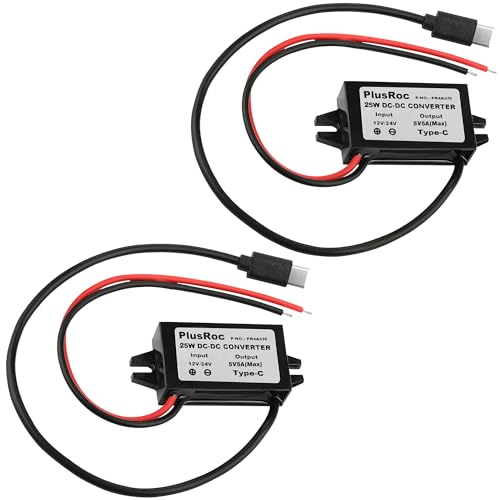
The distinguishing point is the USB-C output and 5A maximum rating, higher than the 3A converter option. Each unit accepts 8–32V DC, with 12V or 24V recommended, and the two-pack is aimed at automotive, industrial, and DIY setups. The maker claims more than 90% conversion efficiency and lists overload, over-current, overheat, and low-voltage protection. USB-C describes the connector, not guaranteed fast charging: the product says it does not support USB PD, and a Raspberry Pi 5 may limit USB current by default. It is not the choice for a cigarette-lighter plug-in adapter.
Bottom line: Choose this for USB-C wiring when its non-PD output fits the device.
12V Car Charger Kit with 11 Connectors

This kit is the most connector-flexible option here: it pairs a cigarette-lighter plug with a power cable and includes Mini-USB, Micro-USB, Type-C, and round plugs in several sizes. The car lead is 59.05 inches long, and the separate USB cable is 39.37 inches. That assortment can help when devices use different input ports, but the matching plug alone does not prove electrical compatibility; the device must accept 5V and its connector polarity and current needs must match. The maximum output current is not provided in the specifications, so this is a poor fit for a device with a known high-current requirement.
Bottom line: Choose this when its included connector matches a 5V device.
GutReise 12V Car Charger and 5V Cable
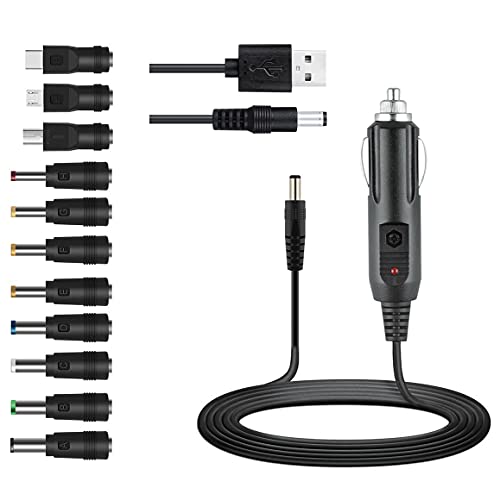
Unlike the wired buck modules, this package combines a 12V car charger with a separate USB-to-DC cable and connector set. Its cable lengths are 1.5 meters for the car charger and 1 meter for the power cable, and the plug set includes USB styles and multiple round barrel sizes. This is useful when you need both a vehicle-socket power lead and a USB-powered DC lead for compatible equipment. The maximum 10A in the name does not establish the 5V cable’s output current, so do not select it for a device whose required current must be confirmed in advance.
Bottom line: Pick this when the two included cable formats match your setup.
How to Choose a 12V to 5V Car Adapter
Start with the device’s required voltage, current, and connector; all three must match. A 5V device rated at 2A needs up to 10W, while 3A at 5V is 15W and 5A at 5V is 25W. A higher current rating is a ceiling, not a demand that the adapter forces into the device, but the device still must be designed for the output and cable. Check the device label or manual for input voltage, current, and polarity. For a barrel plug, compare both outer and inner diameters; a plug that fits physically may still have the wrong polarity. Wired converters also require correct positive and negative connections and insulated joints.
USB-C and USB Output Limits
A USB-C socket does not by itself guarantee USB Power Delivery or fast charging. USB-C can provide 5V as its default power level, while higher-voltage USB-PD charging requires compatible source, cable, and device negotiation; these options are specified as 5V outputs. A 5V/3A output is 15W, and a 5V/5A output is 25W, before accounting for conversion losses. Do not infer higher wattage from the connector shape or a car’s 12V system. For devices with demanding peripherals, verify both the required input current and any charging protocol requirement. A 5V output cannot power equipment that needs 12V simply because the adapter plugs into a vehicle.
Car Power and Wiring Fit
A vehicle’s “12V” system is nominal: a fully charged 12V lead-acid battery is about 12.6V at rest, while charging voltage commonly rises into roughly the 13.7–14.7V range. A converter intended for a vehicle should tolerate the actual input range, not just the label on the battery; options here include 12V/24V or 8–32V input ranges. For a wired module, identify polarity before connecting, disconnect power while making bare-wire connections, and insulate exposed conductors to prevent shorts. Use a cigarette-lighter style lead when you need a removable plug-in connection; use a wired converter when the installation can be secured and fused appropriately.
Connector and Cable Mistakes to Avoid
Barrel connectors are commonly identified by outer and inner diameter in millimeters, and close sizes such as 5.5 × 2.1 mm and 5.5 × 2.5 mm are not interchangeable in every device. Confirm both measurements, polarity, and the device’s 5V input before choosing a multi-tip cable. Extension length also matters: a longer thin cable can produce more voltage drop under load, so use a suitably rated cable for higher current. Never connect a 5V output to a 12V-only input, and do not assume a USB socket’s current rating from its physical shape. With a wired converter, verify the lift range before ordering is irrelevant; instead, confirm the wiring method and output connector suit the installation.
Frequently Asked Questions
Can a 12V car adapter charge a 5V device?
Yes, if the adapter converts the vehicle input to a regulated 5V output and its connector and current rating suit the device. A 5V, 2A device can require up to 10W, so check its input label before connecting.
How many watts is 5V at 3 amps?
Five volts at 3 amps equals 15 watts. The device draws only the current it needs when the power supply is compatible, but a supply rated below that demand may not operate it correctly.
How do I match a barrel plug to my device?
Match the barrel plug’s outer and inner diameters, then verify voltage and polarity. Plugs with similar outer diameters can have different center openings, so a snug physical fit alone is not enough.
Can I use a 12V-to-5V adapter in a 24V truck?
Only if the adapter’s input range includes 24V. A 12V/24V or 8–32V input rating covers that nominal vehicle voltage; a 12V-only unit should not be assumed safe for a 24V system.