
15% Silver Brazing Rods: Three Options Compared

For most buyers seeking a 15% silver brazing rod, BCuP-5 15% Silver, 14-Inch is the closest fit because it is BCuP-5 and has 14-inch sticks. Choose BCuP-5 15% Silver, 10-Inch if you prefer shorter 10-inch rods, or Harris Stay-Silv 15, 20-Inch if you need 20-inch sticks; confirm the pack count for BCuP-5 15% Silver, 10-Inch before ordering because its quantities conflict.
BCuP-5 is a phosphorus-copper brazing alloy used for copper joints; brass and other copper alloys require flux.
We earn a commission if you buy through links on this page. As an Amazon Associate I earn from qualifying purchases. Products are compared on manufacturer specifications, not hands-on testing.
- Best overall: BCuP-5 15% Silver, 14-Inch – BCuP-5 rods come in a 20-piece pack with a 14-inch length.
- Best for 10-inch sticks: BCuP-5 15% Silver, 10-Inch – The stick length is 10 inches, though the pack count needs confirmation.
- Best for 20-inch sticks: Harris Stay-Silv 15, 20-Inch – The stick length is 20 inches, longer than the other options.
| Product | Best for | Stick length | Rod profile | Pack count | Shop |
|---|---|---|---|---|---|
| BCuP-5 15% Silver, 14-Inch | HVAC copper joints | 14 in | Flat, 0.050 × 1/8 in | 20 rods | Check Price on Amazon |
| BCuP-5 15% Silver, 10-Inch | Shorter rod length | 10 in | Flat, 0.050 × 1/8 in | Conflicting: 30-piece title; 15-rod feature | Check Price on Amazon |
| Harris Stay-Silv 15, 20-Inch | Longer stick length | 20 in | 0.039 × 1/8 in | 28 sticks | Check Price on Amazon |
15% Silver Brazing Rods
Compare these BCuP-5 rod options by stick dimensions and pack format before matching one to the joint.
BCuP-5 15% Silver, 14-Inch

BCuP-5 15% Silver, 14-Inch is the 14-inch BCuP-5 option, with 20 flat sticks sized 0.050 by 1/8 inch. The maker gives a solidus of 1,190°F, a liquidus of 1,475°F and a brazing range of 1,300–1,500°F; the rods are intended for HVAC applications with a gas torch. This suits buyers who want a defined temperature range and a longer stick than the 10-inch option. The application is not a universal joint-fit guarantee: brass and other copper alloys need flux, and the product notes that flux is necessary for copper alloy such as brass.
Bottom line: Choose this if you want 14-inch BCuP-5 sticks and can match the alloy and flux to the joint.
BCuP-5 15% Silver, 10-Inch
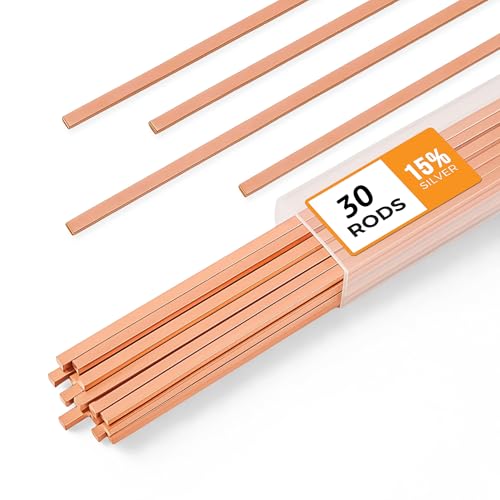
BCuP-5 15% Silver, 10-Inch is the shortest stick option here, at 10 inches, with a flat 0.050-by-1/8-inch profile. Its name identifies it as AWS BCuP-5 with 15% silver, and its applications include HVAC, refrigeration and industrial work. The shorter length may suit buyers who prefer compact sticks over 14- or 20-inch rods. The count is inconsistent: the name says 30 pieces, while the maker says the kit includes 15 rods. Confirm the quantity before buying, and use flux when the joint involves brass or another copper alloy.
Bottom line: Pick this if 10-inch sticks suit your work and you can verify the pack quantity.
Harris Stay-Silv 15, 20-Inch

Harris Stay-Silv 15, 20-Inch stands apart with 20-inch sticks and a 28-stick pack, the longest individual rods in this comparison. The dimensions give a 1/8-inch width and a thickness of about 0.039 inch. That longer format may be useful when you want more rod length per stick than the 10- or 14-inch alternatives. The specifications identify the alloy as Stay-Silv 15 but provide no application or temperature range, so buyers who need those specifications to match a particular joint should verify them before ordering. As with other silver brazing rods, joint material determines whether flux is needed.
Bottom line: Choose this if 20-inch sticks and the 28-stick pack suit your requirements.
How to Choose a 15% Silver Brazing Rod
Match the filler alloy to the base metals first, then choose rod length and profile for access to the joint. BCuP-5 is a phosphorus-copper alloy intended for copper brazing; phosphorus makes it self-fluxing on copper-to-copper joints, but brass, bronze and other non-copper surfaces generally require a suitable flux. A 15% silver label alone does not establish the alloy classification, so check whether the rod is explicitly identified as BCuP-5 when that is required for the job. For the BCuP-5 option, the maker gives a 1,300–1,500°F brazing range. Use the alloy maker’s recommended working range for the selected product rather than assuming every 15% silver filler flows at the same temperature.
Rod Length and Profile for Access
Choose stick length around torch clearance and joint access, not only the total number of rods in a pack. These options span 10 to 20 inches, while the flat profiles are 0.050 by 1/8 inch for the 10- and 14-inch rods. A thinner rod meters less filler into a joint per pass than a thicker one, which can help with small fittings; the correct amount still depends on joint gap and geometry. Brazed joints need close, even clearance so molten filler can flow through the joint by capillary action; a large gap can weaken that action. Clean the mating surfaces before heating, and avoid filling a joint by building a bead on the outside.
Flux and Joint-Material Compatibility
Use flux when brazing brass or other alloys that are not copper-to-copper, because BCuP phosphorus does not replace flux for those joints. Copper-to-copper joints are a common application for phosphorus-copper filler; steel, iron and nickel alloys are not compatible with phosphorus-bearing filler because the joint can become brittle. Clean oxide and oil from the joint before brazing, and apply a flux formulated for the base metals and brazing temperature when needed. A copper-to-brass connection is a decision point: use suitable flux rather than treating the rod as self-fluxing for both metals. Keep flux residue in mind after the joint cools, since corrosive fluxes may require removal.
Safe Brazing and Heat Control
Brazing temperatures can exceed 1,000°F, so protect eyes and skin from radiant heat, hot metal and flux splatter. Use a torch only in a ventilated area clear of combustible material, and keep a suitable fire extinguisher within reach; nearby insulation, wiring and refrigerant lines can be damaged by heat. Heat the joint evenly and let the workpiece bring the filler to flow, rather than melting the rod directly in the flame. The maker’s range for BCuP-5 15% Silver, 14-Inch is 1,300–1,500°F, but use the selected alloy’s recommended range and avoid overheating. Allow the assembly to cool safely before handling or removing residue; never quench a hot brazed joint unless the process instructions specifically allow it.
Frequently Asked Questions
What does BCuP-5 mean on a brazing rod?
BCuP-5 is a phosphorus-copper brazing filler classification, commonly associated with 15% silver rods. The classification helps distinguish the alloy from other silver-bearing fillers, but base-metal compatibility still matters.
Do 15% silver brazing rods need flux?
For BCuP-5 on copper-to-copper joints, phosphorus makes the filler self-fluxing. Brass and other copper alloys generally need an appropriate flux, so match flux use to the joint metals.
Can BCuP-5 braze steel or iron?
No; avoid phosphorus-bearing BCuP filler on steel, iron and nickel alloys because brittle phosphide compounds can form. Choose a filler alloy intended for those base metals instead.
What temperature does a 15% silver brazing rod need?
The maker gives BCuP-5 15% Silver, 14-Inch a brazing range of 1,300–1,500°F, with a solidus of 1,190°F and liquidus of 1,475°F. The appropriate working temperature depends on the particular alloy and joint setup.
How much gap should a brazed joint have?
Brazed joints typically use a close clearance around 0.001–0.005 inch so molten filler can flow by capillary action. The ideal gap changes with base metals, temperature and filler, so confirm the process range for the specific joint.