
2,4-D Amine Selective Post-Emergent Herbicides Compared

Hi-Yield 2,4-D Selective Weed Killer suits most buyers seeking a 2,4-D amine selective post-emergent herbicide because its one-gallon concentrate is labeled for several use settings, including lawns and pastures. Choose Southern Ag Amine 2,4-D Weed Killer instead if a quart-size container better matches your acreage; choose Alligare 2,4-D Amine Concentrate if you want a product whose name identifies a 47.2% active-ingredient concentration.
Post-emergent herbicides are applied after weeds emerge, and selective 2,4-D products target susceptible broadleaf plants while preserving only the grasses allowed by the product label. Match the labeled site and weed to your use before treating.
We earn a commission if you buy through links on this page. As an Amazon Associate I earn from qualifying purchases. Products are compared on manufacturer specifications, not hands-on testing.
- Best overall: Hi-Yield 2,4-D Selective Weed Killer – One-gallon concentrate with uses across lawns, ponds, drainage ditches, pastures, and rangelands.
- Best for quart size: Southern Ag Amine 2,4-D Weed Killer – A 32-ounce container with a use rate of 1 to 4 pints per acre.
- Best for stated concentration: Alligare 2,4-D Amine Concentrate – A one-gallon amine concentrate identified as containing 47.2% active ingredient.
| Product | Best for | Container size | Use sites | Shop |
|---|---|---|---|---|
| Hi-Yield 2,4-D Selective Weed Killer | Multi-site use | 1 gal | Lawns, ponds, ditches, pastures, rangelands | Check Price on Amazon |
| Southern Ag Amine 2,4-D Weed Killer | Quart container | 32 oz | Turf, pastures, rangeland, ditch banks | Check Price on Amazon |
| Alligare 2,4-D Amine Concentrate | Concentration stated | 1 gal | Lawns, pastures, aquatic sites, crops | Check Price on Amazon |
2,4-D Amine Selective Post-Emergent Herbicides
Compare container size, concentration when given, and the use sites identified for each concentrate.
Hi-Yield 2,4-D Selective Weed Killer
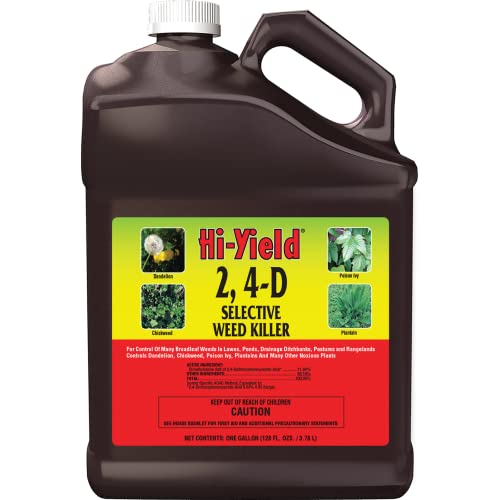
Hi-Yield is the broadest-use fit among these concentrates for buyers who need a product labeled for several outdoor settings. The one-gallon container is intended for broadleaf weed control, and the maker names dandelion, arrowhead, buckhorn, aster, and goatsbeard among susceptible weeds. It can be used on lawns, ponds, drainage ditches, pastures, and rangelands, subject to its label directions. The limitation is that application rates and instructions must be taken from the label, so this is not the choice for someone seeking a ready-to-use product or a concentration.
Bottom line: Choose this concentrate when you need one product for several of its labeled sites.
Southern Ag Amine 2,4-D Weed Killer
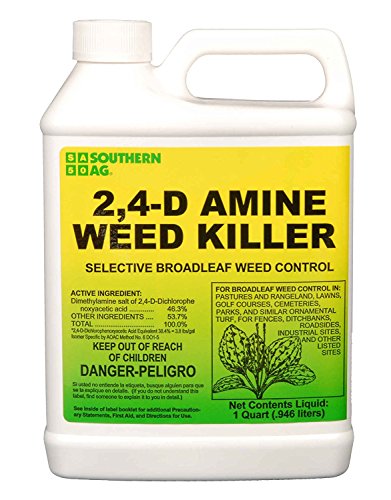
Southern Ag is the quart-size option, with an expressly stated use rate of 1 to 4 pints per acre. Its control includes many broadleaf weeds and woody plants, and its use settings include turf, pastures, rangeland, ditch banks, and fences. A quart can be a sensible match when the treated acreage is limited, but the per-acre rate spans a fourfold range; the applicable label rate matters for the specific site and target weed. Buyers looking for an identified active-ingredient percentage should compare it with a product that provides that figure.
Bottom line: Pick this when a quart container and labeled per-acre use rate suit the job.
Alligare 2,4-D Amine Concentrate

Alligare is the option here with a 47.2% active ingredient, in a one-gallon amine concentrate. Its uses span lawns, pastures, aquatic sites, crops, and forests, and its named targets include pigweed, thistle, and ragweed. That breadth makes it relevant when the intended site is among those labeled uses, but it does not establish that every site or weed can be treated in every jurisdiction. Check the exact product label for the intended site and application directions; the percentage alone does not determine a mixing rate.
Bottom line: Choose this when its concentration and labeled site fit your application.
How to choose a 2,4-D post-emergent herbicide
Choose by labeled use site and target weed first, then by container size and concentration. Post-emergent treatment is aimed at weeds that have emerged and are actively growing; drought, cold, or dormant growth can reduce uptake. Selective describes the intended distinction between susceptible broadleaf weeds and certain established grasses, not safety for every plant or lawn species. 2,4-D labels can differ by formulation and site, so a rate for pasture is not automatically a lawn rate. For a small treated area, a quart may be easier to use up; for repeated work across multiple labeled sites, a gallon may better match the job. Never infer a mixing rate from the container size or active-ingredient percentage alone.
When to apply post-emergent 2,4-D
Apply when target broadleaf weeds are actively growing and weather permits the label-directed treatment. Wind can carry spray onto sensitive broadleaf plants, including ornamental plants and nearby crops, so avoid spraying when drift could reach them. Rainfast intervals and temperature limits depend on the formulation label; do not assume a universal waiting period or heat cutoff. A useful decision rule is to postpone treatment whenever wind is strong enough to move droplets off target or the target weeds are not actively growing. Coverage, weed maturity, and the labeled rate also affect results. The product names and features identify possible targets, but the exact target list and site authorization must match the product label.
2,4-D amine use sites and label fit
Use-site authorization is the main distinction among these options: the maker names turf or lawns, pastures, and additional settings such as aquatic sites, crops, forests, or rangelands, but not every product names the same locations. A 2,4-D product approved for one site should not be assumed usable at another; aquatic applications in particular require explicit label authorization. Before choosing, match three items on the label: the treatment site, the target weed, and the application rate. 2,4-D is a selective herbicide for susceptible broadleaf plants, but drift may injure desirable broadleaf vegetation. Keep the original container and label available when measuring and mixing, and use only labeled protective equipment.
Frequently Asked Questions
What weeds does 2,4-D amine usually control?
2,4-D amine products target susceptible broadleaf weeds, and the exact weed list varies by label. These products name examples such as dandelion, pigweed, thistle, ragweed, and buckhorn.
Does 2,4-D amine kill lawn grass?
Some 2,4-D products are labeled for particular established turf grasses, but tolerance depends on grass type and application conditions. Confirm the grass species and lawn site are permitted on the label before treating.
Can 2,4-D amine be used near flowers?
Use caution because spray drift can injure sensitive broadleaf ornamentals. Avoid application when wind could carry spray beyond the target area, and follow label restrictions for nearby plants.
How much 2,4-D concentrate should I mix?
Use the rate on the specific product label for the target weed and site; there is no single mixing rate for all 2,4-D concentrates. Southern Ag gives a range of 1 to 4 pints per acre, so the appropriate labeled use determines where in that range to apply.
When should I spray weeds with 2,4-D?
Treat emerged weeds while they are actively growing, rather than dormant or drought-stressed plants. Postpone application if wind may move the spray off target, and observe the product label’s weather and timing limits.