
20V to 12V Step Down Converters Compared by Fit

Azocek 20V Battery Converter, 20A is the closest match for a DeWalt 18V/20V battery setup, with 12V output rated up to 20A and 240W.
A step-down converter reduces a higher DC input voltage to a lower DC output voltage for compatible 12V equipment. Match the converter’s input range to your battery and keep the connected load within its output limits.
We earn a commission if you buy through links on this page. As an Amazon Associate I earn from qualifying purchases. Products are compared on manufacturer specifications, not hands-on testing.
- Best overall: Azocek 20V Battery Converter, 20A – DeWalt 18V/20V battery compatibility and 12V output up to 20A and 240W.
- Best for conversion efficiency: Haseed 20V Battery Converter, 20A – Claims up to 96% efficiency alongside 20A, 240W output.
- Best for low-voltage cutoff: 20V Battery Converter with Switch – Specifies automatic shutoff below 15.2V to protect the battery from further discharge.
| Product | Best for | Protection or efficiency | Shop |
|---|---|---|---|
| Azocek 20V Battery Converter, 20A | DeWalt battery projects | Fuse; over-current, over-voltage, overload | Check Price on Amazon |
| Haseed 20V Battery Converter, 20A | Efficiency priority | Up to 96% efficiency | Check Price on Amazon |
| 20V Battery Converter with Switch | Battery cutoff feature | Low-voltage cutoff below 15.2V | Check Price on Amazon |
20V to 12V Step Down Converters
Compare the battery-mounted adapters by their output limits and the protection or conversion features that distinguish them.
Azocek 20V Battery Converter, 20A

Azocek 20V Battery Converter, 20A pairs a DeWalt battery adapter with a wired 12V converter, making it a direct fit for projects built around the DeWalt 18V/20V lithium batteries. The maker rates the output at up to 20A and 240W and includes a wire terminal, fuse holder and 30A fuse. Built-in protection covers over-current, over-voltage, overload and short circuit. Keep the load within the 240W rating and connect polarity correctly; the maker specifically cautions against exceeding rated power. Choose another model if you need a low-voltage battery cutoff.
Bottom line: Choose this for a DeWalt battery setup needing up to 240W of 12V output.
Haseed 20V Battery Converter, 20A
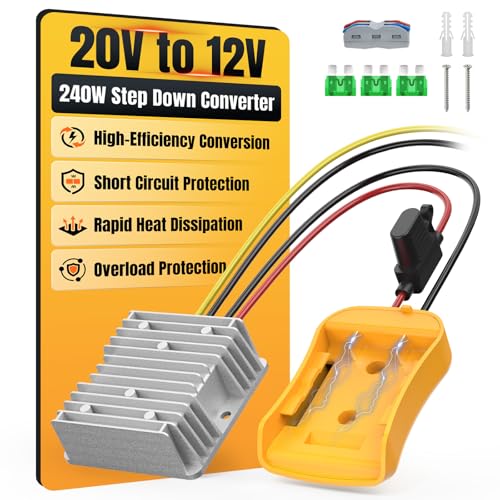
Haseed 20V Battery Converter, 20A stands out for its claimed conversion efficiency of up to 96%, while matching the 18–20V input and 12V, 20A, 240W output of the other battery-mounted choices. It is compatible with DeWalt 18V/20V lithium batteries, including the DCB205, DCB206, DCB204, DCB203, DCB200 and DCB201 families. The maker describes the adapter as a snug, quick-install fit and specifies synchronous rectification.
Bottom line: Choose this if the up-to-96% efficiency is your deciding specification.
20V Battery Converter with Switch

20V Battery Converter with Switch is the only battery-mounted option here that gives a specific low-voltage shutoff point: it says the converter stops below 15.2V. The maker lists low-voltage, over-voltage, over-current, short-circuit, overload and overheat protection. The maker does not establish the switch’s exact wiring behavior, so confirm that control arrangement before choosing it for a setup that depends on a particular switch function.
Bottom line: Choose this when a specified 15.2V battery shutoff is useful for your project.
How to size a 20V to 12V converter
Size the converter by both the load’s current and its total power draw, not just the 12V label. At 12V, 10A equals 120W and 20A equals 240W, using the relationship watts = volts × amps. Add the power requirements of all devices that may run at once, then stay within both output ratings. Motors, pumps and other loads with startup surges can briefly draw more current than their running rating, so a converter that only matches steady-state demand may shut down or overheat. For a device with a published startup current, use that figure when checking the converter’s maximum. Do not treat a 30A fuse as permission to draw 30A from a converter rated for 20A.
Battery fit and polarity for 20V adapters
Battery-mounted converters must match the battery platform and voltage range, not merely the nominal voltage printed on a tool battery. These three adapters specify DeWalt 18V/20V compatibility and an 18–20V DC input, but that does not establish compatibility with other brands or battery families. Check your battery model against the named DCB series before connecting it. DC polarity matters: reversing positive and negative can damage connected electronics, so identify both terminals and verify the wiring before powering a load. A battery adapter also does not make a 12V device compatible with a higher-voltage input directly; connect the device only to the converter’s 12V output and stay within its current and power limits.
Choosing protection and a low-voltage cutoff
Protection labels do not all describe the same safeguard: over-current and short-circuit protection address output faults, while a low-voltage cutoff can stop a battery from being drained further. A fuse is sized to interrupt excessive current in a circuit, but it does not replace the converter’s output rating or correct wiring. For battery-powered equipment, switch off the load when it is not needed and keep the converter’s ventilation and installation consistent with its intended use. Confirm the switch wiring if your project depends on a particular on/off behavior.
Frequently Asked Questions
Can a 20V battery power a 12V device directly?
No; connect the device to a 12V step-down converter rather than directly to the battery. Match the converter input to the battery’s voltage range and keep the device’s current draw within the converter rating.
How many watts does a 12V 20A converter provide?
A 12V output at 20A corresponds to 240W, calculated as volts multiplied by amps. Keep the combined load at or below the converter’s maximum, and account for any motor startup surge.
What does a 15.2V battery cutoff do?
A cutoff below 15.2V stops the converter from drawing power once the battery voltage falls below that threshold. It does not increase the converter’s output rating or guarantee a particular runtime.
Can a 30A fuse make a 20A converter safe at 30A?
No; a 30A fuse does not raise a converter’s 20A maximum output. Keep the load within the converter’s current and 240W limits, and use correctly polarized wiring.