
3.7V Lithium Battery Chargers: 4 Types Compared

A 3.7-volt lithium battery charger should match the battery’s chemistry, physical format and connector; 1-Slot LCD Charger offers selectable current modes and support for several cell sizes. Choose a different option if you need an RC charging cable with an SM-2P plug or a dedicated two-bay charger for loose cells.
These products include both plug-in cables and chargers with adjustable slots, so confirm the battery’s chemistry and connector before choosing.
We earn a commission if you buy through links on this page. As an Amazon Associate I earn from qualifying purchases. Products are compared on manufacturer specifications, not hands-on testing.
- Best overall: 1-Slot LCD Charger – Supports multiple rechargeable cell sizes and offers selectable 500mA, 1A and 2A current modes.
- Best for RC batteries: PTIJPOW SM-2P USB Cable – The roughly 2-foot USB cable ends in an SM-2P plug and supplies 400mA.
- Best for two cells: YOWPEY 2-Bay USB Charger – Its two slots can charge compatible 3.7V lithium-ion cells simultaneously.
| Product | Best for | Charge format | Output | Compatible cells | Shop |
|---|---|---|---|---|---|
| 1-Slot LCD Charger | Selectable current | 1-slot charger | 500mA, 1A, 2A | Li-ion; Ni-MH/Ni-Cd | Check Price on Amazon |
| Multi-Chemistry 18650 Charger | Mixed cell types | Multi-cell charger | — | Li-ion; Ni-MH/Ni-Cd | Check Price on Amazon |
| YOWPEY 2-Bay USB Charger | Two-cell charging | 2-bay charger | Up to 950mA per slot | Li-ion 10440–26650 | Check Price on Amazon |
| PTIJPOW SM-2P USB Cable | RC battery packs | USB cable, SM-2P | 400mA | 3.7V RC batteries | Check Price on Amazon |
3.7V Lithium Battery Chargers
Match the charger’s cell format, chemistry and connector to your battery before considering charging current.
1-Slot LCD Charger
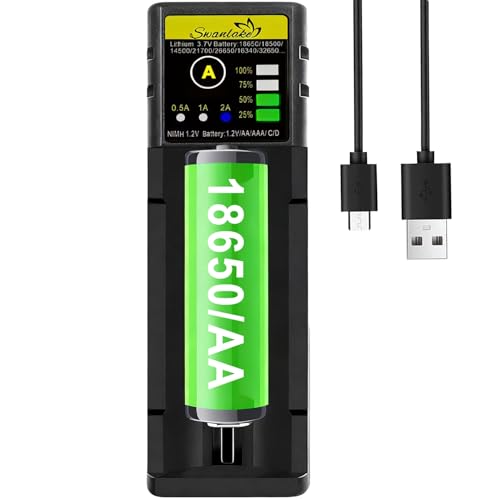
Selectable current and an LCD capacity display set this charger apart from the fixed-output options. The charger supports 500mA, 1A and 2A modes, with the Q1 button changing the current; its display shows 25%, 50%, 75% and 100% capacity. It accepts several listed lithium-ion cell sizes and 1.2V–1.5V Ni-MH or Ni-Cd cells. The maker says it powers off automatically when a battery is fully charged.
Choose it if you want current control and broad cell-size compatibility. Its single slot is the limitation for anyone who needs to charge multiple cells at once.
Bottom line: Pick this if you want one slot with selectable current modes.
Multi-Chemistry 18650 Charger

Support for lithium-ion, Ni-MH and Ni-Cd cells distinguishes this charger from the lithium-focused cable and two-bay model. Its compatible formats include 26650, 18650, 21700, 14500 and 16340 lithium-ion cells, plus AA, AAA and C Ni-MH/Ni-Cd batteries. The maker says the charger includes over-charge, over-voltage, short-circuit and over-current safeguards and stops charging when a battery is full.
This is a fit for households with several rechargeable battery chemistries and sizes. The maker does not give its charging current, so it is a less direct choice if you need to compare charge speed.
Bottom line: Choose this for a mix of lithium-ion and Ni-MH/Ni-Cd cells.
YOWPEY 2-Bay USB Charger
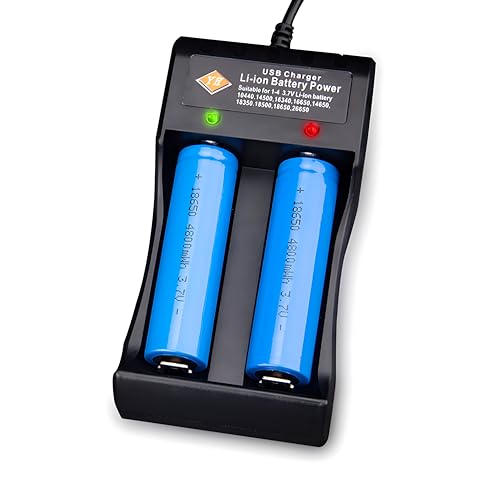
Two independent bays make this model the choice here for charging two compatible lithium-ion cells at once. It accepts listed formats from 10440 through 26650, including 14500, 16340, 18500 and 18650, and uses a 5V USB input. The maker says output reaches up to 950mA per slot and describes multiple protections, though the maker does not enumerate those safeguards.
Choose it when your batteries are compatible 3.7V lithium-ion cells and you want two charging positions. It is not the right match for Ni-MH or Ni-Cd cells, which are supported by some of the other chargers.
Bottom line: Pick this to charge two supported lithium-ion cells at once.
PTIJPOW SM-2P USB Cable

The SM-2P connector and cable form distinguish this option from chargers that hold loose cells in bays. It takes 5V USB input and outputs 3.7V at 400mA, with a cable length of about 2 feet. The maker says the indicator glows red during charging and turns off when charging is complete; it also says the cable has overvoltage, overcurrent and overcharge protection.
Choose this for a compatible small 3.7V RC battery with an SM-2P plug. The fixed connector is a limitation for batteries that use another plug or need a slot-style charger.
Bottom line: Choose this for a compatible RC battery with an SM-2P connector.
How to choose a 3.7V lithium battery charger
Start with the battery chemistry and cell format, then match the connector or slot. A 3.7V label commonly describes a single lithium-ion cell’s nominal voltage; a fully charged standard lithium-ion cell reaches 4.2V, so the charger must be designed for that cell chemistry rather than merely matching the label. Ni-MH and Ni-Cd cells use different charging methods and are not interchangeable with lithium-ion cells.
Choose a charger with a slot sized for the cell or a cable whose plug matches the battery. If charging speed matters, compare output current only among compatible products; higher current is not automatically appropriate for every cell. For a cable, confirm both polarity and connector shape before connecting it, because similar-looking plugs can be wired differently.
Battery size and connector fit
Cell size is a physical fit rule, not just a voltage specification. For example, 18650 and 21700 refer to cylindrical formats with different diameters and lengths, so a bay must physically accept the cell and make contact at both ends. A charger compatible with one size may not fit another even when both batteries are lithium-ion.
Measure the cell or read its format marking before selecting a slot charger; check the battery label for chemistry and voltage as well. For RC batteries, the connector must match exactly, and the plug’s wiring must agree with the battery. Do not force an oversized cell into a bay or adapt an unknown connector by guesswork.
USB cables and slot chargers compared
A USB charging cable is made for a matching battery plug, while a slot charger holds loose rechargeable cells between contacts. The cable format is useful for an RC pack with the correct connector; a bay design suits removable cylindrical cells. Selectable current and a display can add control, but only matter when the cell itself is compatible with the charger.
The table compares the basic format and the decision it serves; the battery’s chemistry and fit still take priority.
| Charger type | Best match | Check before use |
|---|---|---|
| USB cable | Battery with matching plug | Connector and wiring |
| Single-bay charger | One loose cell | Cell size and chemistry |
| Two-bay charger | Two compatible loose cells | Both cells fit its supported formats |
Safe charging and common mistakes
Charge lithium batteries on a stable, nonflammable surface and stay nearby; stop using a battery that becomes unusually hot, swells or leaks. Lithium-ion cells need a charger made for their chemistry, and a 1.2V Ni-MH cell should not be placed in a lithium-ion charging mode. Built-in safeguards do not replace correct battery matching or attentive charging.
A common mistake is choosing by “3.7V” alone and overlooking cell size, plug polarity or chemistry. Another is selecting a higher current without checking that the battery supports it. Use only the current mode appropriate for the cell, and do not charge a damaged battery.
Frequently Asked Questions
What voltage is a 3.7V lithium battery when full?
A standard single-cell 3.7V lithium-ion battery is typically about 4.2V when fully charged. Its 3.7V rating is nominal, so use a charger designed for that lithium-ion cell rather than a charger that simply outputs 3.7V.
Can I charge a 3.7V battery with any USB charger?
No; the USB power source supplies input power, but the charging circuit must match the battery chemistry and format. Check that the charger is designed for the specific lithium battery and that its connector and wiring match before connecting it.
How do I know if an 18650 charger fits my battery?
Check that the charger explicitly supports the 18650 format and that the cell fits between its contacts without force. An 18650 is a cylindrical lithium-ion size; a charger intended for a different diameter or length may not hold it securely.
Is a higher amp setting always better for charging?
No; the correct current depends on the battery’s permitted charging rate, not just the charger’s maximum. If the battery’s supported current is unknown, do not assume the highest setting is safe.
Can one charger handle lithium-ion and Ni-MH batteries?
Some chargers are designed for both chemistries, but they need to identify or use the correct charging mode for each cell. Confirm the charger supports the specific chemistry and cell size before inserting a battery.