
4 Pin Reverse Camera: 3 Models Compared by Fit

For most buyers, DL003 4-Pin Camera is the clearest pick because its 130-degree view and 12V input are specified. Choose VOONOA AHD 1080P 4-Pin Camera instead only if your 4-pin monitor supports AHD; choose LASTBUS 4-Pin Wired Camera if you need a camera for a 12V–24V system and can verify monitor compatibility.
We earn a commission if you buy through links on this page. As an Amazon Associate I earn from qualifying purchases. Products are compared on manufacturer specifications, not hands-on testing.
- Best overall: DL003 4-Pin Camera – Its 130-degree viewing angle and 12V input are specified.
- Best for 12V–24V systems: LASTBUS 4-Pin Wired Camera – It is designed for a 12V–24V DC system.
- Best for AHD monitors: VOONOA AHD 1080P 4-Pin Camera – It supports AHD 1080P when paired with a compatible monitor.
| Product | Best for | Video specification | Power | Shop |
|---|---|---|---|---|
| DL003 4-Pin Camera | Wide view | 800 TVL, 976 × 576 pixels | 12V | Check Price on Amazon |
| VOONOA AHD 1080P 4-Pin Camera | AHD systems | AHD 1080P, 1500 TVL | — | Check Price on Amazon |
| LASTBUS 4-Pin Wired Camera | Wide voltage | 700 TV lines | 12V–24V DC | Check Price on Amazon |
4 Pin Reverse Cameras
Compare video format, viewing angle and power requirements before matching a camera to your monitor and vehicle.
DL003 4-Pin Camera

DL003 4-Pin Camera separates itself with a specified 130-degree viewing angle and 800 TVL image resolution. Its 1/3-inch color CCD sensor and six-layer glass lens are intended for a wide rear view, while 18 infrared lights support night vision. The camera is a match to consider for a 12V RV, truck, van or trailer system using a compatible 4-pin monitor. Its power input is 12V, so it is not the choice for a 24V-only setup; confirm connector and monitor compatibility before ordering.
Bottom line: Pick this for a 12V system where a 130-degree view is the deciding factor.
VOONOA AHD 1080P 4-Pin Camera

VOONOA AHD 1080P 4-Pin Camera is the AHD option, with a 1080P chip and 1500 TVL specification rather than the pixel and angle figures given for the other cameras. Its infrared LEDs are specified for night vision up to 50 feet. This camera suits an RV, truck or other vehicle whose 4-pin monitor accepts both the connector and AHD video signal. The key limitation is that a 4-pin plug alone does not establish signal compatibility; an incompatible monitor will not match this camera’s AHD output.
Bottom line: Choose this only when the existing 4-pin monitor accepts AHD video.
LASTBUS 4-Pin Wired Camera
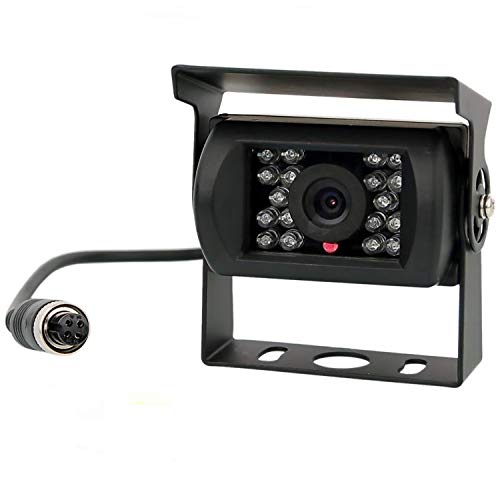
LASTBUS 4-Pin Wired Camera stands out for its 12V–24V DC operating system, making it the option to consider when vehicle voltage is the main constraint. Its CMOS sensor is specified at 700 TV lines, and 18 built-in infrared LEDs switch automatically to night vision in darkness. The wired camera is intended for RVs, campers, trucks and similar vehicles. It does not include a monitor or extension cable, and monitor incompatibility is possible, so this is a poor fit if you need a complete camera-and-screen set or cannot check the existing monitor.
Bottom line: Pick this for a 12V–24V setup when you already have a compatible monitor.
How to match a 4 pin camera to a monitor
A 4-pin connector does not guarantee that a camera will work with a monitor: connector shape and video signal must both match. Conventional analog video and AHD video are different signal formats, so an AHD camera requires a monitor that accepts AHD. Before choosing, check the monitor manual or model specifications for the connector pinout and supported signal; do not rely on the plug count alone. If the monitor’s signal format cannot be confirmed, avoid selecting an AHD-only camera. Also check whether the system uses 12V or 24V power, since camera voltage compatibility is a separate requirement from video compatibility.
Choosing viewing angle and image format
A wider viewing angle captures more of the area beside the vehicle, but can make distant objects look smaller. Use a measurable rule: if seeing a broad area immediately behind a trailer matters more than judging distance, prioritize an angle of 130 degrees or wider; if the camera will mainly help line up a hitch, also consider image detail and monitor resolution. TVL, pixel count and AHD describe different aspects of a video system and should not be compared as interchangeable numbers. A camera’s image quality is limited by the monitor and cable path as well as the sensor, so a high-resolution camera cannot improve a display that does not support its signal.
Camera types compared by system fit
Match the camera type to the system’s voltage and video format first, then use viewing angle to choose among compatible options. The table separates the key constraints from image claims so you can rule out a mismatch before considering image features.
| Need | Choose by | Why it matters |
|---|---|---|
| 12V–24V system | Camera power range | A camera must accept the system voltage. |
| AHD monitor | AHD output support | A 4-pin plug does not ensure signal compatibility. |
| Broad rear view | Specified viewing angle | A wider angle covers more area but reduces apparent object size. |
Camera and monitor should also share the same connector wiring; the same connector family can be wired differently across systems. Confirm the voltage, pinout and video format as a set rather than treating any one match as sufficient.
Installing a wired reversing camera safely
Wired cameras need a stable power connection and a signal cable routed away from hot, moving or sharp-edged parts. Disconnect vehicle power before splicing or modifying wiring, and protect cable pass-throughs with a grommet to prevent chafing. Keep the camera connection secure and weather-protected; waterproof ratings apply to the camera enclosure, not necessarily to an exposed connector or splice. For a long trailer run, make sure the cable is suitable for the distance and system, since voltage drop and signal loss can affect operation. If you are unsure about the vehicle’s wiring or fuse protection, have an automotive installer make the connection.
Frequently Asked Questions
Will any 4-pin camera work with my monitor?
No; the connector and video signal must both be compatible. AHD cameras need an AHD-capable monitor, and pin wiring can also differ between systems.
Can I use a 12V camera on a 24V truck?
Only if the camera’s specified input range includes 24V. A camera limited to 12V should not be connected directly to a 24V supply.
What does a wider camera viewing angle change?
A wider angle shows more area across the rear, but makes objects appear smaller. A 130-degree angle is useful when coverage matters more than judging distance.
How far can infrared camera night vision reach?
Infrared night vision ranges vary by camera and conditions. One camera here specifies visibility up to 50 feet, but obstacles, weather and display quality can reduce practical visibility.
Do I need an extension cable for a trailer camera?
You need enough cable to reach the monitor along a safe route, but the required length depends on the vehicle and mounting path. Measure the run before installation and keep wiring clear of moving parts and heat.