
8 Pin Male DIN Connector Plugs and Cable Compared

For a conventional full-size 8-pin DIN male connector, MEIRIYFA 8-Pin DIN Male Plug, 4-Pack is the closest match because it is a solder plug sold as a four-pack; SHUKEFER 8-Pin DIN Male Plugs, 4-Pack is a similar solder-plug alternative. Choose Mini-8P MD8 Male-to-Wire Cable, 1 m only if your device needs Mini-DIN 8-pin, since Mini-DIN is a different, smaller connector format and it is already attached to a cable.
We earn a commission if you buy through links on this page. As an Amazon Associate I earn from qualifying purchases. Products are compared on manufacturer specifications, not hands-on testing.
- Best overall: MEIRIYFA 8-Pin DIN Male Plug, 4-Pack – A four-pack of full-size 8-pin DIN male solder plugs for making or repairing cables.
- Best for zinc-alloy construction: SHUKEFER 8-Pin DIN Male Plugs, 4-Pack – Its plug uses a zinc-alloy body with PE insulation and eight solder terminals.
- Best for ready-made cable: Mini-8P MD8 Male-to-Wire Cable, 1 m – A 1-meter Mini-DIN 8-pin cable has color-coded bare wire ends and shielding.
| Product | Best for | Connector format | Termination | Package or length | Shop |
|---|---|---|---|---|---|
| MEIRIYFA 8-Pin DIN Male Plug, 4-Pack | Cable repairs | Full-size DIN, 8-pin | Solder terminals | 4 plugs | Check Price on Amazon |
| SHUKEFER 8-Pin DIN Male Plugs, 4-Pack | Alloy plug bodies | Full-size DIN, 8-pin | Solder terminals | 4 plugs | Check Price on Amazon |
| Mini-8P MD8 Male-to-Wire Cable, 1 m | Bare-wire connection | Mini-DIN, 8-pin | Pre-tinned bare wires | 3.28 ft / 1 m | Check Price on Amazon |
8 Pin Male DIN Connector Options
Match the plug format and termination to the device and cable before choosing among these options.
MEIRIYFA 8-Pin DIN Male Plug, 4-Pack

MEIRIYFA 8-Pin DIN Male Plug, 4-Pack is the closest fit for replacing or assembling a conventional 8-pin DIN male cable end, and it comes as four individual plugs. The connector has a black plastic housing, metal construction, and nickel-plated copper contacts; the contact positions are numbered to help with wiring. Its 13 mm diameter can help distinguish it from smaller Mini-DIN formats when checking a mating socket. The plug requires soldering, so it suits cable makers comfortable matching each wire to the correct pin. It is not a ready-made cable, and the connector diameter alone does not establish device compatibility.
Bottom line: Pick this for a four-plug supply of conventional DIN solder ends.
SHUKEFER 8-Pin DIN Male Plugs, 4-Pack
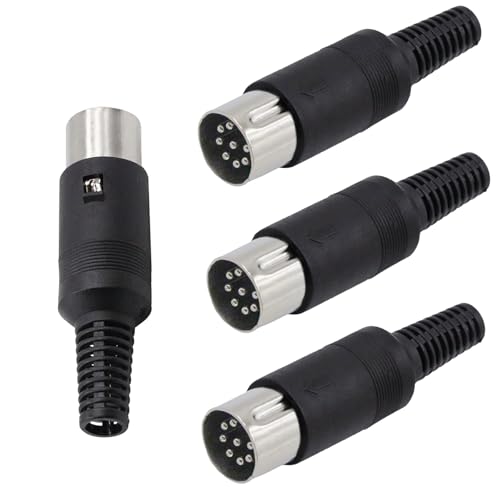
SHUKEFER 8-Pin DIN Male Plugs, 4-Pack offers four 8-terminal male DIN solder plugs, with zinc-alloy and PE construction distinguishing it from the plastic-cased option. The terminals are intended for solder installation, making this a cable-end component rather than a cable adapter with wire leads. Its applications include audio, video, AV, keyboard, and MIDI cable uses, but the actual device must still accept the same full-size DIN pin arrangement. This pack is a practical alternative when the material construction is the deciding factor. It does not include a finished cable, so allow for soldering and correct pin-to-pin wiring.
Bottom line: Choose this when you want four solder plugs with zinc-alloy and PE construction.
Mini-8P MD8 Male-to-Wire Cable, 1 m

Mini-8P MD8 Male-to-Wire Cable, 1 m differs from the solder-plug parts because it is a 1-meter cable with a Mini-DIN 8-pin male connector at one end and pre-tinned, color-coded bare wires at the other. The cable uses 28 AWG copper cores, aluminum-foil shielding, and a PVC jacket; the maker says it supports RS232, RS422, and RS485 communication. Its applications include PLCs, PTZ cameras, servo drives, and inverters, so it suits installations that need a Mini-DIN device connection translated to individual conductors. It is not a full-size DIN plug, and its protocol compatibility does not guarantee the correct pinout for a particular device.
Bottom line: Pick this for a Mini-DIN device that needs a 1-meter bare-wire lead.
Full-size DIN and Mini-DIN are different formats
Full-size DIN and Mini-DIN plugs are not interchangeable, even when both have eight pins. A standard DIN plug body is about 13 mm across, while Mini-DIN connectors are smaller; the circular shell, keying, and pin layout also differ. Compare the socket itself or its device manual before ordering rather than relying on pin count alone. A full-size DIN plug is commonly found in older audio and control connections, while Mini-DIN appears in compact interfaces such as some computer and camera connections. The term “8-pin DIN” can be used loosely, so confirm the connector family and pin arrangement first. If a device specifies Mini-DIN, select a Mini-DIN part, not a conventional DIN solder plug.
Choose a plug or cable by termination
A solder plug is a connector shell with terminals that you attach to your own cable; a pre-made lead already includes wire and a connector. Soldering lets you choose cable length and wiring, but each conductor must land on the correct numbered pin and avoid shorts between adjacent terminals. For signal wiring, use a small iron and heat each joint only long enough to flow solder, then inspect the connections before closing the shell. A cable with bare leads saves connector assembly but still needs the correct device-side pinout. Use the following distinction to narrow the choice.
| Need | Choose | Trade-off |
|---|---|---|
| Make or repair a full-size DIN lead | Solder plug | Requires cable and wiring work |
| Connect a Mini-DIN socket to loose conductors | Mini-DIN-to-wire cable | Fixed cable length and pinout to verify |
Check pinout before wiring an 8-pin connector
Eight pins do not imply a universal signal assignment: MIDI, serial control, and equipment-specific connections can use different pinouts. Identify the device model’s connector view and pin numbering before soldering; diagrams may show the socket face, plug face, or solder side, which can appear mirrored. Match signal, ground, and any power conductors according to the equipment documentation, and do not assume wire colors identify functions unless the cable maker provides that mapping. A continuity tester can confirm that each conductor reaches the intended terminal and that neighboring pins are not shorted. For connections carrying power or controlling machinery, disconnect the equipment before wiring and verify voltage requirements before connecting the lead.
Frequently Asked Questions
Are 8-pin DIN and 8-pin Mini-DIN the same connector?
No. Full-size DIN and Mini-DIN have different shell sizes and mating geometry, so an 8-pin count does not make them compatible. Check the device socket family and pin arrangement before buying.
How can I tell which side shows the pin numbers?
Connector diagrams may show the mating face or the solder side, and those views are mirrored. Use the diagram labeled for the side you are wiring and verify each wire with a continuity tester before closing the housing.
Can I use any 8-pin DIN plug for MIDI?
No. MIDI commonly uses a 5-pin DIN connection, so an 8-pin plug is not a direct substitute. Confirm that the equipment specifically calls for an 8-pin DIN socket and that its pinout matches.
What should I check before soldering a DIN cable?
Confirm the connector family, pin numbering, and device-specific wiring diagram first. Keep solder joints separate, inspect for bridges, and test continuity with the equipment disconnected before use.