
Best TV Antenna for Rural Areas: 3 Options Compared

For most rural homes, the Antennas Direct ClearStream 4V is the strongest fit because it is designed for outdoor or attic installation and receives both UHF and VHF signals. Choose an indoor model only if you have a strong signal and can place it near a window; hills, trees and distance from broadcast towers can make indoor reception unreliable.
We earn a commission if you buy through links on this page. As an Amazon Associate I earn from qualifying purchases. Products are compared on manufacturer specifications, not hands-on testing.
- Best overall: Antennas Direct ClearStream 4V – Its four loops, reflectors and Hi-VHF elements are designed to receive UHF and VHF broadcasts.
- Best for flexible placement: 360° Amplified Indoor/Outdoor Antenna – It is described for indoor or outdoor use and has 360° reception.
- Best for weather exposure: Voivey 6000-Mile Indoor/Outdoor Antenna – It is described as waterproof for indoor or outdoor use.
| Product | Best for | Installation | Reception design | Shop |
|---|---|---|---|---|
| Antennas Direct ClearStream 4V | Outdoor or attic | Indoor, attic or outdoor | Multi-directional; UHF and VHF | Check Price on Amazon |
| 360° Amplified Indoor/Outdoor Antenna | Flexible placement | Indoor or outdoor | 360°; amplified | Check Price on Amazon |
| Voivey 6000-Mile Indoor/Outdoor Antenna | Weather exposure | Indoor or outdoor | 360°; amplified | Check Price on Amazon |
TV antennas for rural areas
Compare each option’s installation style and reception design against the distance and obstructions between your home and broadcast towers.
Antennas Direct ClearStream 4V
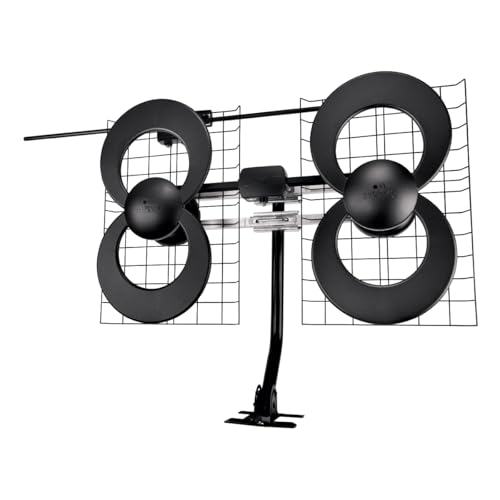
The ClearStream 4V is the only option here with a size and explicit UHF and VHF elements, making its physical design easier to plan around. It uses four loops, reflectors and Hi-VHF elements; the manufacturer says reception depends on tower distance and obstructions such as trees and building materials. Its 27.8-inch width calls for more mounting room than a compact indoor antenna, so measure the intended spot before choosing it. The antenna suits homes that can install an antenna in an attic or outdoors, but its multi-directional design does not remove terrain or building barriers.
Bottom line: Pick this if you can mount a full-size antenna in an attic or outdoors and need UHF and VHF reception.
360° Amplified Indoor/Outdoor Antenna

The 360° design is the key distinction here: it is intended to receive from any direction, which may help when local broadcast towers are spread across different bearings. The manufacturer claims a range of 6,000+ miles, but that figure should not guide a rural installation decision; reception depends on the actual path to broadcast towers. The antenna includes an amplifier and a 35-foot coaxial cable, giving more placement flexibility than the shorter-cable options. It suits buyers who need to experiment with positioning, though an amplifier cannot overcome a hill or other severe obstruction.
Bottom line: Choose this if you want 360° reception and a long cable for trying multiple placements.
Voivey 6000-Mile Indoor/Outdoor Antenna

The Voivey is the weather-focused option, described as waterproof for indoor or outdoor installation. Its features also identify a Smart IC chip and cellular/FM filters, plus a 39-foot coax cable; the manufacturer claims reception up to 6,000 miles. Treat that range as a manufacturer claim rather than a practical rural coverage estimate, since terrain and tower direction remain decisive. This model may suit a location where weather exposure and cable reach matter. Its 360° reception is not a substitute for choosing a clear, elevated mounting position when nearby terrain blocks signals.
Bottom line: Pick this if weather exposure and a 39-foot cable are priorities for your installation.
How to choose a rural TV antenna
Start with tower direction and terrain, not a claimed mileage number. Broadcast reception needs a usable signal path; a ridge, dense trees or a metal-sided building can weaken reception even when a product advertises an extreme range. Check the UHF and VHF stations you want: UHF television broadcasts use channels 14–36, while high-VHF uses channels 7–13. A design that receives both bands is useful when local stations are split across them. If towers lie in several directions, a multi-directional design can reduce the need to re-aim, but it cannot compensate for a blocked path.
For a home with a clear outdoor mounting position, compare full-size outdoor designs first. If you are close to towers and have a window facing them, an indoor antenna may be workable. Do not treat an amplifier as a way to create a signal where terrain blocks one.
Where to mount an antenna in rural areas
Mounting height and a clear view toward towers matter more than a huge range label. An outdoor roof or gable position usually clears more nearby obstacles than a room-level indoor placement, while an attic can avoid direct weather exposure but roof materials may attenuate signals. Try a location with the clearest path toward the towers, then scan channels at the television after each move. Avoid mounting where the antenna or mast could contact overhead power lines; maintain safe separation and use a qualified installer if the site is difficult to access.
Use a measurable fit rule: if the planned spot cannot accommodate a 27.8-inch-wide antenna, choose a smaller design or another mounting location. Longer coax provides placement reach, but cable length alone does not improve reception.
Directional and 360-degree antennas compared
Directional antennas concentrate reception toward a chosen tower area, while multi-directional designs aim to receive signals across a broader arc. The right choice depends on the locations of receivable stations, not simply whether a home is rural. A single clear tower bearing may favor a directional model; towers spread across different bearings can make a multi-directional design convenient. Neither approach guarantees reception through hills or dense obstructions.
This table connects common rural reception conditions to a practical antenna choice.
| Reception condition | Design to consider | Reason |
|---|---|---|
| Towers are in one general direction | Directional | Can be aimed toward the desired tower area |
| Towers are spread across directions | Multi-directional or 360° | May reduce the need to re-aim |
| Tower path is blocked by terrain | Higher outdoor placement | Height may clear nearby obstructions |
| Strong signal near a tower-facing window | Indoor | May work without exterior mounting |
Amplifiers, cable and installation safety
An amplifier increases signal level but cannot recover a broadcast that a hill or building has blocked. Long coax runs also lose some signal, so keep the cable route practical and avoid unnecessary length; a longer included cable is chiefly useful for reaching a better antenna position. For outdoor installations, secure the mast for local wind conditions and keep the antenna system away from power lines. Antenna masts and coaxial cable grounding are part of safe installation; follow applicable electrical requirements and use a qualified installer if you are uncertain.
Before settling on a location, check reception with the antenna connected and scan for channels after moving or re-aiming it. Small changes in height or direction can change which stations arrive reliably.
Frequently Asked Questions
Do TV antennas really reach thousands of miles?
A claimed range of thousands of miles is not a dependable planning measure for over-the-air television. Usable reception depends on tower distance, terrain, antenna height and obstructions along the signal path.
Will a TV antenna work behind a hill?
A hill can block or weaken broadcast signals, and an amplifier cannot restore a signal that does not reach the antenna. Try a higher outdoor position with a clearer path toward the towers.
Does a rural TV antenna need to receive VHF?
It may, because television stations can use both UHF channels 14–36 and high-VHF channels 7–13. Check which bands the local stations you want use before choosing an antenna.
Is an attic better than an outdoor antenna mount?
An attic protects an antenna from direct weather, but roof materials can weaken reception. An outdoor mount may offer a clearer path and more height, so compare reception at the actual mounting locations.
Can I install an outdoor TV antenna near power lines?
No; keep the antenna and mast clear of overhead power lines because contact can cause fatal electric shock. Outdoor antenna systems also require proper mast and coax grounding under applicable electrical requirements.