
Best Fishing Pliers and Scissors: 3 Sets Compared

KastKing Cutthroat Pliers & Scissors Set suits most anglers who want corrosion-resistant pliers and scissors in one saltwater-oriented set, with 7.5-inch polymer-coated 420 stainless-steel pliers. Choose Pullther Pliers and Scissors Kit instead for a lanyard and a shorter pair of 6.5-inch pliers, or KastKing SteelStream Fishing Tool Set if you want a broader set with a 55-pound lip gripper and fillet knife.
We earn a commission if you buy through links on this page. As an Amazon Associate I earn from qualifying purchases. Products are compared on manufacturer specifications, not hands-on testing.
- Best overall: KastKing Cutthroat Pliers & Scissors Set – 7.5-inch polymer-coated 420 stainless-steel pliers pair with tungsten-carbide line cutters and scissors.
- Best for kayak carry: Pullther Pliers and Scissors Kit – Includes a lanyard to help keep the pliers and scissors from being lost if dropped.
- Best for added tools: KastKing SteelStream Fishing Tool Set – Adds a 7-inch fillet knife and an 8.5-inch lip grip rated to float fish up to 55 pounds.
| Product | Best for | Pliers length | Scissors length | Included extras | Shop |
|---|---|---|---|---|---|
| KastKing Cutthroat Pliers & Scissors Set | Saltwater fishing | 7.5 in | — | Tungsten-carbide cutters | Check Price on Amazon |
| Pullther Pliers and Scissors Kit | Lanyard carry | 6.5 in | 4.6 in | Lanyard | Check Price on Amazon |
| KastKing SteelStream Fishing Tool Set | Expanded tool set | 7 in | 4.5 in | 7 in knife; 8.5 in lip grip | Check Price on Amazon |
Fishing pliers and scissors compared
Compare the tool sizes, cutting features, and other gear to choose a set that matches your fishing routine.
KastKing Cutthroat Pliers & Scissors Set
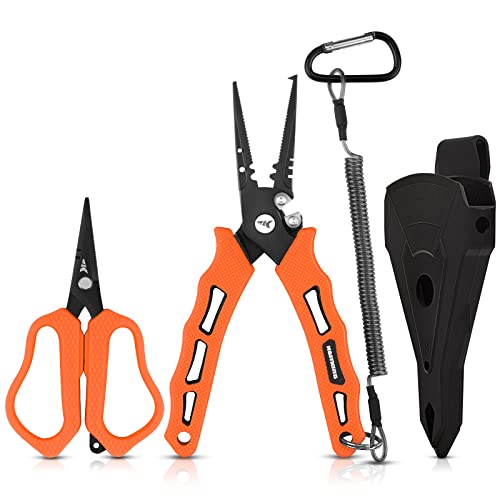
KastKing Cutthroat Pliers & Scissors Set stands out for its polymer-coated 420 stainless-steel pliers and tungsten-carbide cutters, a useful combination for anglers who want a dedicated plier-and-scissors set for saltwater-oriented use. The 7.5-inch pliers have rubber handles and side-mounted cutters; the maker says the cutters handle monofilament, braid, and fluorocarbon. This is a focused choice rather than a broad tool kit, so anglers who also want a knife or fish gripper should consider a set with those tools.
Bottom line: Pick this for coated stainless pliers with tungsten-carbide line cutters.
Pullther Pliers and Scissors Kit

Pullther Pliers and Scissors Kit is the compact option, pairing 6.5-inch stainless-steel pliers with 4.6-inch scissors and a lanyard. The pliers include line cutters, a hook-removal function, and a split-ring opener; the maker says the scissors cut braid, fluorocarbon, thick nylon, and stiff thread. That range of functions suits anglers who want both tools close at hand for kayak or fly fishing. The shorter pliers may be less appealing if reach is a priority, and the specifications do not identify a corrosion-resistant coating, so saltwater anglers should confirm care needs before ordering.
Bottom line: Choose this for shorter tools and a lanyard for carry.
KastKing SteelStream Fishing Tool Set

KastKing SteelStream Fishing Tool Set differs from the dedicated plier-and-scissors pairs by adding a 7-inch fillet knife and an 8.5-inch lip grip rated to float fish up to 55 pounds. Its 7-inch pliers use S45C carbon steel with a fluoropolymer coating and TPR handles; the multi-function jaw opens split rings, removes hooks, crimps weights, tunes baits, and cuts line. The set also includes 4.5-inch scissors, a coiled lanyard, and an aluminum carabiner. It is aimed at freshwater anglers and offers more gear than a two-tool set, which may be unnecessary if you only need pliers and scissors.
Bottom line: Pick this if the knife and lip grip are as important as the pliers.
How to choose fishing pliers and scissors
Start with the line and tasks you handle most: plier cutters can be specified for braid, monofilament, or fluorocarbon, while scissors add a compact option for trimming and rigging. For braid, look for a cutting edge designed for it and keep the blades clean; flattened or worn edges can crush fibers rather than sever them. A split-ring opener helps with lure hardware, while hook-removal jaws are useful when hooks sit deep. If you regularly change hooks or crimp weights, confirm those functions are included rather than assuming every fishing plier has them.
Tool length and carry for fishing
Tool length changes reach and packability: the options here range from 6.5 to 7.5 inches for pliers, while scissors range from 4.5 to 4.6 inches where their size is given. A shorter tool is easier to stow in a vest or kayak pocket; a longer jaw can give more reach around a hook. For kayak use, a lanyard or tether reduces the chance that a dropped tool sinks or drifts away. Choose a lanyard-attached set when you fish over water without a secure tool pocket, and make sure the tether attaches to a fixed loop rather than a moving reel or line.
Saltwater corrosion and tool care
Salt accelerates corrosion on exposed steel, so freshwater rinsing and thorough drying after each saltwater trip are practical habits. Coatings can slow corrosion but do not make metal maintenance-free, especially around cutting edges, springs, and joints. Stainless steel composition and protective coatings differ: KastKing Cutthroat Pliers & Scissors Set uses polymer-coated 420 stainless steel, while KastKing SteelStream Fishing Tool Set uses fluoropolymer-coated S45C carbon steel. After rinsing, open and close the jaws to clear trapped water, then dry the pivots and apply a small amount of suitable tool lubricant if they begin to stiffen. Store scissors dry with their blades protected.
Fishing tool set differences
A dedicated plier-and-scissors pair keeps the kit focused, while a broader fishing tool set can add a knife, gripper, or other gear. The extra equipment matters if you need to handle fish and prepare a catch at the water, but it also adds items to carry and maintain. Use this table to match the set type to the task that matters most.
| Need | Useful feature | Trade-off |
|---|---|---|
| Line trimming | Cutters or dedicated scissors | Cutting ability depends on edge design and upkeep |
| Hook and lure work | Hook-removal jaws and split-ring opener | Jaw size affects access to small hardware |
| Fish handling | Lip grip | Adds bulk beyond a pliers-and-scissors pair |
Frequently Asked Questions
Do fishing pliers cut braided line?
Some fishing pliers have cutters designed for braid, but cutting performance depends on edge condition and line position. Keep braid taut and cut near the knot or tag end without pinching the line against a dull edge.
How should I rinse saltwater fishing pliers?
Rinse saltwater-exposed tools with fresh water after each trip and dry the joints and cutting edges completely. Salt can remain in pivots, so open and close the jaws while rinsing and dry the tool before storage.
Are fishing scissors better than plier cutters?
Scissors can be easier to control for short trims and rigging, while plier cutters keep line cutting integrated with hook and tackle work. For frequent braid cutting, choose an edge specified for braid and replace or maintain tools when cuts begin to fray.
What does a split-ring opener do on fishing pliers?
A split-ring opener separates the coils of a lure’s split ring so a hook or other hardware can be added or removed. Match the jaw tip to the ring size; a large tip can make small rings harder to work.
Can I use carbon-steel fishing pliers in saltwater?
Coated carbon-steel pliers can be used around saltwater, but the coating does not eliminate corrosion risk at joints or worn edges. Rinse and dry the tool after every saltwater outing, and inspect exposed steel before storage.